Questions
Strength questions, answered
Each with its answer up top, then the reasons and the studies.
Building muscle: where to start
-
 How do you build muscle?Lift two or three times a week, every big muscle, with hard sets that end 1 to 3 reps short of failure. Add weight or reps over time, eat enough protein and sleep.
-
 What's a good workout plan for beginners?Two full-body sessions a week, A and B, six moves each. 2 sets for the first two weeks, then 3, stopping a couple of reps short. Add weight when every set hits its reps.
-
 Is a full-body workout or a split better?Neither wins once the weekly sets match, so pick by your week. Train full body on two or three days, upper and lower on four, and a body-part split on five or six.
- How do I start lifting weights?Two full-body sessions a week, five moves, two sets each, stopping two or three reps short. Chair squats, counter push-ups and grocery bags all count.
-
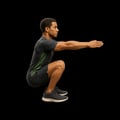 How do you get stronger legs?Squat, hinge, do one single-leg move and raise your calves, twice a week, 2 or 3 hard sets each, and add weight when every set hits its reps. It works at 90.
-
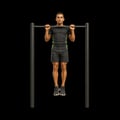 How do you get stronger arms?Press and pull twice a week, then add one curl and one overhead extension. Your triceps are most of your upper arm, so presses do more for it than curls.
- How do I get stronger?Lift twice a week, every big muscle, heavy enough that the last two or three reps are hard, and add a little weight once every set hits its reps. That's most of it.
-
 How long should a strength workout be?About 30 to 45 minutes for five moves of two or three sets, with a couple of minutes' rest. Two of those a week sits right where the big studies found the most benefit.
- How many days a week should I lift weights?Two, the US guideline's number. Extra days only help because they add sets, and with sets matched, frequency made no difference across 22 studies.
Sets, reps and weight
-
 How many sets and reps should I do?For strength, 2 to 3 sets of a heavy weight on the big lifts, early in the workout. For size, 10 or more hard sets per muscle a week (ACSM 2026).
-
 Are 8 to 12 reps best for building muscle?They're a good default, but light and heavy weights build similar muscle when sets end close to failure. 8 to 12 wins on time and comfort. Go heavier for max strength.
- How much weight should I lift?Enough that the last two or three reps of each set are hard but clean. For pure strength, work toward a weight you can lift about 5 to 10 times.
-
 How long should I rest between sets?Two to three minutes on the big lifts. In an eight-week trial, 3-minute rests built more strength and muscle than 1-minute rests. Small moves need less.
- When should I add weight?When every set hits the top of your rep range with good form, add the smallest step your weights allow, then build the reps back up.
-
 Why am I not getting stronger?Usually the weight stopped going up. If your log shows the same weight three weeks running, you've stopped adding. Then check sleep, food and how many hard sets you do.
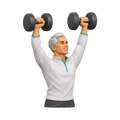
Results, and lifting at any age
-
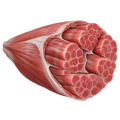 How long does it take to build muscle?Muscle starts growing within three weeks, but slowly. Young men gained about 3.4 lb of it in programs averaging 10 weeks. Judge your first eight weeks by your lifts.
- Can you still build muscle after 40, 50 or 60?Yes. Adults 50 to 83 gained about 2.4 lb of lean mass in five months of lifting, and 90-year-olds grew their thighs 9%. Lift the same way, with longer warm-ups.
-
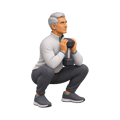 Is it safe to lift weights over 60?Yes, and it's when lifting helps most. Start lighter, warm up longer, skip max tests, and ask your doctor first if you have heart disease or high blood pressure.
-
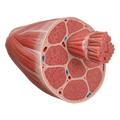 How fast do you lose muscle as you get older?About half a percent a year in midlife, closer to 1% by 75, and strength drops two to five times faster than muscle. Lifting slows it at any age.
-
 How long does it take to get stronger?Within a few weeks, because your nerves learn first. Strength rose 39% in five weeks in one study, and once-a-week lifters gained 30 to 50% in their first year.
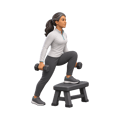
Women, teens, bones and GLP-1
- Should women lift heavy weights?Yes. On the same program, women grow muscle by the same share as men and gain more upper-body strength. Heavy means the last reps are hard, and it builds bone too.
-
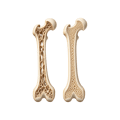 How do you build stronger bones?Heavy lifting and jumping. Women with low bone mass who lifted heavy twice a week for eight months gained spine density while the home-exercise group lost it.
-
 How do you keep your muscle on a GLP-1?Lift twice a week and eat protein first at every meal. In diet trials, lifting saved 93.5% of the lean mass older adults lost dieting alone.
-
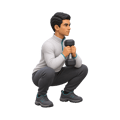 Is it safe for teenagers to lift weights?Yes, with coaching and sensible loads, says the American Academy of Pediatrics. We don't set weights or standards for anyone under 18, so start with a coach.

Food, sleep and soreness
-
 How much protein do I need to build muscle?Typical is 1.2 to 1.6 g per kg a day, 100 to 130 g at 180 pounds. In 49 trials, gains stopped rising past about 1.6. The Gyroscope app personalizes yours.
-
 Does creatine make you stronger?A little, on top of lifting. In two reviews of 60 and 53 placebo trials, it added a small extra strength gain. A few pounds of water is the main side effect.
-
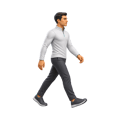 Do I need cardio if I lift weights?Yes. In the Harvard cohorts, walking 150 minutes a week went with a bigger drop in deaths than lifting alone, and both together went with the lowest risk of all.
-
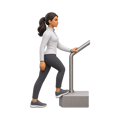 Should I work out if I'm still sore?Yes, lightly, or train other muscles. Soreness fades after the first weeks and isn't a sign it worked. Pain past 3 days, swelling or dark urine goes to a doctor.

Strength and a long life
- Does lifting weights help you live longer?Probably. Lifters had 15% lower death rates across 16 studies, though they chose to lift. In trials, lifting builds the strength and balance those studies track.
- How much strength training do you need to live longer?About two sessions a week. In a 2026 Harvard study of 147,374 US adults, 90 to 119 minutes a week went with 13% lower risk of death. Lifting longer added nothing extra.

The tests
-
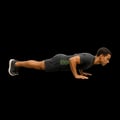 How many push-ups should I be able to do?For a man in his 40s, 13 to 16 is Good and 25 or more Excellent on the Canadian table. Test one way, add a rep a set each week. The famous 40 came from firefighters.
-
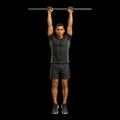 How long should I be able to dead hang?A minute or more is Strong and 45 seconds is Good on Gyroscope's training bands. Nobody has published adult hang times by age, so a chart claiming norms is guessing.
- What is the sit-to-stand test, and what's a good score?Sit on the floor and stand up, a point off for each hand or knee. In 4,282 adults aged 46 to 75, 3.7% of perfect scorers died in 12 years, against 42% of the lowest.
-
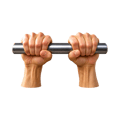 How can I test my grip strength at home?Hang from a bar and time it. It's repeatable and works your hands, forearms and shoulders. A hand gauge gives the squeeze number the big studies used.
-
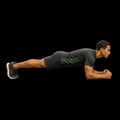 How long should I be able to hold a plank?One to two minutes in a straight line is Good on Gyroscope's training bands. Past two minutes, make it harder instead of longer. College men averaged about two minutes.
-
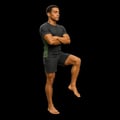 How long should you be able to stand on one leg?Past 50, at least 10 seconds with eyes open. Adults 51 to 75 who couldn't had an 84% higher risk of death over 7 years. Eyes closed, 8 seconds is average in your 50s.
- How many pull-ups should I be able to do?One strict pull-up is a real milestone, and 5 to 9 is Solid on Gyroscope's training bands. No population table exists, and plenty of strong adults start at zero.
-
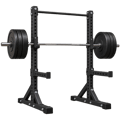 How much should I be able to squat?Your bodyweight for one rep is Good and one and a half times is Strong on Gyroscope's training bands. Estimate yours from any set, no max attempt needed.
-
 What are good strength standards for my age and weight?Squat your bodyweight and you're Good, one and a half times and you're Strong. Push-ups and grip have real tables by age. Bench and deadlift have no fair public one.
-
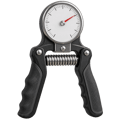 What is a good grip strength for my age?Above the middle for your age and sex. In US adults, both hands added together peak in the 30s at about 216 lb for men and 136 lb for women, then fall slowly.
Run the strength tests in Gyroscope (push-ups, pull-ups, plank, squat, dead hang, floor rise and one-leg balance), most about a minute and each scored 0 to 100 against your peers, and retest when a result turns yellow after two months. Log every set as you lift, with weight, reps and reps in reserve, and each lift builds its own estimated one-rep max trend. Open Gyroscope