How much protein do I need to build muscle?
On this page
Typical is 1.2 to 1.6 g of protein per kg of body weight a day, which is 100 to 130 g at 180 pounds. In 49 trials, extra protein stopped adding muscle past about 1.6. Get into that range, spread it across your meals, and put the rest of your effort into the lifting. The Gyroscope app personalizes yours.
Gym wisdom says a gram per pound, which is 2.2 g per kg, or about 180 g a day for a 180-pound man. Add the shake within 30 minutes of the workout and the tub of powder by the door, and protein starts to look like the main event. It’s easy to see why. You can buy it, measure it and drink it, while the lifting is slow and hard. But protein is the smaller part of the deal, and past a point more of it adds nothing.
What we’d do
Eat 1.2 to 1.6 g per kg a day from whatever protein foods you like, split over three meals, so about a third at each. If you’re lean and lifting hard, the top of the range or a bit more is fine. Don’t buy anything special until you’re lifting twice a week, because protein adds to training and does very little on its own.
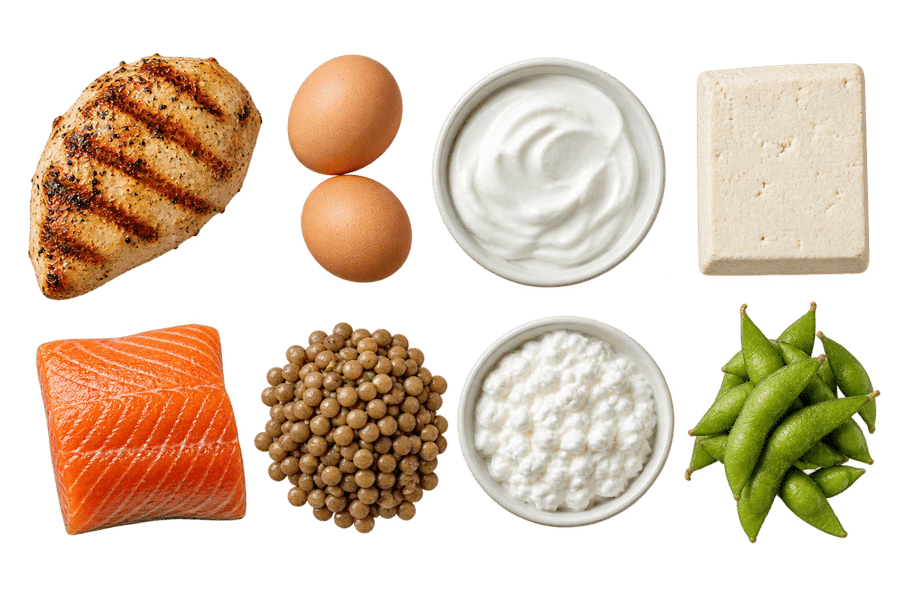
Ordinary food gets most people there: three eggs and a cup of Greek yogurt at breakfast is about 34 g. A shake is only for the days a meal falls short. How to build muscle naturally, without supplements has a whole day of food at about 128 g.
Your range
Under 1.2 g per kg is too low for most people who lift. Here’s the typical range by weight.
| Your weight | Protein a day | At each of three meals |
|---|---|---|
| 130 lb (59 kg) | 70 to 95 g | 25 to 30 g |
| 150 lb (68 kg) | 80 to 110 g | 25 to 35 g |
| 180 lb (82 kg) | 100 to 130 g | 35 to 45 g |
| 210 lb (95 kg) | 115 to 150 g | 40 to 50 g |
| 240 lb (109 kg) | 130 to 175 g | 45 to 60 g |
If more than a fifth of your weight is to lose, count from your goal weight plus a fifth of today’s weight instead. For someone lean and lifting hard, bodyfat.guide also gives a higher range of 2.3 to 3.1 g per kg of lean mass. Its protein calculator works out all three for you, and the Gyroscope app personalizes yours.
Protein is the bricks
Protein is like bricks delivered to a building site, and lifting is the crew. With no crew, the bricks just sit in the yard. Once the crew has plenty to work with, a bigger delivery doesn’t make the wall go up faster.
What 49 trials found
In 2018, Robert Morton and his colleagues pooled every trial they could find where people lifted for weeks or months and took either extra protein or a placebo.
Protein on top of lifting
49 trials, 1,863 healthy adults. Morton and others, British Journal of Sports Medicine, 2018
Extra protein added about 5.5 lb (2.49 kg) to people’s one-rep max and about 0.7 lb (0.30 kg) of lean mass over the length of the training. The gains stopped rising at about 1.62 g per kg of body weight a day.
The range around that cutoff was wide, 1.03 to 2.20 g, so some people may do well on less or need more. Older people gained less lean mass from the extra protein.
Half a pound of muscle and five pounds on the bar is a real gain. Every one of those trials had people lifting at the same time.
1.6 gper kg a day
Where extra protein stopped adding muscle in 49 trials of people who lifted (Morton, 2018).
5.5 lbon your max
The average extra strength protein added on top of training in those trials.
49trials pooled
Each one had people lifting for weeks or months with extra protein or a placebo (Morton, 2018).
Food without the lifting
In 1994, Maria Fiatarone’s team gave 100 frail nursing home residents, average age 87, one of four things for ten weeks: lifting, a nutrition supplement, both or neither. The lifters’ strength rose 113%, against 3% in those who didn’t train. The supplement on its own did nothing for any of the main results.
On a diet or a GLP-1
Protein gets harder to hit when you’re eating less, and dieting takes muscle along with fat, so on a diet or a GLP-1, protein and lifting together are what hold on to it (see how to keep your muscle on a GLP-1). For how much belongs in one meal, meals.guide has how much protein should be in a meal.
3 sources
- Morton RW and others, A systematic review, meta-analysis and meta-regression of the effect of protein supplementation on resistance training-induced gains in muscle mass and strength in healthy adults, British Journal of Sports Medicine, 2018pmc.ncbi.nlm.nih.gov
- Fiatarone MA and others, Exercise training and nutritional supplementation for physical frailty in very elderly people, New England Journal of Medicine, 1994europepmc.org
- bodyfat.guide, Protein calculator, typical rangesbodyfat.guide