How do I get stronger?
On this page
Lift twice a week, every big muscle, heavy enough that the last two or three reps of each set are hard, and add a little weight once every set hits its reps. That’s most of it. Everything else you’ve seen online is detail on top of those four things.
Most people who want to get stronger start by shopping for a program, and there are thousands. Splits, pyramids, supersets, apps that change the workout every day. It looks like the secret must be hiding in the details, so people switch plans every few weeks and never stay on one long enough to see it work. Strength comes from something much more boring. You lift something heavy, then something a little heavier, for months.
What we’d do
Pick five moves (a squat, a hinge, a push, a pull and a carry) and do all five twice a week, two or three sets each. Stop every set when you could still do two or three more reps. When every set hits the top of your rep range, add the smallest weight you can. Test yourself every eight weeks, and don’t change anything else until the numbers stop going up.
The five moves
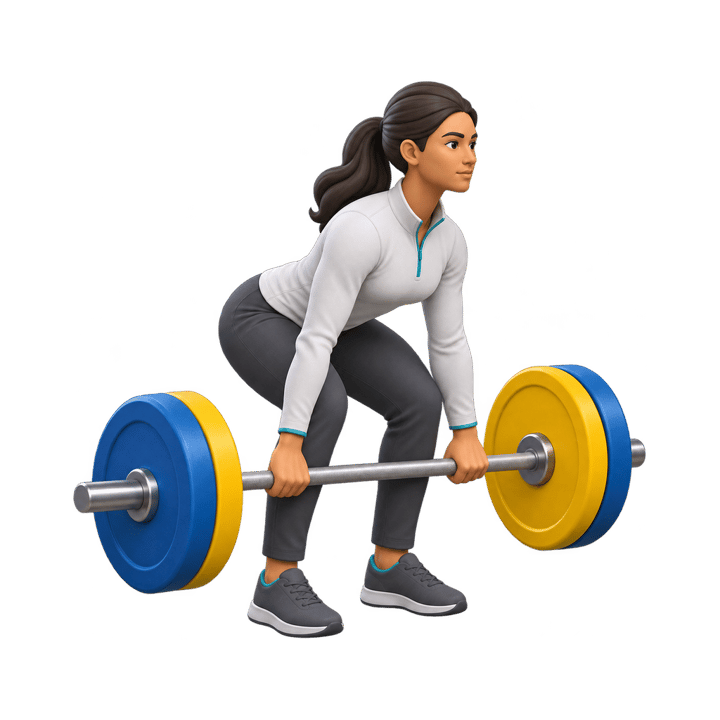
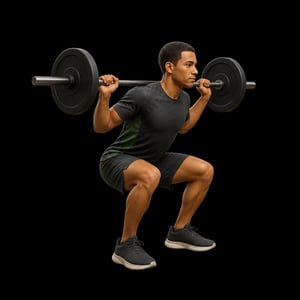
Every big muscle gets worked by one of five movements. Pick one version of each that fits what you have.
| Move | What it is | At home | With dumbbells | At a gym |
|---|---|---|---|---|
| Squat | Standing up from a sit | Chair squats | Goblet squats | Barbell or goblet squats |
| Hinge | Picking something up off the floor with a flat back | Glute bridges | Dumbbell Romanian deadlifts | Trap bar or Romanian deadlifts |
| Push | Pushing weight away from you | Counter push-ups | Floor or bench presses | Bench or dumbbell presses |
| Pull | Pulling weight toward you | Rows under a sturdy table | One-arm rows | Pulldowns or rows |
| Carry | Walking while holding something heavy | Two full grocery bags | Farmer carries | Farmer carries |
Put the squat and the hinge first, while you’re fresh. The 2026 position stand from the American College of Sports Medicine (ACSM) found strength rose most when the lift came early in the session.
It works like a staircase
Getting stronger is like climbing stairs. Each step is one small plate on the bar, and you take the next step only once you’re standing firmly on the last one. Stay on the same step for six months and your legs get very good at that step and nothing higher.
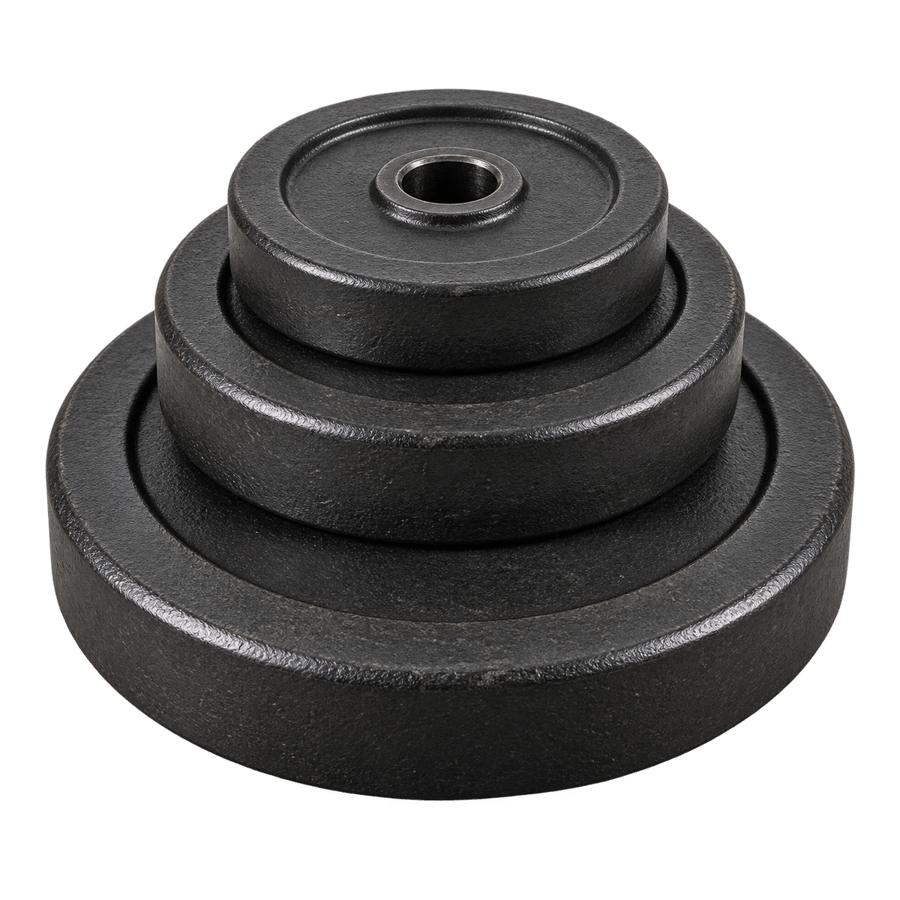
That idea is older than most gyms. In 1945, an army doctor named Thomas DeLorme was trying to rebuild the legs of injured soldiers, who were filling military hospitals at the end of World War II. He had them lift their heaviest 10-rep weight for several sets. By 1948 he’d settled on three sets of ten, each one heavier, and called it Progressive Resistance Exercise, which is where “three sets of ten” comes from.
3 x 10an army doctor, 1948
The plan Thomas DeLorme used to rebuild the legs of injured soldiers after World War II.
39%stronger in 35 days
Seven young adults training their legs three times a week, measured by Seynnes and colleagues in 2007.
174%stronger at age 90
Nine nursing home residents after eight weeks of heavy leg training (Fiatarone, 1990).
What happens in your body
The first few weeks are mostly your nerves. Your brain learns to switch on more of the muscle you already have, and to fire it all at once. In a classic 1979 study of 15 people training for eight weeks, nerve changes explained most of the early gain, and muscle growth took over after about three to five weeks.
Growth starts earlier than people used to think, though. In the 2007 study, the thigh muscle was measurably bigger by day 20, and strength was up 39% by day 35. Once the nerves have learned the move, the rest has to come from bigger, better muscle, and muscle only grows when it meets a load it hasn’t handled before. That’s why the weight has to keep rising.
What the details add
The ACSM pulled together 137 reviews covering more than 30,000 people for its 2026 position stand. Strength rose most with loads of 80% of your max or more, a full range of motion, two to three sets, and two or more sessions a week. On the usual formula, a weight you can lift about eight times is close to 80% of your max.
A lot of the things people argue about made no consistent difference: training to failure, machines against free weights, and changing the plan in planned phases. A 2022 review of 15 studies found stopping a couple of reps short built the same strength as going to failure. Stopping short is fine, as long as the weight keeps going up.
It works at any age. When nine frail nursing home residents aged about 90 lifted heavy for eight weeks, their leg strength went up 174% on average. Only 32.9% of US adults did strength work twice a week in 2024, so most people have all of that still ahead of them.
Start here
Score yourself first on the How strong am I? scorecard, so you have numbers to beat in eight weeks. Then take the quiz for your first two weeks, built around what you have at home or at the gym.
7 sources
- Currier BS and others, ACSM position stand on resistance training, Medicine and Science in Sports and Exercise, 2026pmc.ncbi.nlm.nih.gov
- Todd JS and others, Thomas L. DeLorme and the science of progressive resistance exercise, Journal of Strength and Conditioning Research, 2012europepmc.org
- Moritani T and deVries HA, Neural factors versus hypertrophy in the time course of muscle strength gain, American Journal of Physical Medicine, 1979europepmc.org
- Seynnes OR and others, Early skeletal muscle hypertrophy and architectural changes in response to high-intensity resistance training, Journal of Applied Physiology, 2007europepmc.org
- Grgic J and others, Effects of resistance training performed to repetition failure or non-failure on muscular strength and hypertrophy, Journal of Sport and Health Science, 2022pmc.ncbi.nlm.nih.gov
- Fiatarone MA and others, High-intensity strength training in nonagenarians, JAMA, 1990europepmc.org
- Healthy People 2030, PA-04, adults who do enough muscle-strengthening activity, US Office of Disease Prevention and Health Promotionodphp.health.gov