How long should I be able to hold a plank?
One to two minutes with a straight line from your head to your heels is Good on Gyroscope’s training bands. Past two minutes, make the plank harder instead of holding it longer. In a study of 471 college students, men held for about two minutes on average and women for about 80 seconds.
Plank challenges and record attempts make it look like longer is always better, as if the goal were to hold one through a whole podcast episode. Most people also think of the plank as an ab test. The ab idea falls apart once you look at why people stop. In the college study, only about 1 in 5 quit because of their abs. Most gave up because their arms or legs had had enough.
What we’d do
Hold a clean plank and stop at the first sag, then test again in eight weeks. Once you can hold two minutes, stop adding time. Lift one foot, then one arm, or have someone put a weight plate on your back, and work back up from 30 seconds.
Gyroscope’s plank bands
| How long you hold | Band |
|---|---|
| Under 30 seconds | Building |
| 30 to 59 seconds | Fair |
| 60 to 119 seconds | Good |
| 2 minutes or more | Strong |
These are Gyroscope’s own practical bands from its benchmark page, for a plank held in good form, and the scorecard uses the same numbers. They aren’t clinical cutoffs or percentiles. The plank’s best population numbers come from college students, and the tests with long-term health studies behind them are the floor rise, grip, push-ups and one-foot balance.
How to test it
- Put your phone face up on the floor with a timer running, or use the test timer, which says the rules out loud.
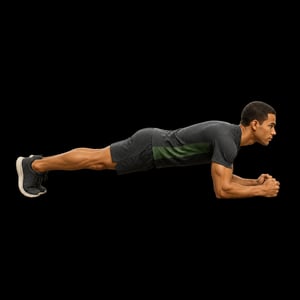
- Set your forearms on the floor with your elbows under your shoulders, then stretch your legs out behind you on your toes.
- Make one straight line from your head to your heels and start the clock.
- Stop at the first sign of your hips sagging, piking up or twisting. Write down the seconds.
A plank is the job your middle does when you carry a heavy box up the stairs or push a stalled car. It stays stiff so your arms and legs can do the work. That’s also why the test is harder than it looks. Your shoulders hold up the front half of you, your legs hold the back half, and your middle keeps the two from folding.
The college study
In 2014, researchers tested 471 students at two US universities, about 20 years old, in a forearm plank held to failure. The tester stopped the clock when the student quit or lost the straight line. Men held for an average of 124 seconds and women for 83, with a wide spread (72 seconds either way for men, 63 for women). The medians were 110 seconds for men and 72 for women.
| Percentile | Men | Women |
|---|---|---|
| 20th | 79 seconds | 48 seconds |
| 50th | 110 seconds | 72 seconds |
| 80th | 157 seconds | 108 seconds |
The researchers also asked everyone why they stopped. Legs and arms tied at 32% each. Abs came third at 21%, and the back at 6%.
124 smen’s average
College men held a forearm plank for about two minutes, and college women for 83 seconds.
21%quit because of their abs
Arms and legs gave out first for most people in the 2014 study.
2 minthen make it harder
The top of Gyroscope’s plank bands, and the point to add difficulty instead of time.
Keep in mind those are college students, about a quarter of them varsity athletes. A 50-year-old who holds 75 seconds is doing well, and Good on Gyroscope’s bands. The plank is also one of the strength tests in Gyroscope, scored 0 to 100 against your peers (how tracking works).
If your lower back starts to ache, check whether your hips have sagged. If they have, stop the clock there and count that as your time.
2 sources
- Strand SL and others, Norms for an isometric muscle endurance test, Journal of Human Kinetics, 2014pmc.ncbi.nlm.nih.gov
- Gyroscope, Plank benchmark, practical bands and protocolgyrosco.pe