How do you get stronger legs?
On this page
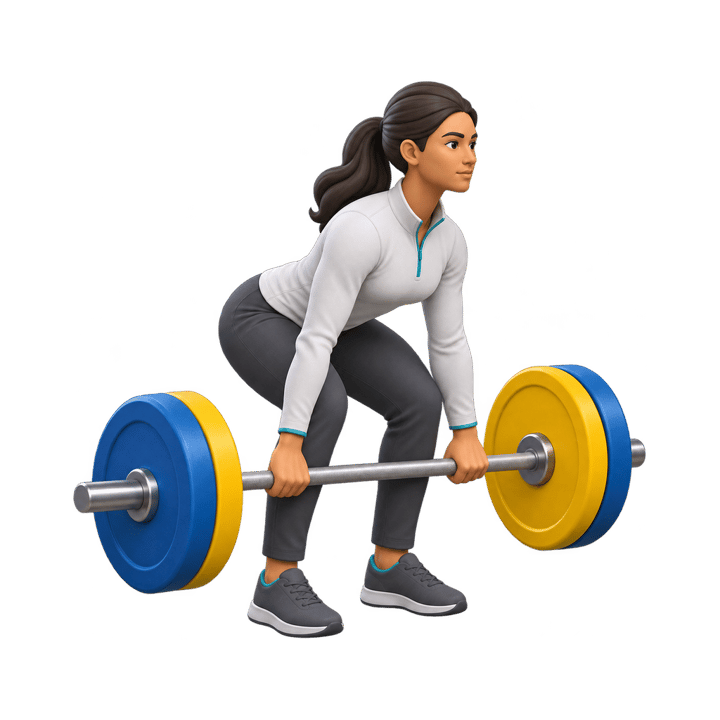
Train all four parts of your legs twice a week: a squat for your quads, a hinge like a Romanian deadlift for your hamstrings and glutes, one single-leg move like a split squat or step-up, and calf raises. Do 2 or 3 hard sets of each, stopping a rep or three before you’d fail, and add weight whenever every set hits the top of its reps.
Most people try to get stronger legs by walking or running more, or by doing the one leg machine at the gym. Walking and running are great for your heart and keep your legs working, but they ask for the same small effort thousands of times, and muscle grows from hard sets that end near failure. And a leg extension machine trains only the front of your thigh, which leaves the back of your legs and your hips behind.
What we’d do
Twice a week, two or three days apart: a goblet squat or back squat for 3 sets of 6 to 10, Romanian deadlifts for 3 sets of 6 to 10, split squats or step-ups for 3 sets of 8 to 12 a leg, and slow calf raises for 3 sets of 10 to 15. Add the smallest weight step you have once every set hits the top of its range. If you also want the upper body done, the strength protocol builds the whole week.
Four muscle groups, four jobs
| Muscle | What it does in your day | Best moves | The full page |
|---|---|---|---|
| Quads, front of the thigh | Straighten your knee, to get you out of a chair and up the stairs | Squat, split squat, step-up | Strong quads |
| Hamstrings, back of the thigh | Bend your knee and straighten your hip, and brake your leg when you run | Romanian deadlift, leg curl, Nordic curl | Strong hamstrings |
| Glutes, your hips | Stand you up and drive you up stairs and hills | Hip thrust, split squat, deadlift | Strong glutes |
| Calves | Push you off the ground with every step | Slow calf raise, heels low | Strong calves |
Each page has the best exercises at home and in a gym, how to do them, and the mistakes to skip.
A picture from daily life
Think of a table with four legs. You can make one leg twice as thick, and the table still wobbles if another is short. Legs get stronger the same way, as a set of four, and the squat, the hinge, the single-leg move and the calf raise each keep one of them from being the short one.
Why the back of your legs needs its own work
A squat trains your quads and glutes hard and leaves your hamstrings mostly untouched. In a 2023 trial, 9 weeks of squats or hip thrusts barely grew the hamstrings at all. That’s why the hinge is in the plan. Hamstrings also get hurt more than any other muscle group in soccer, and across 15 studies of 8,459 athletes, programs that added Nordic curls had about half as many hamstring injuries. If you run fast or play a sport, add Nordic curls once or twice a week.
Your glutes grow from more than one move. In that same trial, 34 new lifters built about the same glute muscle with back squats as with hip thrusts. Pick the one you like and can load.
Stronger legs, healthier knees
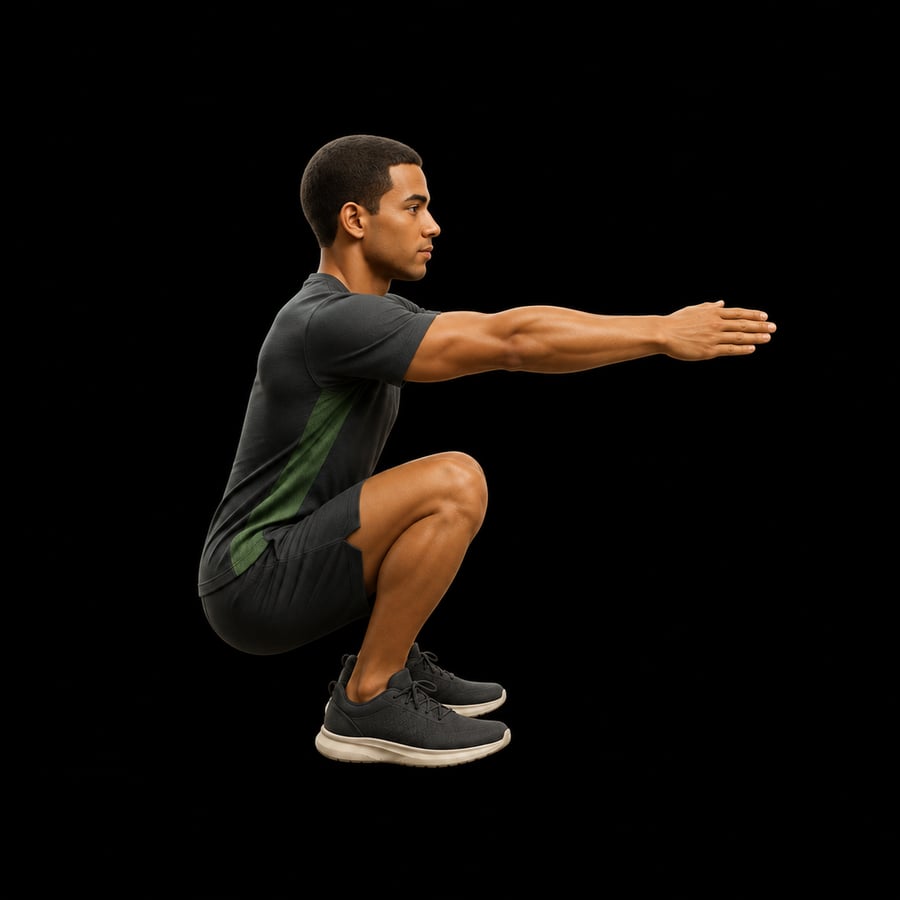
People often skip leg training because their knees hurt. Weak quads may be part of the reason. In 5 long-term studies of 5,707 adults, people with weak quads at the start had about 65% higher odds of developing painful knee arthritis later, though weakness could also be an early sign of a knee heading that way. If your knees are sore, squat down to a bench at a height that doesn’t hurt and lower it over the weeks. Squats are bad for your knees covers the myth.
How fast it comes, at any age
Legs get stronger fast, mostly because your nerves learn to use more of the muscle in the first weeks. In 1990, Maria Fiatarone’s team put ten frail nursing home residents, aged 90 on average, through 8 weeks of heavy leg training. The nine who finished got 174% stronger, and their thigh muscle grew 9%. The 2026 American College of Sports Medicine review found strength rose most with two or more sessions a week, and muscle grew most with 10 or more hard sets per muscle a week. Two leg days with three moves for each muscle gets you close.
Test your legs
You don’t need a barbell to know where you stand. The floor rise asks you to sit down on the floor and stand back up with as little help as you can. In a 2025 study of 4,282 adults aged 46 to 75, the groups with lower scores had more deaths over about 12 years. If you’re 60 or older, the chair stand counts how many times you can stand from a chair in 30 seconds, against CDC’s line for your age. If you squat, estimate your max from any set with the one-rep max calculator and check it against the squat standards. Test again in eight weeks.
8 sources
- Currier BS and others, ACSM position stand: resistance training prescription for muscle function, hypertrophy, and physical performance in healthy adults, Medicine and Science in Sports and Exercise, 2026pmc.ncbi.nlm.nih.gov
- Fiatarone MA and others, High-intensity strength training in nonagenarians: effects on skeletal muscle, JAMA, 1990europepmc.org
- Oiestad BE and others, Knee extensor muscle weakness is a risk factor for development of knee osteoarthritis: a systematic review and meta-analysis, Osteoarthritis and Cartilage, 2015europepmc.org
- van Dyk N, Behan FP and Whiteley R, Including the Nordic hamstring exercise in injury prevention programmes halves the rate of hamstring injuries: a systematic review and meta-analysis of 8459 athletes, British Journal of Sports Medicine, 2019europepmc.org
- Ekstrand J, Hagglund M and Walden M, Epidemiology of muscle injuries in professional football (soccer), American Journal of Sports Medicine, 2011europepmc.org
- Plotkin DL and others, Hip thrust and back squat training elicit similar gluteus muscle hypertrophy and transfer similarly to the deadlift, Frontiers in Physiology, 2023pmc.ncbi.nlm.nih.gov
- Araujo CGS and others, sitting-rising test and natural and cardiovascular death in 4,282 adults, European Journal of Preventive Cardiology, 2025europepmc.org
- CDC STEADI, Assessment: 30-Second Chair Stand, 2017nj.gov