
How long does it take to get stronger?
On this page
Within a few weeks, because your nerves learn first. In one study, leg strength rose 39% in five weeks. After that it slows down, and in the records of 14,690 people who lifted once a week, strength rose about 30 to 50% in the first year. Give it eight weeks before you judge.
Most people look for proof in the mirror, and the mirror is the slowest place it shows up. In the first month your muscles grow by a few percent, which nobody can see. It feels like nothing is happening, and a lot of people quit right when they’re getting stronger faster than they ever will again.
What we’d do
Test yourself on day one, lift twice a week, and test again at week eight with the same tests done the same way. Judge it by the numbers, never by the mirror. Expect the biggest jumps in the first two or three months and smaller, steadier ones after that.
Your nerves go first
Getting stronger in the first weeks is like learning a new song on the piano. Your fingers don’t grow over the first week, but by Friday you play the song much better, because your brain has learned which fingers to move and when. Lifting works the same way. Your brain learns to switch on more of the muscle you already have, and to fire it all together.
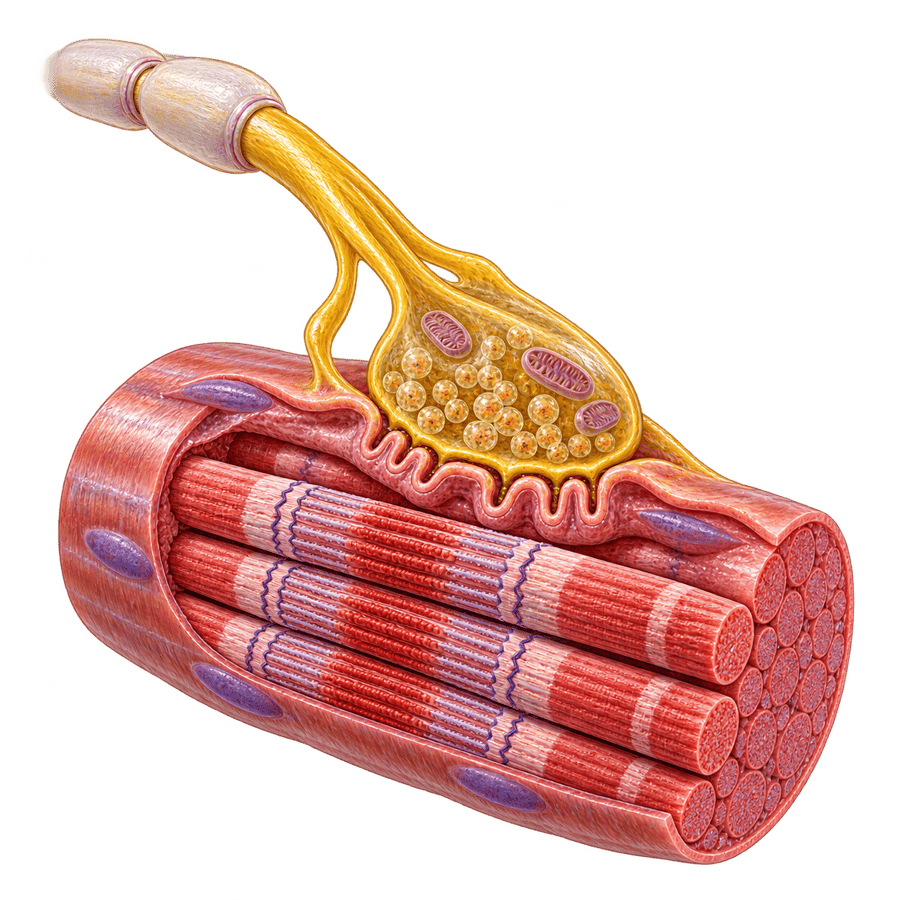
In a classic 1979 study, Toshio Moritani and Herbert deVries trained 15 men and women for eight weeks and measured both their muscles and the nerve signal driving them. Nerve changes explained most of the early gain. Muscle growth became the bigger part after about three to five weeks.
The muscle catches up sooner than you’d think
In 2007, Olivier Seynnes and colleagues had seven young adults train their thighs three times a week for 35 days, and scanned them as they went. Strength was up 39% by day 35. The thigh muscle was measurably bigger by day 20, 3.5 to 5% depending on where they measured. That’s earlier than most people expected, and it means growth starts helping within the first month too.
Day 20muscle shows on a scan
Thigh muscle was 3.5 to 5% bigger after less than three weeks of training (Seynnes, 2007).
39%stronger by day 35
Seven young adults, three leg sessions a week, five weeks.
30 to 50%in the first year
14,690 people lifting once a week, one hard set on each of six machines (Steele, 2023).
The first year and after
| When | What’s changing | What the studies found |
|---|---|---|
| Weeks 1 to 3 | Mostly your nerves | Nerve changes explained most of the early gain (Moritani, 15 people) |
| Around day 20 | Muscle starts to grow | Thigh muscle 3.5 to 5% bigger (Seynnes, 7 young adults) |
| Week 5 | Both | Strength up 39% (Seynnes) |
| Week 8 | Your first retest | Nine frail 90-year-olds gained 174% in leg strength (Fiatarone, 1990) |
| Year 1 | Mostly muscle | About 30 to 50% stronger on one set a week (Steele, 14,690 people) |
| Years 2 to 6 | Slower and slower | About 50 to 60% above the start after six years, nearly flat after year one or two |
The long-run numbers come from James Steele and colleagues, who went through the training records of 14,690 people (60% women, average age 48) at one company. Everyone did one set to failure on each of six machines, once a week, for up to 6.8 years. Gains were fast in year one and nearly flat after one to two years. It’s a look back at records, not a trial, and the people who kept coming may be the ones it worked best for. But it’s a huge group, and it shows that even one short session a week moves strength a lot in the first year.
Percentages run biggest when you start low. The nursing home residents in the 1990 study were about 90, and their 174% came from a very low starting point. Anyone starting late has the most to gain.
Stopping sends it back
Strength goes back down when you stop. Across 103 studies, the longer the break, the more people lost, and people over 65 lost more than younger people. Twice a week, kept up, protects what the first months built.
Measure it
Score yourself now on the How strong am I? scorecard and use the test timer for the hang, plank and one-foot balance. Both give you a retest date eight weeks out. If week eight shows nothing, why am I not getting stronger? has the checklist.
5 sources
- Moritani T and deVries HA, Neural factors versus hypertrophy in the time course of muscle strength gain, American Journal of Physical Medicine, 1979europepmc.org
- Seynnes OR and others, Early skeletal muscle hypertrophy and architectural changes in response to high-intensity resistance training, Journal of Applied Physiology, 2007europepmc.org
- Steele J and others, Long-term time-course of strength adaptation to minimal dose resistance training, Research Quarterly for Exercise and Sport, 2023europepmc.org
- Fiatarone MA and others, High-intensity strength training in nonagenarians, JAMA, 1990europepmc.org
- Bosquet L and others, Effect of training cessation on muscular performance: a meta-analysis, Scandinavian Journal of Medicine and Science in Sports, 2013europepmc.org