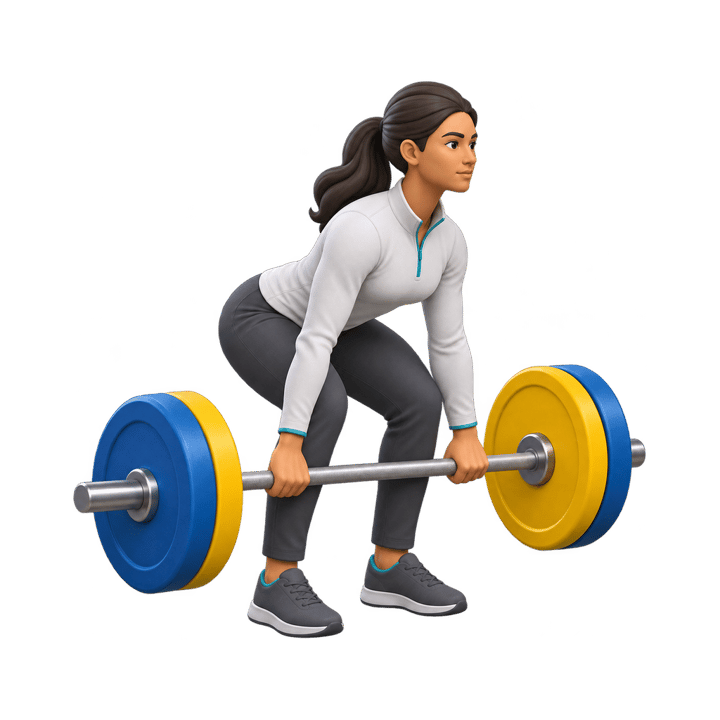

Does lifting weights help you live longer?
On this page
Probably, yes. Across 16 long-term studies, people who did any strength training had a 15% lower risk of death than people who did none. They chose to lift, so some of that credit belongs to the rest of their lives. What trials do prove is that lifting rebuilds the strength people lose with age, at any age, and that strength is what the survival tests measure.
You’ve probably seen both versions of this. One headline says lifting adds years to your life. Then someone points out that people who lift also tend to be the people who walk, sleep and eat well, so of course they live longer. Both have a point, and the useful answer sits between them.
What we’d do
Lift twice a week for the things the trials prove: more strength, better balance and stronger bones, at any age. Count the longer life as a likely bonus. If you’re over 60 and think it’s too late, the trials say you have the most to gain.
Judging a restaurant by its regulars
Studies of lifters are a bit like judging a restaurant by its regulars. If the regulars look healthy, maybe the food is good, or maybe healthy people just like that kind of place. You’d learn a lot more by feeding a random group of strangers there for a year. In lifting research, the first kind of study is common and the second kind, run long enough to count deaths, hasn’t been done.
What the long-term studies found
16 cohort studies
Hundreds of thousands of adults followed for years. Momma and others, British Journal of Sports Medicine, 2022
Any muscle-strengthening activity went with 15% lower risk of death, 17% lower heart disease, 12% lower cancer and 17% lower diabetes. The lowest risk of death came at about 40 minutes a week. Lifting plus aerobic exercise went with 40% lower risk than neither.
The authors rated the certainty for death “very low”, because people chose how to exercise.
147,374 health professionals
US nurses and other health professionals, up to 30 years. Zhang and others, British Journal of Sports Medicine, 2026
90 to 119 minutes of lifting a week went with 13% lower risk of death, even after accounting for how much aerobic exercise people did.
Self-reported, mostly white health professionals.
Adjusting for aerobic exercise takes out one of the biggest other explanations, and the link held. That’s a good sign, but it can’t take out everything a lifter might do differently.
What the trials prove
Nobody has run a trial that assigns people to lift for decades and counts deaths. Trials that measure strength itself have been run, and the results are big.
In 1994, Maria Fiatarone and colleagues took 100 frail nursing home residents with an average age of 87 (the oldest was 98) and randomly assigned half to ten weeks of heavy leg training. Strength rose 113% in the lifters against 3% in the rest. Stair-climbing power rose 28% against 4%, and walking speed rose 12% while the others got slightly slower. A nutrition supplement, tested in the same trial, did nothing for any of those on its own.
15%lower death rates
In people who did any muscle-strengthening activity, across 16 cohort studies.
113%stronger at 87
Frail nursing home residents after ten weeks of training, in a randomized trial.
2 to 5xfaster than muscle
How much faster strength falls than muscle size with age.
Why strength is the part that counts
With age, strength drops two to five times faster than muscle size does. By 75, men lose about 3 to 4% of their strength a year and women about 2.5 to 3%. That’s the loss people notice on stairs and getting out of low chairs, and more than 1 in 4 US adults 65 and older fall each year.
Strength is also what the simple survival tests pick up. Grip strength predicted death better than systolic blood pressure in 139,691 adults aged 35 to 70 across 17 countries. Getting up off the floor without your hands and standing on one leg for 10 seconds each tracked who lived longest in studies of thousands of middle-aged and older adults. Lifting builds exactly the things those tests measure, and the trials show it works even at 90.
Test yourself
The tests take about ten minutes on your living room floor. Start with what is the sit-to-stand test?, then how long should you be able to stand on one leg?, and put your results into the How strong am I? scorecard. lifespan.guide answers the same question alongside everything else that adds years, in does lifting weights help you live longer?
6 sources
- Momma H and others, Muscle-strengthening activities are associated with lower risk and mortality in major non-communicable diseases, British Journal of Sports Medicine, 2022pmc.ncbi.nlm.nih.gov
- Zhang Y and others, Long-term resistance training with all-cause and cause-specific mortality, British Journal of Sports Medicine, 2026pmc.ncbi.nlm.nih.gov
- Fiatarone MA and others, Exercise training and nutritional supplementation for physical frailty in very elderly people, New England Journal of Medicine, 1994europepmc.org
- Mitchell WK and others, Sarcopenia, dynapenia, and the impact of advancing age on human skeletal muscle size and strength, Frontiers in Physiology, 2012pmc.ncbi.nlm.nih.gov
- Leong DP and others, Prognostic value of grip strength: findings from the Prospective Urban Rural Epidemiology (PURE) study, The Lancet, 2015europepmc.org
- Centers for Disease Control and Prevention, Older adult falls datacdc.gov