How many pull-ups should I be able to do?
One strict pull-up is a real milestone, and 5 to 9 is Solid on Gyroscope’s training bands. Nobody has published a fair table of pull-ups by age for ordinary adults, so zero only tells you where to start. Plenty of strong people start there, and the way from zero to one is well marked.
Most people’s idea of a pull-up count comes from a school gym test, a military standard or a video of someone swinging out 30 reps. None of those fit an ordinary adult. The swinging kind (kipping) uses momentum from the hips, so it isn’t the same test. Military and school standards are set for young recruits and kids. Gyroscope’s own benchmark page notes there’s no strong published norm table for strict pull-ups across the general adult population.
What we’d do
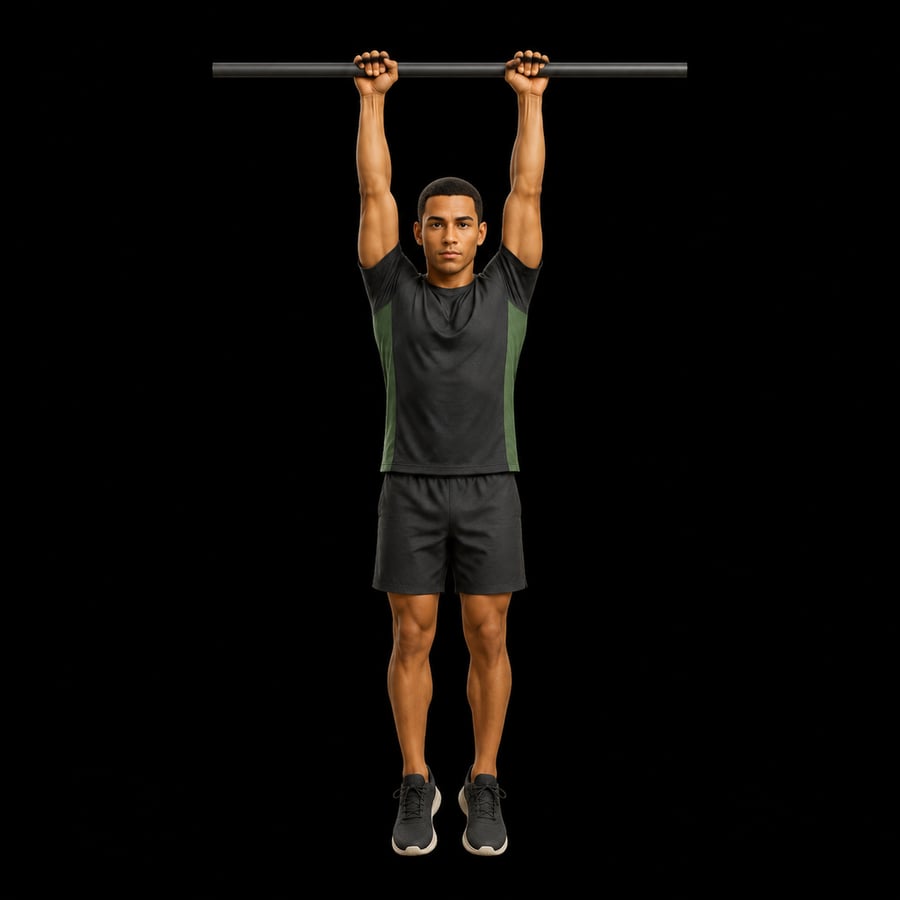
If you can’t do one yet, build a 45-second dead hang, row twice a week, and practice the lowering half. Jump or step up so your chin is over the bar, then take 3 to 5 seconds to lower yourself to straight arms. If you can do a few, add one rep every week or two and test a strict set every eight weeks. Count only strict reps, every time.
Gyroscope’s pull-up bands
| Strict pull-ups in one set | Band |
|---|---|
| 0 | Building |
| 1 to 4 | Developing |
| 5 to 9 | Solid |
| 10 to 14 | Strong |
| 15 or more | Elite |
Gyroscope uses these as practical bands for a consistent strict test, and its page says they aren’t medical or population cutoffs. They’re the same for every age and both sexes. Pull-ups aren’t on the scorecard, and the dead hang stands in for them there.
What counts as one
- Warm up your shoulders, elbows and hands first.
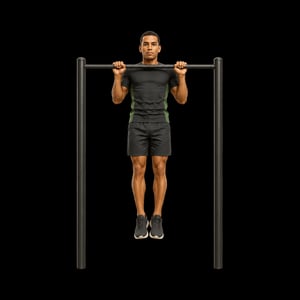
- Grab the bar with both hands and start from a dead hang, arms straight, body still, feet off the floor.
- Pull until your chin is fully over the bar, then lower under control all the way to straight elbows.
- No swinging, no kipping, and no shortening the bottom. Keep going in one set until you can’t clear the bar or control the way down.
A pull-up is the move you’d need to climb over a high wall or haul yourself up into a tree house. You’re lifting your whole body with your back and arms, which makes it a test of strength for your weight. Lose 15 pounds and the same back moves 15 fewer pounds, so your count goes up without any new muscle.
From zero to one
Muscle gets stronger fastest when it lifts something close to its limit. The 2026 position stand from the American College of Sports Medicine, built on 137 reviews and more than 30,000 people, found strength rose most with loads of 80% of your max or more. If you can’t do a single pull-up, your bodyweight is more than 100% of your max, so the move has to be made lighter before it can train you.
There are a few ways to do that. A resistance band looped over the bar takes some weight off. A foot on a box takes more. Or you train only the lowering half, which you can control long before you can pull. The same position stand found muscle grew more when people lowered weights under load, which is what a slow negative does. A long hang helps too, since a pull-up starts from one.
1the first milestone
One strict pull-up moves you from Building to Developing on Gyroscope’s bands.
5 to 9Solid
A strict set in this range is Solid on Gyroscope’s training bands at any age.
17studies of women and men
On the same programs, women gained more upper-body strength for their starting point than men did.
Women and pull-ups
Women usually start with fewer pull-ups, and plenty of women assume that’s how it stays. A 2020 review pooled studies where women and men did the same lifting program. Across 17 studies, women gained more upper-body strength relative to where they started than men did, and grew muscle by a similar share. The gap at the start is real, but it narrows with training.
Pull-ups are one of the strength tests in Gyroscope, scored 0 to 100 against your peers (how tracking works). If your first two weeks should include pull-up work, the quiz picks the version that fits what you have.
3 sources
- Gyroscope, Pull-ups benchmark, practical bands and protocolgyrosco.pe
- Currier BS and others, ACSM position stand on resistance training, Medicine and Science in Sports and Exercise, 2026pmc.ncbi.nlm.nih.gov
- Roberts BM, Nuckols G and Krieger JW, Sex differences in resistance training: a systematic review and meta-analysis, Journal of Strength and Conditioning Research, 2020europepmc.org