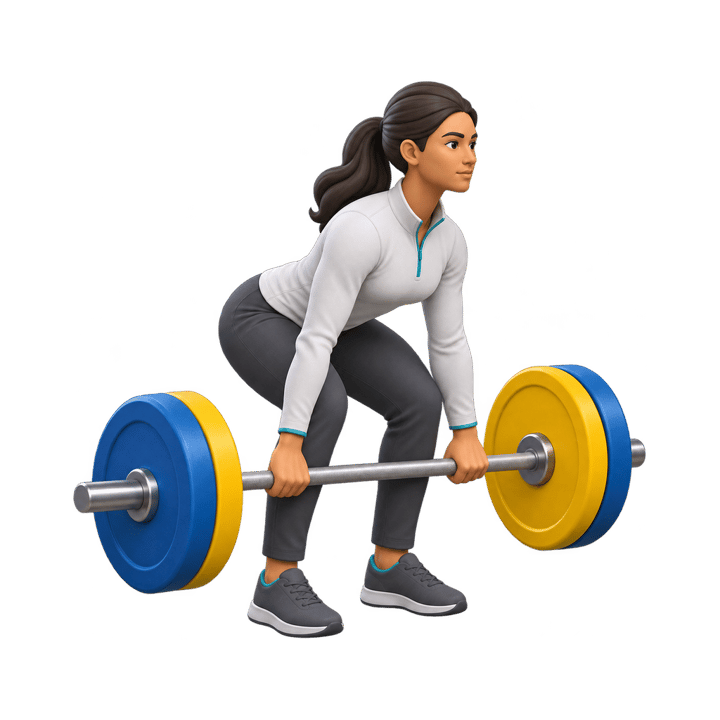

How many days a week should I lift weights?
On this page
Two, which is what the US guidelines ask for. More days help only because they add more sets. When researchers matched the total number of sets, training one, two, three or four days a week made no difference to strength across 22 studies. Two full-body days, two or three days apart, covers it.
Online fitness makes it look like serious people lift six days a week, with a day for chest, a day for legs and a day for arms. That makes twice a week sound like the lazy option, when it’s what the guidelines ask for and what a 2026 review of 137 reviews found works for strength. Most adults still don’t manage it. In 2024, only 32.9% of US adults did strength work on two or more days a week.
What we’d do
Lift twice a week, two or three days apart (Monday and Thursday, or Tuesday and Friday), and work every big muscle each time. If you want more, add a third day before you make any session longer. Fill the other days with walking. One day a week is a fine start if that’s all you have.
It’s like a grocery budget
Weekly sets work like a weekly grocery budget. Spend it in two trips or four and you bring home the same food. Your muscles count the hard sets they did that week, and they don’t much care how many days you spread them over. Extra days only help when they add sets you wouldn’t have done otherwise.
The 22 studies
Jozo Grgic and colleagues pooled 22 studies that compared training frequencies, in 2018. At first glance more days won. The gains grew with every extra day.
| Days a week | Strength gain (effect size, sets not matched) |
|---|---|
| 1 | 0.74 |
| 2 | 0.82 |
| 3 | 0.93 |
| 4 or more | 1.08 |
A bigger number means a bigger gain. But the people training more days were also doing more sets. When the researchers looked only at studies that matched the total sets, frequency made no difference at all. The extra days were just a way of fitting in more work.
2days a week
What the US guidelines ask for, working all the major muscle groups.
22studies, no difference
With total sets matched, days a week didn’t change strength gains (Grgic, 2018).
1day still works
14,690 people lifting once a week got about 30 to 50% stronger in their first year.
Why two beats one
Two days lets you fit enough sets without long sessions. Five moves at three sets, twice a week, gives each big muscle about six hard sets a week, and each session stays under 45 minutes. The 2026 position stand from the American College of Sports Medicine, built on 137 reviews, found strength rose most with two or more sessions a week, and made “at least twice weekly” its main advice for healthy adults.
One day isn’t nothing, though. In the training records of 14,690 people who did one hard set on each of six machines once a week, strength rose about 30 to 50% in the first year. If a single session is all your week can hold, do that and do it every week.
Why not every day?
You can, if you split the body up, but it isn’t needed, and a plan with six gym days is a lot harder to keep up than one with two. Full-body sessions twice a week, two or three days apart, cover every muscle with the fewest trips.
Where walking fits
The US guidelines also ask for 150 to 300 minutes a week of moderate activity like brisk walking. Walking on the days between lifts covers that, and in the 2026 Harvard study of 147,374 US adults, walking enough went with a bigger drop in deaths than lifting alone. Drag the sliders on how much is enough? to see where your week lands.
6 sources
- US Office of Disease Prevention and Health Promotion, Top 10 things to know about the second edition of the Physical Activity Guidelines for Americansodphp.health.gov
- Grgic J and others, Effect of resistance training frequency on gains in muscular strength: a systematic review and meta-analysis, Sports Medicine, 2018europepmc.org
- Currier BS and others, ACSM position stand on resistance training, Medicine and Science in Sports and Exercise, 2026pmc.ncbi.nlm.nih.gov
- Steele J and others, Long-term time-course of strength adaptation to minimal dose resistance training, Research Quarterly for Exercise and Sport, 2023europepmc.org
- Zhang Y and others, Long-term resistance training with all-cause and cause-specific mortality, British Journal of Sports Medicine, 2026pmc.ncbi.nlm.nih.gov
- Healthy People 2030, PA-04, adults who do enough muscle-strengthening activityodphp.health.gov