When should I add weight?
On this page
When every set hits the top of your rep range with good form, add the smallest step your weights allow, then build the reps back up. If you do 3 sets of 8 to 10, the day all three sets reach 10, the next session goes up 5 pounds and back to 8.
People get this wrong in both directions. Some add weight every session because it felt OK last time, until their form falls apart or something starts to hurt. Many more never add at all. They use the same dumbbells for three years and wonder why nothing changes. Others swap exercises every week to “confuse” the muscle, but muscle only changes when it’s asked for more.
What we’d do
Use a rep range and climb it. Pick a range like 8 to 10. Stay at a weight until every set reaches 10 with clean form, then add the smallest step you have and start back at 8. Write every set down, because you won’t remember what you did three sessions ago, and the log is what tells you when to go up.
Clear the bar, then raise it
It works like the high jump. You raise the bar only after you’ve cleared it cleanly, and only by a little, because a bar moved up a foot just knocks you back down.
Here’s what that looks like on a squat over six sessions, in 3 sets of 8 to 10:
| Session | Weight | Reps in each set | Next time |
|---|---|---|---|
| 1 | 135 lb | 10, 9, 8 | Same weight |
| 2 | 135 lb | 10, 10, 9 | Same weight |
| 3 | 135 lb | 10, 10, 10 | Add 5 lb |
| 4 | 140 lb | 9, 8, 8 | Same weight |
| 5 | 140 lb | 10, 9, 9 | Same weight |
| 6 | 140 lb | 10, 10, 10 | Add 5 lb |
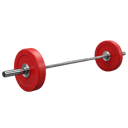
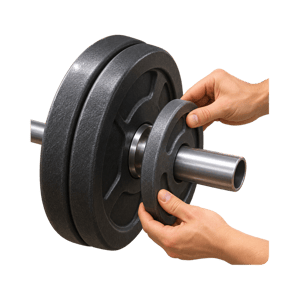
Every session either adds a rep or adds weight. On a barbell the smallest common step is 5 lb, a 2.5 lb plate on each side (in kilograms, a 1.25 kg plate a side). The plates calculator works out what to load.
The army doctor who worked it out
In 1945, Thomas DeLorme was an army doctor at the end of World War II, with hospitals full of soldiers whose legs had been badly injured. He had them lift their heaviest 10-rep weight for several sets. By 1948 he’d refined it to three sets of ten, each heavier than the last, and named it Progressive Resistance Exercise. His 1951 book made it the standard in military and civilian physical therapy.
1945the first heavy sets
Thomas DeLorme starts injured soldiers on their 10-rep max, several sets at a time.
5 lbthe usual barbell step
One 2.5 lb plate on each side. Under 4% of a 140 lb squat.
Dumbbells jump bigger
Dumbbells usually go up 5 pounds at a time, and that’s a big jump at the light end. Going from 20 to 25 lb is 25% more weight in one step, where adding 5 lb to a 140 lb barbell is under 4%. With dumbbells, stretch the range instead. Climb to 12 or even 15 reps before you move up, then drop back to 8 with the heavier pair.
Do you have to keep adding forever?
For health, you don’t. The 2026 position stand from the American College of Sports Medicine found that steady progression isn’t needed to get real benefits, and it’s mainly needed by people who want to keep getting stronger over the long run. It adds that in some groups, beginners among them, progression is needed to get a meaningful benefit at all. In practice that means adding weight is how the first year works, and later you can decide how far you want to push.
Progress also slows down, whatever you do. In the records of 14,690 people who lifted once a week, strength rose about 30 to 50% in the first year and was nearly flat after one to two years. Expect weekly jumps early, then monthly ones.
When it stalls
If a weight won’t move for three sessions in a row, check sleep, food and how hard your sets are before anything else. If those are fine, a common coaching fix is to take about a tenth off the bar and climb back up over a few weeks. Over 60, take smaller steps and skip true max tests. Why am I not getting stronger? has the full checklist.
3 sources
- Todd JS and others, Thomas L. DeLorme and the science of progressive resistance exercise, Journal of Strength and Conditioning Research, 2012europepmc.org
- Currier BS and others, ACSM position stand on resistance training, Medicine and Science in Sports and Exercise, 2026pmc.ncbi.nlm.nih.gov
- Steele J and others, Long-term time-course of strength adaptation to minimal dose resistance training, Research Quarterly for Exercise and Sport, 2023europepmc.org