How many push-ups should I be able to do?
On this page
There’s no one number for everybody. Do one unbroken set with your chest close to the floor and check the count against your age and sex in the table below (a man in his 40s is Good at 13 to 16), then add one rep a set each week. The famous “40 push-ups” came from 1,104 male firefighters, and the best group in that study had exactly one heart event.
In 2019 a study found that men who could do more than 40 push-ups had 96% fewer heart events than men who managed 10 or fewer, and 40 became everybody’s target. Look up a push-up chart and it gets more confusing. Charts disagree by a lot, because they test it different ways. Some count for one minute and some go until you stop. Some go to a metronome, some let you rest at the top, some count knee push-ups, and most don’t say which. The same man can land in two different categories on two different charts.
What we’d do
Test it one way and keep it that way, with one unbroken set, no time limit, and a stop when your form breaks. Put the count into the scorecard for your band, and test again in eight weeks. To get more, do three sets twice a week, stopping two reps short, from a counter or bench if the floor is too hard, and add one rep to each set every week. Treat 40 as a nice number to hit, and never as a heart test.
How to test your push-ups
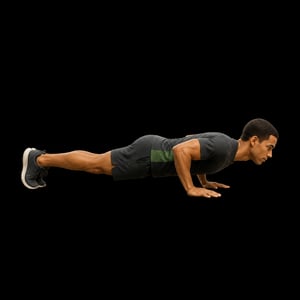
- Start at the top of a push-up with your hands about shoulder width apart and your body in one straight line. Men go from the toes and women from the knees on the table the scorecard uses.
- Lower until your chest is close to the floor and your elbows are bent to about 90 degrees, then push back up to straight arms.
- Keep going at a steady pace without resting at the top. Stop when you can’t do another clean rep or your hips sag out of line.
- Count only the clean reps, and write down whether you did them from your toes or your knees.
This is the protocol the Canadian Society for Exercise Physiology published in 2003, and the table behind the scorecard uses it. If you’re a woman who does them from your toes, the scorecard still puts you on the knee table and says so, which underrates you. A man’s knee push-ups get no band, only a step toward doing them from the toes.
What your count means for your age
These are the Canadian Society for Exercise Physiology’s norms from 2003, for one unbroken set to exhaustion, men from the toes and women from the knees. Over 69, use the 60 to 69 row.
| Age | Excellent | Very good | Good | Fair | Needs improvement |
|---|---|---|---|---|---|
| Men 20 to 29 | 36+ | 29 to 35 | 22 to 28 | 17 to 21 | 16 or fewer |
| Men 30 to 39 | 30+ | 22 to 29 | 17 to 21 | 12 to 16 | 11 or fewer |
| Men 40 to 49 | 25+ | 17 to 24 | 13 to 16 | 10 to 12 | 9 or fewer |
| Men 50 to 59 | 21+ | 13 to 20 | 10 to 12 | 7 to 9 | 6 or fewer |
| Men 60 to 69 | 18+ | 11 to 17 | 8 to 10 | 5 to 7 | 4 or fewer |
| Women 20 to 29 | 30+ | 21 to 29 | 15 to 20 | 10 to 14 | 9 or fewer |
| Women 30 to 39 | 27+ | 20 to 26 | 13 to 19 | 8 to 12 | 7 or fewer |
| Women 40 to 49 | 24+ | 15 to 23 | 11 to 14 | 5 to 10 | 4 or fewer |
| Women 50 to 59 | 21+ | 11 to 20 | 7 to 10 | 2 to 6 | 1 or fewer |
| Women 60 to 69 | 17+ | 12 to 16 | 5 to 11 | 2 to 4 | 1 or fewer |
We could only open this table as a copy on a fitness blog, which names the 2003 Canadian source and notes that the sample behind the cut points isn’t documented. So use it as a rough guide to where you stand, and watch your own count go up. The scorecard does the lookup for you.
A push-up is the same move as pushing yourself up off the floor after you trip, or hauling yourself out of a pool without the ladder. Your chest, shoulders and arms press a big share of your bodyweight away from the ground, and your middle holds you stiff like a plank while they do it.
The firefighter study behind “40”
Researchers went back through the medical records of 1,104 male firefighters from 10 fire departments in Indiana, with an average age of 39.6. Between 2000 and 2007, each man had done push-ups at a clinic exam, in time with a metronome at 80 beats a minute. The test stopped at 80 push-ups, after three missed beats, or when he couldn’t go on. Over about 10 years, 37 of them had a heart event.
| Push-ups in one go | Heart events per 100,000 person-years |
|---|---|
| 0 to 10 | 1,757 |
| 11 to 20 | 625 |
| 21 to 30 | 288 |
| 31 to 40 | 433 |
| 41 or more | 79 |
The trend looks clean at the two ends, and messier in the middle. The men who did 31 to 40 had more heart events than the men who did 21 to 30. The 41-plus group’s rate of 79 comes from a single event. Once the researchers adjusted for age and other differences between the men, the only comparison that stood clear of chance was 21 to 30 push-ups against 0 to 10. The authors wrote that their results “do not support” push-up capacity as an independent predictor of heart disease, and that the findings may not apply to women, older people or inactive people.
1,104men, no women
Every person in the famous push-up study was a male firefighter in Indiana.
1heart event at 41 or more
The best group’s low rate rests on one man’s heart event over about 10 years.
80beats a minute
The firefighters pushed in time with a metronome, a pace almost nobody tests at home.
Men who could do more push-ups did have fewer heart events, which is a good reason to train them, but one study of firefighters can’t turn 40 into a line between a healthy heart and a sick one.
How to get more push-ups
Do three sets, twice a week, and stop each set when you could still do two more. If the floor is too hard, put your hands on a kitchen counter, then a sturdy bench, then the floor as you get stronger. Add one rep to each set every week, so three sets of 6 become three sets of 7.
Push-ups train your chest, shoulders and triceps, and your core holds the line. To build those for real, add presses and rows to a full week: how to get a strong chest, how to build strong triceps and the strength protocol. If push-ups come out as your weak link in the quiz, it adds these drills to your plan.
2 sources
- Yang J and others, Association between push-up exercise capacity and future cardiovascular events among active adult men, JAMA Network Open, 2019pmc.ncbi.nlm.nih.gov
- Canadian Society for Exercise Physiology, CPAFLA push-up test protocol and norms (2003), as described in Push-up test norms by age and sexsensai.fit