What is a good grip strength for my age?
Above the middle for your age and sex is a good grip. In a big US survey, the best squeeze of each hand added together peaked in the 30s, at about 216 lb for men and 136 lb for women, and fell slowly after that. Find your row below, then train your whole body and let your grip follow.
Grip charts online are a mess, and it’s not your fault if yours made no sense. Some show one hand and some show both. Some use kilograms, some pounds. Some take your best try and some your average, on different gauges, sitting or standing. A man who squeezes 100 lb with one hand can look weak on one chart and strong on the next. The table here comes from the US national health survey (NHANES), and it adds the best squeeze of each hand together, so you need a number for both hands to compare.
What we’d do
Aim at or above the middle (the 50th percentile) for your age. If you’re under the 20th, take it as a sign to get your whole body stronger, with carries, rows and hangs twice a week, and test again in eight weeks. Skip the hand gripper as a fix, since a strong grip is mostly a sign of how strong the rest of you is.
The US grip table
Both hands added together, in pounds, from 3,497 men and 3,400 women in the 2011 to 2012 survey. The bands are the ones the scorecard uses. Under the 20th percentile is Building, the 20th to 50th Fair, the 50th to 80th Good, and the 80th and up Strong.
Men
| Age | Building | Fair | Good | Strong |
|---|---|---|---|---|
| 18 to 29 | under 178 | 178 to 207 | 208 to 240 | 241 and up |
| 30 to 39 | under 185 | 185 to 215 | 216 to 244 | 245 and up |
| 40 to 49 | under 180 | 180 to 207 | 208 to 233 | 234 and up |
| 50 to 59 | under 162 | 162 to 194 | 195 to 219 | 220 and up |
| 60 to 69 | under 152 | 152 to 184 | 185 to 205 | 206 and up |
| 70 and up | under 129 | 129 to 155 | 156 to 177 | 178 and up |
Women
| Age | Building | Fair | Good | Strong |
|---|---|---|---|---|
| 18 to 29 | under 113 | 113 to 129 | 130 to 147 | 148 and up |
| 30 to 39 | under 118 | 118 to 135 | 136 to 153 | 154 and up |
| 40 to 49 | under 115 | 115 to 132 | 133 to 153 | 154 and up |
| 50 to 59 | under 107 | 107 to 121 | 122 to 141 | 142 and up |
| 60 to 69 | under 100 | 100 to 116 | 117 to 130 | 131 and up |
| 70 and up | under 77 | 77 to 92 | 93 to 113 | 114 and up |
A man of 45 who squeezes 100 lb with his right hand and 95 with his left has 195 lb in all. That’s Fair for his age, 13 lb short of Good. A woman of 55 with 62 and 60 has 122, right on the middle for her age, which is Good. If your gauge shows kilograms, multiply by 2.2 to get pounds. The survey started at 20, and the scorecard uses the 20s row for 18 and 19.
The dashboard light
Grip works like the oil light on a car’s dashboard. The light tells you something about the whole engine, which is why mechanics pay attention to it. But polishing the bulb won’t fix the engine. A strong grip mostly means a strong, healthy body behind it, and that’s the part to train.

The biggest study of grip and survival is called PURE. Researchers measured grip with a hand gauge in 139,691 adults aged 35 to 70 across 17 countries, from cities and villages, and followed them for a median of four years. Each 5 kg (about 11 lb) less grip went with a 16% higher risk of death from any cause and a 17% higher risk of death from heart disease. Grip predicted both better than systolic blood pressure did. One surprise was what it didn’t predict. Grip had no link with injuries from falls or with getting diabetes.
216 lbmen’s peak, in their 30s
The middle for US men aged 30 to 39, both hands added together.
136 lbwomen’s peak, in their 30s
The middle for US women aged 30 to 39, both hands added together.
16%per 11 lb less grip
Higher risk of death from any cause in 139,691 adults across 17 countries.
PURE shows a link. It can’t show that squeezing a gripper every day would change anyone’s risk, and nobody has run that trial. The myth page on grip training goes through why.
How the survey measured it
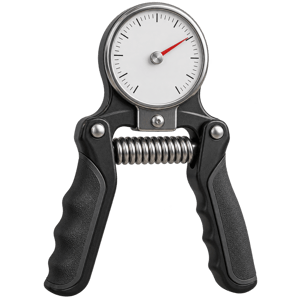
Everyone stood with feet about hip width apart and the arm straight down by the side, holding a digital gauge. They squeezed three times with each hand, switching hands each time, with a minute between tries on the same hand. The best squeeze from each hand was added together. Test yours the same way if you own a gauge, or use a dead hang if you don’t. How to test your grip at home covers both.
2 sources
- Perna FM and others, Muscular grip strength estimates of the US population from the National Health and Nutrition Examination Survey 2011-2012, Journal of Strength and Conditioning Research, 2016pmc.ncbi.nlm.nih.gov
- Leong DP and others, Prognostic value of grip strength: findings from the Prospective Urban Rural Epidemiology (PURE) study, The Lancet, 2015europepmc.org