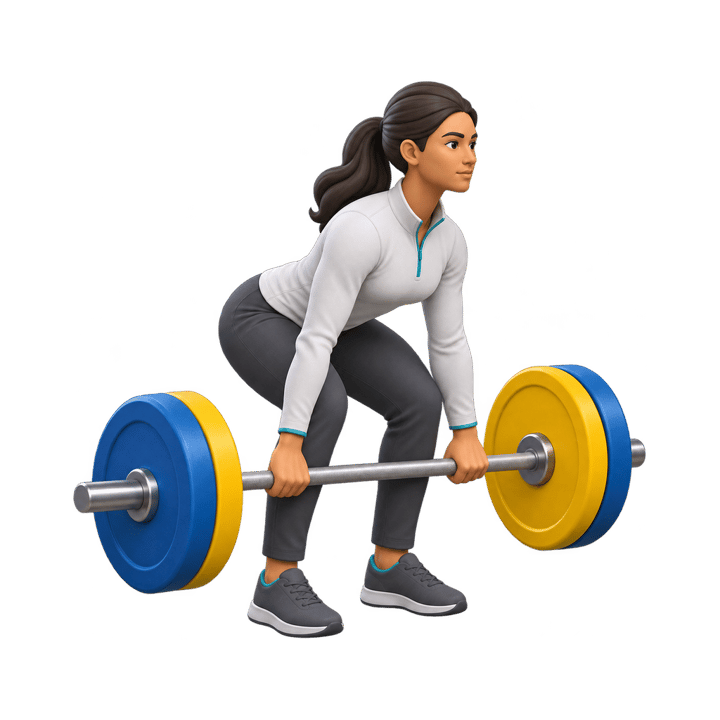
Should women lift heavy weights?
On this page
Yes. On the same program, women grow muscle by about the same share as men and gain more upper-body strength for where they started. Heavy just means a weight where the last two or three reps of each set are slow and hard, and you build up to it over a few weeks. After menopause, heavy lifting raised spine bone density in a trial where a gentle home program lost it.
Women have been handed a different kind of exercise for decades. It came with little pink dumbbells, sets of 30, the word “toning” and a warning that heavy weights would make you bulky. The idea behind it is that light weights shape a muscle and heavy ones inflate it. In studies, a light weight lifted until the set got hard grew muscle about as much as a heavy one, and the heavy weight built more strength on top.
What we’d do
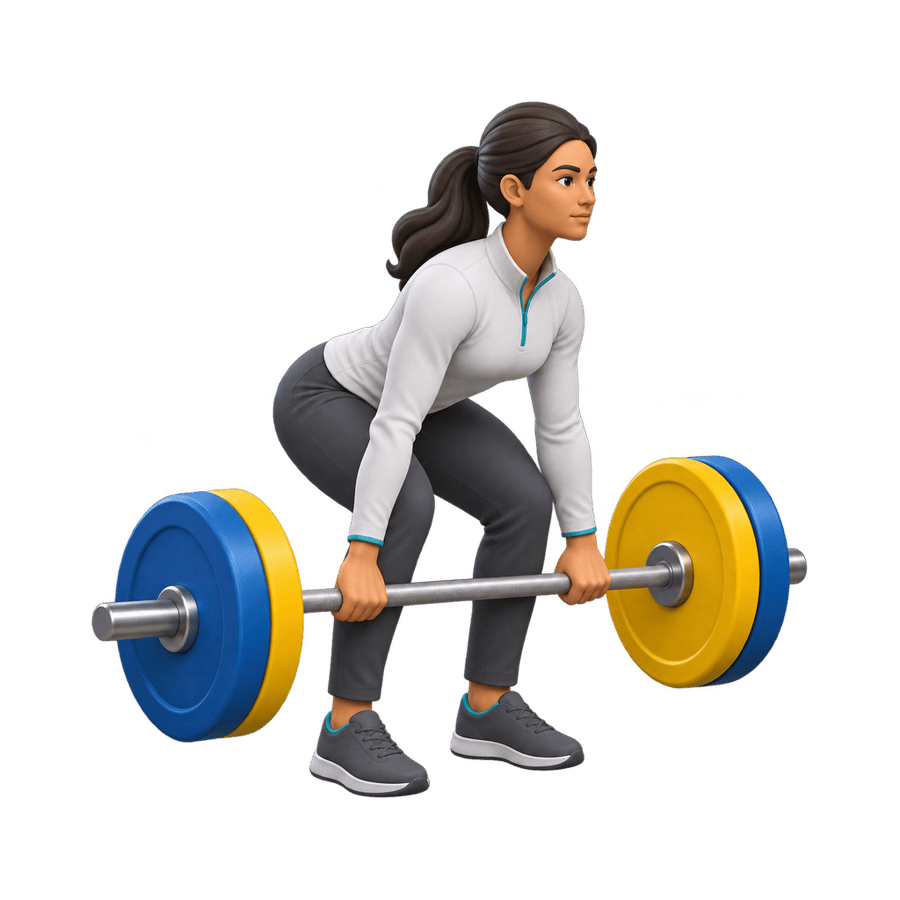
Do the same program a man would, two or three days a week, every big muscle. For the first two weeks, use weights you could lift 10 to 12 times and stop at 8 to 10. Then go heavier on the squat, hinge, push and pull, to a weight where the last two or three reps of each set are hard but clean, and add weight whenever every set hits its reps. You never need to test a one-rep max.
What happens when women lift heavy
In 2020, three researchers pooled the studies where men and women followed the same lifting program. Muscle growth came out about the same across 10 studies, measured as a share of what each person started with. Lower-body strength rose about the same across 23 studies. Upper-body strength rose more in women, across 17 studies, by a moderate margin. The studies were short, and the authors weren’t sure why the difference showed up only in the upper body.
In a 2022 trial in Norway, 50 young women who had never lifted did 3 sets of each move, two or four days a week, starting with a weight they could lift 12 times and working down to an 8-rep weight over 12 weeks. Their leg press went up 28 to 29%, their bench press 26 to 30% and their lat pulldown 26 to 27%, with about 2% more muscle mass.
Will it make you bulky?
Women start with less muscle, so the same share of growth adds fewer pounds. In a 2000 study that scanned 468 adults, men averaged about 73 lb (33.0 kg) of skeletal muscle and women about 46 lb (21.0 kg), and the gap was biggest in the upper body. Muscle grows slowly from there, over months and years, and strength rises much faster than size at the start. In one study of seven young adults, strength rose 39% in five weeks while thigh muscle grew about 7%. Lifting weights will make you bulky goes through it.
What heavy means
Heavy is relative, like a steep hill on a bike. The same hill is easy for one rider and brutal for another, and what makes your legs fitter is the climb that’s hard for you. In the gym, heavy is a weight where the last two or three reps of a set slow down and take real effort, with clean form. The 2026 position stand from the American College of Sports Medicine (ACSM) found strength rose most with loads of 80% of your max or more. The program’s strength sets put the big lifts at 4 to 6 reps, around 80 to 85% of your max, and you find that weight by feel.
Bones, after menopause
In the LIFTMOR trial, 101 women around 65, past menopause and with low bone mass, trained twice a week for eight months. Half did 30-minute supervised sessions of heavy lifts, 5 sets of 5 at more than 85% of their max, plus jumping. The other half did a gentle home program. Spine bone density rose 2.9% in the lifters and fell 1.2% in the home group, and the lifters did better on every function test. There was one injury, a minor back spasm. Every session was closely supervised, so if you have osteoporosis, start with a physical therapist or a coach who works with bone loss, and check with your doctor. How to get stronger bones has more.
Pregnancy and creatine
If you’re pregnant, the American College of Obstetricians and Gynecologists says that without complications, staying active is safe and good for you, and women who were active before can keep going with some changes as the body changes. Ask your obstetrician which lifts to change.
A 2021 review found creatine appears to improve strength and exercise performance in women before menopause, and that women after menopause may gain some muscle and function from it too. creatine.guide covers creatine for women, and who needs what covers what changes for women, older lifters and teens.
9 sources
- Roberts BM, Nuckols G and Krieger JW, Sex differences in resistance training: a systematic review and meta-analysis, Journal of Strength and Conditioning Research, 2020europepmc.org
- Pedersen H and others, A randomized trial on the efficacy of split-body versus full-body resistance training in non-resistance trained women, BMC Sports Science, Medicine and Rehabilitation, 2022pmc.ncbi.nlm.nih.gov
- Schoenfeld BJ and others, Strength and hypertrophy adaptations between low- vs. high-load resistance training: a systematic review and meta-analysis, Journal of Strength and Conditioning Research, 2017europepmc.org
- Janssen I and others, Skeletal muscle mass and distribution in 468 men and women aged 18-88 yr, Journal of Applied Physiology, 2000europepmc.org
- Seynnes OR and others, Early skeletal muscle hypertrophy and architectural changes in response to high-intensity resistance training, Journal of Applied Physiology, 2007europepmc.org
- Watson SL and others, High-intensity resistance and impact training improves bone mineral density and physical function in postmenopausal women with osteopenia and osteoporosis: the LIFTMOR randomized controlled trial, Journal of Bone and Mineral Research, 2018europepmc.org
- Currier BS and others, ACSM position stand: resistance training prescription for muscle function, hypertrophy, and physical performance in healthy adults, Medicine and Science in Sports and Exercise, 2026pmc.ncbi.nlm.nih.gov
- American College of Obstetricians and Gynecologists, Physical activity and exercise during pregnancy and the postpartum period, Committee Opinion 804, Obstetrics and Gynecology, 2020europepmc.org
- Smith-Ryan AE and others, Creatine supplementation in women's health: a lifespan perspective, Nutrients, 2021pmc.ncbi.nlm.nih.gov