How can I test my grip strength at home?
Hang from a bar and time it. A dead hang is easy to repeat and tests your hands, forearms and shoulders at once. If you want the number the big studies used, get a hand grip gauge and test it the way the US survey did, standing with your arm straight down by your side.
Search for a home grip test and you’ll find tennis balls, bathroom scales and towels to wring out. They feel clever, but none of them can be checked against anything. Every grip number in the big studies came from a hand grip gauge (a dynamometer). The PURE study of 139,691 adults used a Jamar gauge, and the US national survey used a Takei digital gauge. Without one, the best home test is the one that needs only a bar and a clock.
What we’d do
Make the dead hang your grip test. Do it every eight weeks on the same bar, timed the same way, and aim for a minute. If you want to see where you stand against other people your age, buy a hand gauge and test it the way the US survey did. Either way, train grip with carries, rows and short hangs, and let the number follow.
Two tests, side by side
The dead hang
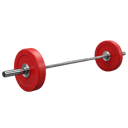
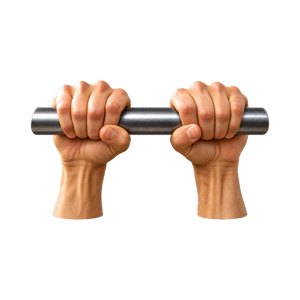
You need a sturdy bar you can reach and get off safely. It measures how long your hands can hold your whole bodyweight. Score it on Gyroscope’s training bands below. There’s no age table, because nobody has published one.
The hand gauge
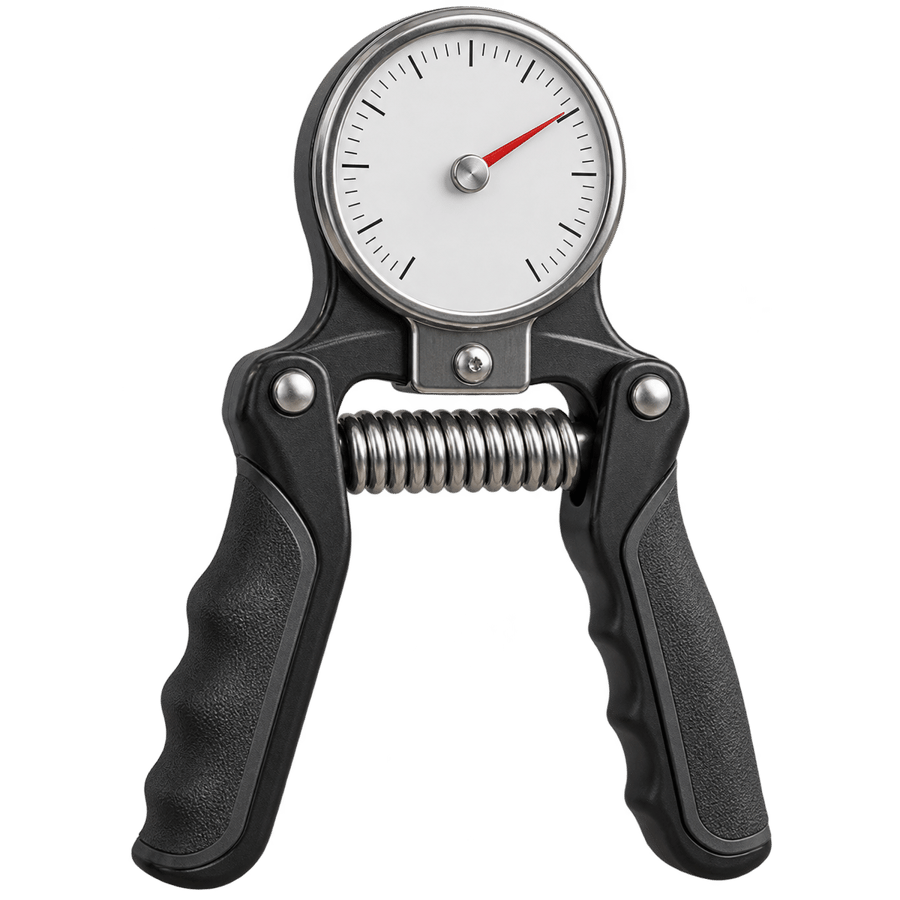
You need a hand grip gauge. It measures your strongest single squeeze. Add your best squeeze from each hand and compare it with the US table by age and sex on what a good grip is for your age.
The two measure different things, the way carrying heavy shopping bags in from the car is different from opening a stuck jar. The hang is the bags, holding on for as long as you can. The gauge is the jar, one hard squeeze. Gyroscope’s benchmark page notes that the gauge medians don’t predict a hang time, so keep the two numbers separate.
How to do the hang
- Dry your hands and the bar. Chalk is fine, but no towel or straps. Pick a bar low enough that you land on your feet.
- Grab the bar with both hands and let your arms go fully straight.
- Start the clock when both feet leave the ground.
- Stop when a hand lets go, your feet touch down, or you have to step off.
| How long you hang | Band |
|---|---|
| Under 20 seconds | Building |
| 20 to 44 seconds | Fair |
| 45 to 59 seconds | Good |
| A minute or more | Strong |
These are Gyroscope’s practical bands, the same for every age and both sexes. The test timer says the rules out loud, counts you in and keeps your phone awake. How long should I be able to dead hang? has more on what the time means.
How to use a hand gauge
The US survey (NHANES 2011 to 2012) tested 3,497 men and 3,400 women this way, so copying it lets you use their table.
- Stand with your feet about hip width apart and hold the gauge with your arm straight down by your side.
- Squeeze as hard as you can.
- Do three tries with each hand, switching hands each time, so each hand gets about a minute between tries.
- Take the best squeeze from each hand and add them together. If the gauge shows kilograms, multiply by 2.2 for pounds.
In that survey, both hands added together peaked in the 30s, at about 216 lb for men and 136 lb for women.
60 sa Strong hang
The top of Gyroscope’s dead hang bands, for any age.
3 trieswith each hand
The US survey took the best squeeze of each hand and added the two together.
17countries
Grip predicted death better than systolic blood pressure in 139,691 adults aged 35 to 70.
Why test it at all
In the PURE study, researchers measured grip in 139,691 adults aged 35 to 70 across 17 countries and followed them for a median of four years. Each 5 kg (about 11 lb) less grip went with a 16% higher risk of death from any cause, and grip predicted death better than systolic blood pressure did. Grip mostly reflects how strong your whole body is, so it’s a cheap way to keep an eye on the rest of you.
The dead hang is one of the strength tests in Gyroscope, scored 0 to 100 against your peers (how tracking works). The scorecard takes your hang time, your gauge numbers or both.
3 sources
- Gyroscope, Grip strength and dead hang benchmark, practical bands and protocolgyrosco.pe
- Perna FM and others, Muscular grip strength estimates of the US population from the National Health and Nutrition Examination Survey 2011-2012, Journal of Strength and Conditioning Research, 2016pmc.ncbi.nlm.nih.gov
- Leong DP and others, Prognostic value of grip strength: findings from the Prospective Urban Rural Epidemiology (PURE) study, The Lancet, 2015europepmc.org