How much should I be able to squat?
A one-rep max equal to your bodyweight is Good on Gyroscope’s training bands, and one and a half times your bodyweight is Strong. You don’t have to test a max to find out. Any set of 1 to 12 reps gives you an estimate, and sets under 10 reps give the tightest one.
Search for squat standards and you’ll find big tables that put you somewhere between novice and elite. Most of them are built from lifts people typed in themselves, on sites where the people who post tend to be the ones proud of their numbers. That tilts the tables toward strong. The other way people find out is to load the bar and try for a max, which takes nerve and a spotter, when a good set gets you a close estimate without either.
What we’d do
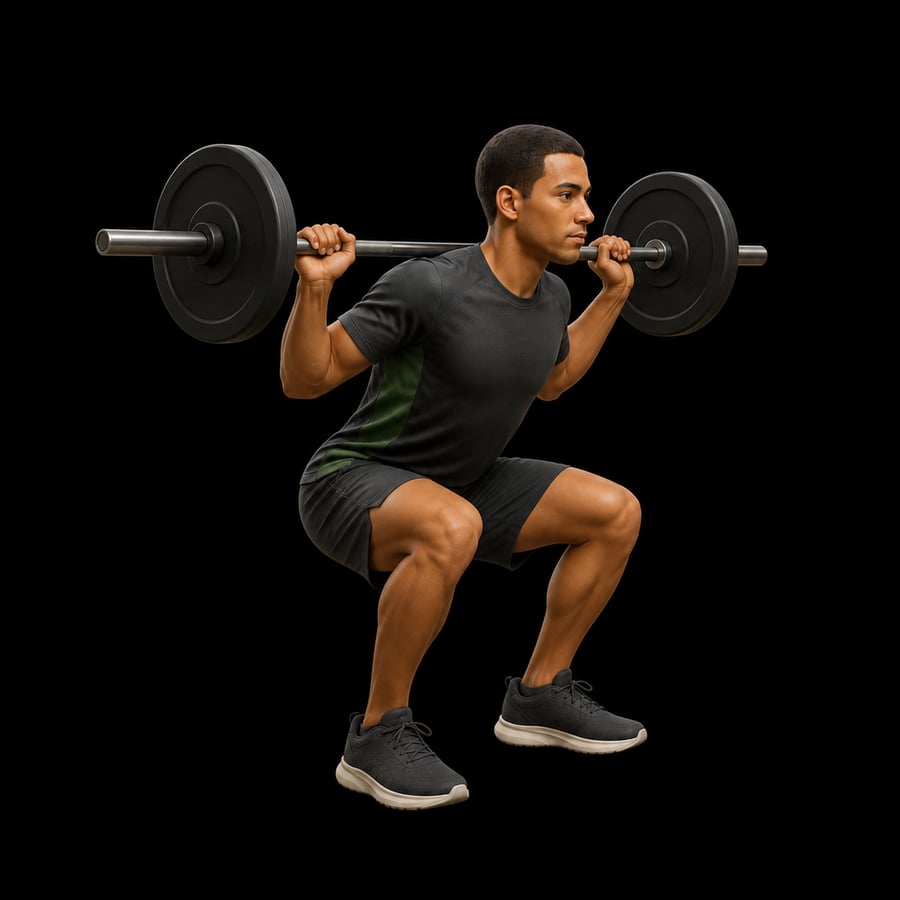
Warm up, then do one set of 3 to 6 clean reps at a weight you control, at least down to parallel, and stop before your form breaks. Put the weight and reps into the one-rep max calculator. Aim for your bodyweight first, then one and a half times. If you’re over 60, skip true max tests entirely and use a set.
Gyroscope’s squat bands
Your estimated one-rep max divided by your bodyweight:
| Max over bodyweight | Band |
|---|---|
| Under 0.75 | Building |
| 0.75 to 0.99 | Fair |
| 1.0 to 1.49 | Good |
| 1.5 and up | Strong |
These are Gyroscope’s practical bands from its squat benchmark page, which calls them training context and not medical cutoffs. There’s no published squat norm for the general public. The scorecard uses the same bands, on the middle of the estimate.
Worked examples
| Your set | Bodyweight | Estimated max | Times bodyweight | Band |
|---|---|---|---|---|
| 185 lb for 5 | 180 lb | 208 to 220 lb, middle 216 | 1.2 | Good |
| 135 lb for 8 | 160 lb | 162 to 172 lb, middle 169 | 1.1 | Good |
| 95 lb for 10 | 140 lb | 119 to 128 lb, middle 127 | 0.9 | Fair |
| 225 lb for 3 | 150 lb | 238 to 256 lb, middle 245 | 1.6 | Strong |
The calculator runs seven published formulas and shows them all, because they disagree. At 5 reps, 185 lb comes out anywhere from 208 to 220. At 10 reps, the same 185 lb comes out 231 to 249, a wider spread. The formulas pull apart after about 10 reps, so a heavier set of 3 to 6 gives a tighter answer.
Count the same depth every time
A squat is getting up out of a low chair, done with weight. Every time you stand up off a couch, your legs move your body through the same path. The lower the seat, the harder it gets, and the same is true under a bar.
That’s why depth has to stay the same from test to test. A half squat lets you put a lot more on the bar, which makes your ratio look better than it is. It may also be harder on your joints. A 2013 review of 164 articles on squat depth found that worries about deep squats damaging knees are unfounded when the technique is learned and the weight goes up gradually, and that heavy half and quarter squats may load the knees and spine more. The myth page on squats and knees has the full story.
1xbodyweight is Good
An estimated max equal to your bodyweight puts you in Gyroscope’s Good band.
1.5xbodyweight is Strong
The top band on the scorecard, at any age, for women and men.
7formulas, one set
The calculator shows every formula’s answer as a range, since they spread apart as reps rise.
Loading the bar
Once you know your target, the plates calculator works out what goes on each side and builds your warm-up sets. The squat is also one of the strength tests in Gyroscope, scored 0 to 100 against your peers. You log every set as you lift, and each lift builds its own estimated one-rep max trend (how tracking works).
3 sources
- Gyroscope, Squat strength benchmark, practical bodyweight-ratio bands and protocolgyrosco.pe
- Wikipedia, One-repetition maximum, the estimation formulasen.wikipedia.org
- Hartmann H, Wirth K and Klusemann M, Analysis of the load on the knee joint and vertebral column with changes in squatting depth and weight load, Sports Medicine, 2013europepmc.org