How do you build muscle?
On this page
Lift two or three times a week, work every big muscle, and end each set 1 to 3 reps short of failure, when the last reps are slow and hard but still clean. Add a little weight or a few reps as you get stronger, eat enough protein and sleep at least seven hours. That’s the whole recipe, and almost everything sold on top of it adds very little.
Building muscle looks complicated from the outside. There’s the special rep range for size, the chest day, the pump, the shake you supposedly have to drink within 30 minutes, and the idea that every set has to end with you unable to move. A lot of beginners copy a five-day plan from a bodybuilder, get so sore they can barely walk, and quit. Muscle comes from a much shorter list, and the list is the same at 25 and at 75.
What we’d do
Start with two full-body sessions a week, two or three days apart. Each one has a squat, a hinge, a push, a pull, a lunge and a carry. Do 2 sets of each for the first two weeks, then 3, with weights where the last two or three reps of every set are hard. When every set reaches the top of its rep range with clean form, add the smallest weight you have. Once that’s a habit, add a third day if you want more size. Eat protein at every meal and protect your sleep.
What makes a muscle grow
A muscle grows when it has to work close to its limit, again and again, and the weight on the bar counts for less than most people think. In 2017, Brad Schoenfeld and his colleagues pooled 21 studies where people took every set to failure, some with light weights (60% of their max or less) and some with heavy ones. Muscle grew about the same in both, and the heavy groups gained more one-rep max strength. The 2026 position stand from the American College of Sports Medicine (ACSM), built from 137 reviews covering more than 30,000 people, found loads from 30% to 100% of a person’s max built similar muscle when the effort was similar.
What those sets had in common was the ending, with the last few reps slow and hard, though you don’t have to go all the way to failure. The ACSM found training to failure didn’t consistently add anything, and suggested stopping with about 2 or 3 reps left.
Every big muscle needs its own work
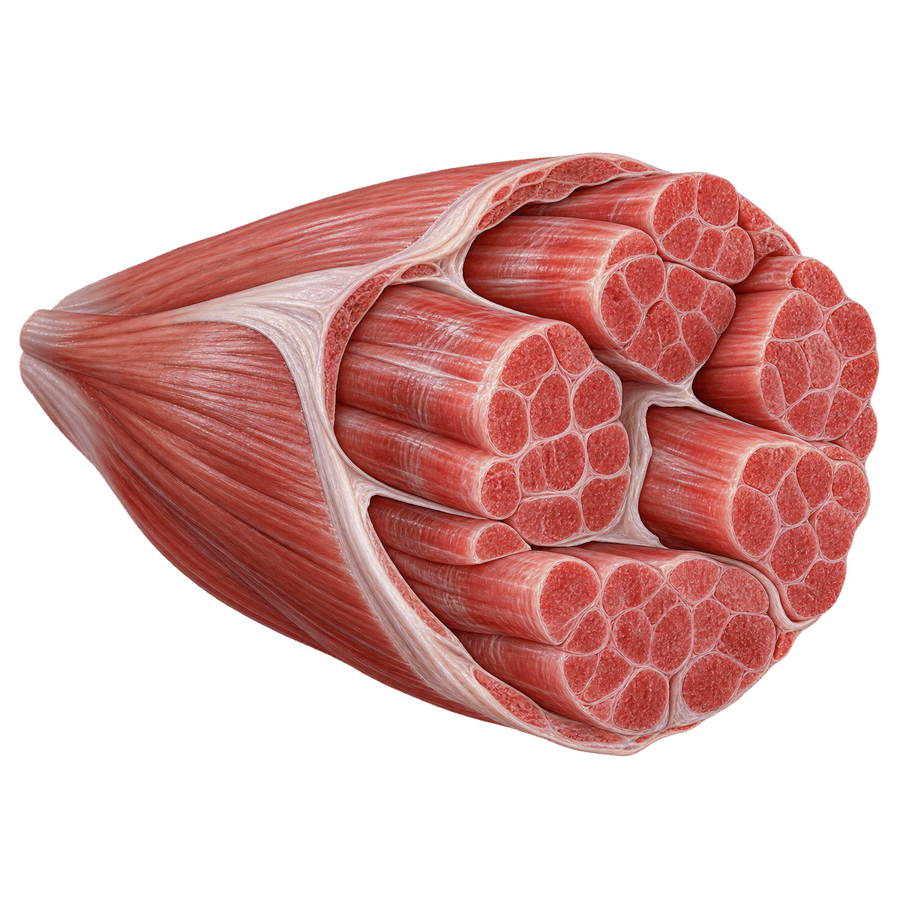
Muscle adapts the way the skin on your hands does. Rake leaves all weekend and you get calluses where the handle rubbed, and nowhere else. A muscle builds where it was asked to work hard, so bench pressing grows your chest, shoulders and triceps and leaves your legs exactly as they were. That’s why a good plan has a squat, a hinge, a push and a pull, and why every muscle has its own page with the moves that train it.
How many hard sets
The ACSM found size grew most with 10 or more hard sets per muscle a week, with the gains flattening around 18 to 20. In an earlier analysis of 15 studies, each extra weekly set went with about 0.37% more growth. Two full-body days give most people about 4 to 6 hard sets per muscle a week, which builds strength and some size, and a third day takes you close to 10.
Add a little, over and over
Once a weight stops being hard, it stops asking the muscle for anything new, so the load has to creep up. When every set hits the top of your rep range with clean form, add the smallest step you have, about 5 lb (2.5 kg) on upper-body lifts and 5 to 10 lb (2.5 to 5 kg) on lower-body lifts, then build the reps back up. When should I add weight? has the details.
Food and sleep
Lifting does the building, and food supplies the material. In a 1994 trial of 100 frail nursing home residents, a nutrition supplement on its own did nothing for strength, while 10 weeks of lifting more than doubled it.
Protein helps on top of the lifting. A 2018 analysis of 49 trials and 1,863 people found protein supplements added about 0.7 lb (0.30 kg) of lean mass over months of lifting, and the gains stopped rising past about 1.6 g per kg of bodyweight a day. Under 1.2 g per kg a day is too low, and 1.2 to 1.6 g per kg is typical, about 100 to 130 g at 180 pounds. The Gyroscope app personalizes yours. protein.guide has the detail on how much, and the food chapter covers the rest.
Sleep feeds into it too. In a 2021 study, 13 healthy young adults spent one night awake in a lab, and the next day their muscle building after a meal was 18% lower than after a normal night. In a 2010 study of 10 adults on a diet, two weeks of 5.5 hours in bed instead of 8.5 meant 60% more fat-free mass lost (5.3 lb against 3.3 lb), though fat-free mass includes water as well as muscle. Both studies were small, and the CDC says adults 18 to 60 need 7 or more hours a night. The rest chapter has more.
The guide puts all of this in one place, and the program turns it into a plan for 2, 3 or 4 days a week.
8 sources
- Currier BS and others, ACSM position stand: resistance training prescription for muscle function, hypertrophy, and physical performance in healthy adults, Medicine and Science in Sports and Exercise, 2026pmc.ncbi.nlm.nih.gov
- Schoenfeld BJ and others, Strength and hypertrophy adaptations between low- vs. high-load resistance training: a systematic review and meta-analysis, Journal of Strength and Conditioning Research, 2017europepmc.org
- Schoenfeld BJ, Ogborn D and Krieger JW, Dose-response relationship between weekly resistance training volume and increases in muscle mass: a systematic review and meta-analysis, Journal of Sports Sciences, 2017europepmc.org
- Fiatarone MA and others, Exercise training and nutritional supplementation for physical frailty in very elderly people, New England Journal of Medicine, 1994europepmc.org
- Morton RW and others, A systematic review, meta-analysis and meta-regression of the effect of protein supplementation on resistance training-induced gains in muscle mass and strength in healthy adults, British Journal of Sports Medicine, 2018pmc.ncbi.nlm.nih.gov
- Lamon S and others, The effect of acute sleep deprivation on skeletal muscle protein synthesis and the hormonal environment, Physiological Reports, 2021pmc.ncbi.nlm.nih.gov
- Nedeltcheva AV and others, Insufficient sleep undermines dietary efforts to reduce adiposity, Annals of Internal Medicine, 2010pmc.ncbi.nlm.nih.gov
- Centers for Disease Control and Prevention, About sleepcdc.gov