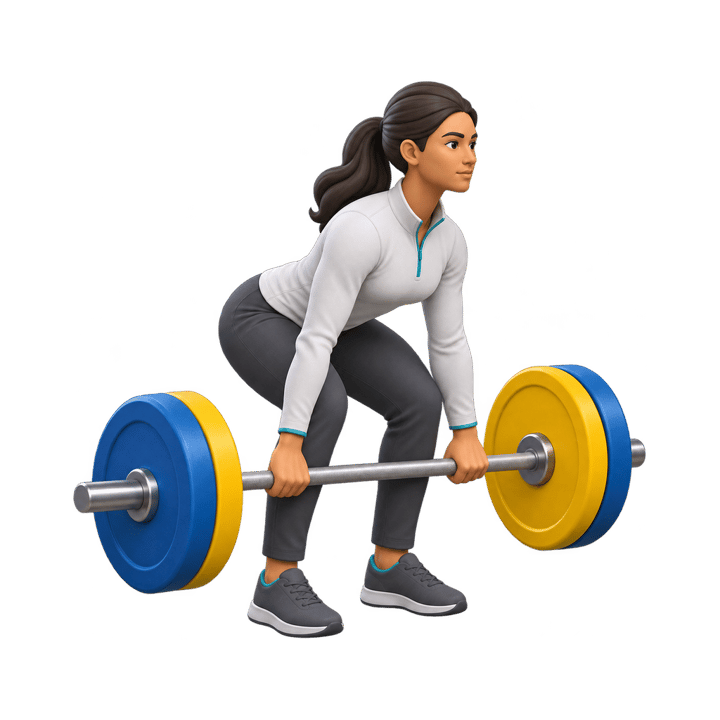
What changes for women, beginners, over-60s and people on a GLP-1?
On this page
The program barely changes. Everyone does the same five moves, twice a week, with weights that make the last few reps hard. What changes are the reasons and the extras: bones for women after menopause, balance after 60, protein and the scale on a GLP-1, and patience in your first months. Under 18, it starts with a coach and good form, with no set loads.
Fitness gets sold in separate boxes. Women get light pink dumbbells and “toning”, older people get chair stretches, beginners are told to get fit first, and anyone losing weight is told to do cardio. Most of that is marketing. Muscle responds to load in pretty much the same way in all of these people, and the trials that tested them used real weights.
What we’d do
Start everyone on the same plan, the five moves on two days a week, and change only the starting weight. Then add the one extra that fits you. Women past menopause, lift heavier over time for your bones. Over 60, practice balance daily. On a GLP-1, protect your muscle with lifting and protein while the weight comes off. Beginners, give it eight weeks before you judge. Teenagers, find a coach.
If you remember three things
- Women gain muscle at the same rate as men, relative to where they start, and gained more relative upper-body strength in a 2020 analysis.
- Heavy lifting built bone. Women around 65 with low bone mass raised their spine density 2.9% in eight months, while the home group lost 1.2%.
- Lifting protects muscle during weight loss. In older adults dieting, it prevented 93.5% of the lean mass loss the diet caused.
A picture from daily life
A family shares one bike. Everyone rides it the same way, pedals and brakes and gears, and each person sets the seat to their height before they get on.
Strength training is the bike. The five moves, the sets and the rule for adding weight are the same for everyone. The weight you start with and the extras you add are the seat.
| Who | What stays the same | What to add | Why |
|---|---|---|---|
| Women | The five moves, heavy enough | Heavier work over time, especially after menopause | Bone density, and strength that lasts |
| Beginners | Everything | Two sets in week one, then three | Your nerves learn fast in the first weeks |
| Over 60 | Everything | Daily balance practice, the chair stand test, a longer warm-up | Falls, and the fastest gains of anyone |
| On a GLP-1 | Everything | Protein first at every meal, and judging strength by more than push-ups | Keeping muscle while the weight comes off |
| Under 18 | The habit | A qualified coach, technique first | Form and supervision prevent most injuries |
Women
Women worry about getting bulky, and the numbers say they won’t. In a 2020 analysis comparing men and women on the same programs, muscle grew by about the same share in both, and women gained more relative strength in the upper body. But women start with less muscle. In 468 adults scanned with MRI, men had 33 kg of skeletal muscle on average and women 21 kg, and the gap was biggest in the upper body. The same percentage gain on a smaller start is fewer pounds, so women get stronger and firmer. Lifting weights will make you bulky.
The bigger reason for women is bone. In the LIFTMOR trial, 101 women after menopause, around 65 and with low bone mass, did supervised heavy lifting and jumping twice a week for eight months, 30 minutes a session, 5 sets of 5 at more than 85% of their max. Their spine density rose 2.9% and their hip held steady, while the home-exercise group lost 1.2% at the spine and 1.9% at the hip. If you’ve been diagnosed with osteoporosis, get your doctor’s go-ahead first, and start supervised if you can. How do you build stronger bones?
On the push-up test, the published norms count women from the knees. If you do yours from your toes, the scorecard scores them on the knee table and says so, since it underrates you.
Beginners
The first months are the best part. In a 2007 study, seven young adults got 39% stronger in five weeks, mostly from their nerves learning to use the muscle they had. In the records of 14,690 adults who lifted once a week, strength rose 30 to 50% in the first year.
Start with 2 sets of each move in week one, at a weight you could lift 10 to 12 times but stop at 8 to 10, and go to 3 sets in week two. Your form and your confidence are the goals for the first month. Judge your progress by your log, since the mirror lags behind by weeks. How do I start lifting weights?
Over 60
You have the most to gain and the most to protect. In a trial of 100 frail nursing home residents, average age 87, strength rose 113% in 10 weeks of training against 3% without it. The US guideline asks older adults to mix balance training in with their aerobic and strength work.
Practice standing on one foot next to the counter every day, add the 30-second chair stand to your tests, warm up longer, and skip one-rep max tests. If you have heart disease or high blood pressure, ask your doctor before you add heavy lifting. What happens to strength as you age.
On a GLP-1, or losing weight fast
Any big weight loss takes some muscle with it. In the tirzepatide trial’s body scan study, about a quarter of the weight people lost was lean mass, the same share as in the placebo group, who lost much less weight. The drugs cause more loss, so more muscle goes in pounds. In six diet trials in older adults with obesity, lifting three times a week prevented 93.5% of the lean mass the diet alone cost.
The two sessions count for even more now. Put protein first at each meal. Typical is 1.2 to 1.6 g per kg of bodyweight a day, about 100 to 130 g at 180 pounds, and the Gyroscope app personalizes yours. Judge your strength by your squat and your grip more than push-ups and the hang, since those get easier as the scale drops, whatever your muscle is doing. bodyfat.guide has the drug trials in detail: do GLP-1 drugs make you lose muscle? How do you keep your muscle on a GLP-1?
Under 18
The American Academy of Pediatrics supports resistance training for children and teens, and a 2010 review of youth training found no evidence that it harms growth in height. Injury to the growth plates hadn’t been reported in any study that followed young people through a training program. Most injuries in young lifters were accidents, and among 8 to 13-year-olds seen in emergency rooms, about two-thirds were to the hands and feet, mostly from dropping or pinching weights. A recurring theme was that no qualified adult was supervising.
We don’t set loads or standards for anyone under 18, and our tools don’t score them. Find a qualified coach, learn the moves with light weights, and build from there. Is it safe for teenagers to lift weights? Lifting weights stunts a kid’s growth.
With a heart condition or high blood pressure
Ask your doctor before you add heavy lifting. Walking and the home tests are a good place to start while you wait, and bloodpressure.guide covers the things that lower blood pressure, including wall sits and hand grips.
11 sources
- Roberts BM, Nuckols G and Krieger JW, Sex differences in resistance training: a systematic review and meta-analysis, Journal of Strength and Conditioning Research, 2020europepmc.org
- Janssen I and others, Skeletal muscle mass and distribution in 468 men and women aged 18-88 yr, Journal of Applied Physiology, 2000europepmc.org
- Watson SL and others, High-intensity resistance and impact training improves bone mineral density and physical function in postmenopausal women with osteopenia and osteoporosis: the LIFTMOR randomized controlled trial, Journal of Bone and Mineral Research, 2018europepmc.org
- Seynnes OR and others, Early skeletal muscle hypertrophy and architectural changes in response to high-intensity resistance training, Journal of Applied Physiology, 2007europepmc.org
- Steele J and others, Long-term time-course of strength adaptation to minimal dose resistance training, Research Quarterly for Exercise and Sport, 2023europepmc.org
- Fiatarone MA and others, Exercise training and nutritional supplementation for physical frailty in very elderly people, New England Journal of Medicine, 1994europepmc.org
- Look M and others, Body composition changes during weight reduction with tirzepatide in the SURMOUNT-1 study of adults with obesity or overweight, Diabetes, Obesity and Metabolism, 2025pmc.ncbi.nlm.nih.gov
- Sardeli AV and others, Resistance training prevents muscle loss induced by caloric restriction in obese elderly individuals, Nutrients, 2018pmc.ncbi.nlm.nih.gov
- Stricker PR, Faigenbaum AD and McCambridge TM, Resistance training for children and adolescents, Pediatrics, 2020europepmc.org
- Faigenbaum AD and Myer GD, Resistance training among young athletes: safety, efficacy and injury prevention effects, British Journal of Sports Medicine, 2010pmc.ncbi.nlm.nih.gov
- US Department of Health and Human Services, Physical Activity Guidelines for Americans, 2nd edition, executive summary, 2018odphp.health.gov