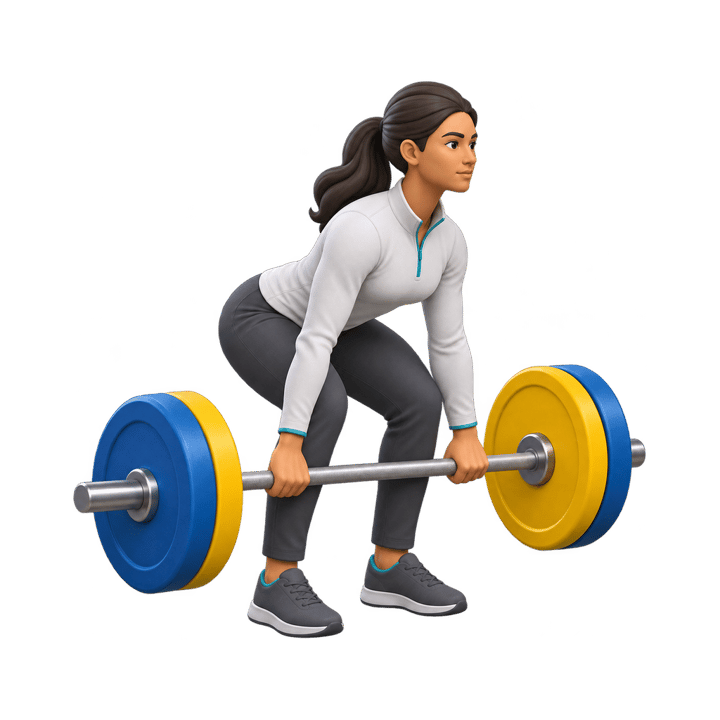
How to build muscle naturally, without supplements
On this page
If you want to and you can, build muscle the natural way. Lift two to four days a week, get your protein from ordinary food at every meal, and sleep seven hours or more. Your body builds muscle on its own when it gets a reason to, the material to build with and the time to do it. Supplements come last, and creatine is the only one with much behind it.
The supplement aisle makes muscle look like something you buy. There are tubs of whey, amino acid drinks and testosterone boosters, and online there are bodies that changed faster than any program could manage, some of them with drugs. So a lot of people think they need a shake after every workout, or that they’ll never get anywhere without help. In the trials, the free parts did nearly all the work.
What we’d do
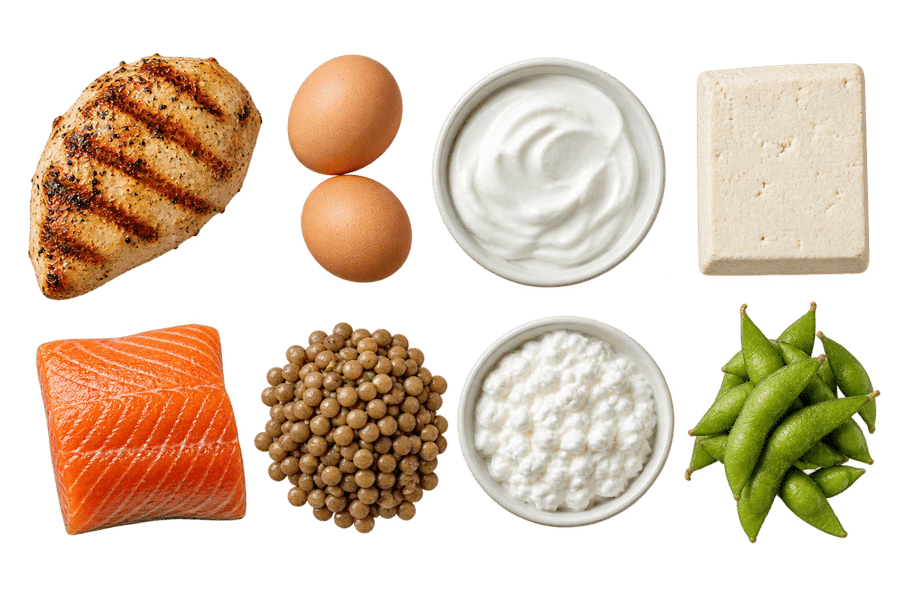
Start with two full-body sessions a week from the strength protocol, and add a little weight whenever every set hits its reps. Put a solid serving of protein on every plate: eggs, Greek yogurt, fish, chicken, beef, tofu, beans or lentils. Keep a shake for the days a meal falls short. Sleep seven hours or more. After a few months, if you want one supplement, take 3 to 5 g of creatine a day. We’d skip everything else on the shelf, and we’d never touch steroids or SARMs.
If you remember three things
- Lifting is the signal. In frail people with an average age of 87, a nutrition drink on its own changed nothing, and lifting more than doubled their strength.
- Food is the material. A gram of protein from an egg or a chicken breast counts the same as a gram from a scoop.
- Your body makes creatine too. It makes about half of what it needs each day, and food brings the rest.
A picture from daily life
A tomato plant grows on sun, water and good soil. Fertilizer helps a little once those are right, and it does nothing for a plant kept in a dark closet. For muscle, lifting is the sun, food is the soil and sleep is the water. The supplement aisle is the fertilizer.
Lifting is the signal
Muscle grows when you ask it to do more than it’s used to, and food on its own doesn’t ask. In 1994, Maria Fiatarone’s team randomly assigned 100 frail nursing home residents, average age 87, to lift weights with their legs, drink a nutrition supplement, do both or do neither, for 10 weeks. Strength more than doubled in the people who lifted (113%, against 3% in those who didn’t). The drink on its own did nothing for their strength or their muscle.
Everything else on this page helps the lifting work, and none of it replaces the lifting. The weight has to keep going up, a little at a time. The strength protocol sets your week, and how to keep getting stronger covers adding weight.
Food is the material
Typical protein for building muscle is 1.2 to 1.6 g per kg of bodyweight a day, about 100 to 130 g at 180 pounds. The Gyroscope app personalizes yours. Ordinary food gets you there with a solid serving at each meal. Here’s one day at about 128 g, with USDA’s numbers.
| Meal | Food | Protein |
|---|---|---|
| Breakfast | 3 large eggs and a 5.3 oz cup of plain nonfat Greek yogurt | 34 g |
| Lunch | 3 oz of canned light tuna and a cup of cooked lentils | 34 g |
| Afternoon | A cup of 2% milk | 8 g |
| Dinner | 6 oz of grilled chicken breast | 52 g |
Plants work too. Half a cup of firm tofu has about 22 g, and a cup of black beans about 15 g. protein.guide has ways to eat more protein and how to get enough from plants.
Plain milk has a good record in a trial. In 2007, researchers in Canada had 56 young men who’d never lifted train five days a week for 12 weeks. Right after each session and an hour later, they drank fat-free milk, a soy drink with the same protein and calories, or a carbohydrate drink with the same calories. Everyone gained lean mass, and the milk group gained the most. Their strength rose about the same in all three groups.
A shake isn’t a different kind of protein. A gram from a scoop counts like a gram from food, and a scoop of whey has about 25 g, so it’s handy on a morning when breakfast is toast and coffee. In Robert Morton’s 2018 analysis of 49 trials, extra protein added a little muscle on top of lifting, and the gains stopped rising past about 1.6 g per kg a day. Once you’re in the range, more protein, from a tub or a plate, adds little. What to eat to build muscle and how much protein you need.
Creatine is food too
Creatine is in meat and fish, and your body makes it. Your muscles use up 1 to 3 g of it a day, depending on how much muscle you have. About half the replacement comes from food, and your liver and kidneys make the rest, according to the International Society of Sports Nutrition’s 2017 review. A pound of raw beef or salmon has about 1 to 2 g.
A supplement tops your stores up by about 20 to 40%, and in 60 placebo trials of leg strength it added a small extra gain on top of training. That’s a real effect, and it’s small next to the lifting itself. People who eat no meat start with lower stores, which is why creatine.guide calls vegetarians and vegans the most improved. If you have kidney disease, ask your doctor before you take it. Does creatine make you stronger?
Sleep is when it gets built
The workout starts the building, and most of it happens over the next day or two. In a 2021 trial, 13 young adults spent one night without sleep, and the muscle building after a meal the next day was 18% lower than after a normal night. Seven hours or more is the cheapest thing on this page. Rest, sleep and recovery.
What natural means in a gym
In gyms, natural means no steroids or similar drugs, and that explains a lot of what you see online. In 1996, Shalender Bhasin’s team gave 43 healthy men a weekly injection of 600 mg of testosterone or a placebo for 10 weeks, with or without lifting three times a week. The men on testosterone who didn’t exercise at all gained more arm and leg muscle than the men on the placebo, and their squat rose 16 kg against 3. The men who took it and lifted gained 6.1 kg (13 lb) of lean mass in 10 weeks.
Without drugs, muscle comes more slowly. Across 111 studies of young men, programs averaging about 10 weeks added about 3.4 lb (1.5 kg) of muscle (how long it takes). The two numbers aren’t measured the same way, since lean mass counts water too, but the gap is why a body online that changed in a few months tells you little about what lifting does.
The drugs carry real harm. The US Food and Drug Administration says products sold for muscle as SARMs aren’t approved, and people taking them have had liver injury, including liver failure, along with a possible higher risk of heart attack and stroke. It also warns that some bodybuilding products sold as supplements illegally contain steroids or steroid-like substances. The legal testosterone boosters are a different problem. When researchers looked at 50 of them in 2020, 90% claimed to raise testosterone, only about a quarter had data behind that, and 13 went over the safe upper limit for zinc, vitamin B3 or magnesium.
When a supplement makes sense
Some people can’t get there with food alone, or don’t want to, and that’s fine. A protein shake makes sense on days a meal falls short, when your appetite is small (on a GLP-1 drug, for example), or when your diet makes the typical range hard to reach. How to keep your muscle on a GLP-1. Creatine makes sense once you lift regularly, and most of all if you eat little or no meat. BCAAs, HMB and testosterone boosters added little or nothing in the trials, which are on what to eat to build muscle.
12 sources
- Fiatarone MA and others, Exercise training and nutritional supplementation for physical frailty in very elderly people, New England Journal of Medicine, 1994europepmc.org
- Hartman JW and others, Consumption of fat-free fluid milk after resistance exercise promotes greater lean mass accretion than does consumption of soy or carbohydrate in young, novice, male weightlifters, American Journal of Clinical Nutrition, 2007europepmc.org
- Morton RW and others, A systematic review, meta-analysis and meta-regression of the effect of protein supplementation on resistance training-induced gains in muscle mass and strength in healthy adults, British Journal of Sports Medicine, 2018pmc.ncbi.nlm.nih.gov
- US Department of Agriculture, FoodData Central, protein per serving for whole eggs (171287), plain nonfat Greek yogurt (170894), light tuna canned in water (173709), boiled lentils (172421), 2% milk (171267), grilled chicken breast (171534), firm tofu (172475) and boiled black beans (173735), as tabled by protein.guidefdc.nal.usda.gov
- protein.guide, Does protein powder count as real protein?protein.guide
- Kreider RB and others, International Society of Sports Nutrition position stand: safety and efficacy of creatine supplementation in exercise, sport, and medicine, Journal of the International Society of Sports Nutrition, 2017pmc.ncbi.nlm.nih.gov
- Lanhers C and others, Creatine supplementation and lower limb strength performance: a systematic review and meta-analyses, Sports Medicine, 2015europepmc.org
- Lamon S and others, The effect of acute sleep deprivation on skeletal muscle protein synthesis and the hormonal environment, Physiological Reports, 2021pmc.ncbi.nlm.nih.gov
- Bhasin S and others, The effects of supraphysiologic doses of testosterone on muscle size and strength in normal men, New England Journal of Medicine, 1996europepmc.org
- US Food and Drug Administration, Certain bodybuilding products put consumers at risk for heart attack, stroke, serious liver damage and more (SARMs), current as of December 2, 2025fda.gov
- US Food and Drug Administration, Caution: Bodybuilding Products Can Be Risky, updated September 20, 2024fda.gov
- Clemesha CG, Thaker H and Samplaski MK, Testosterone boosting supplements composition and claims are not supported by the academic literature, World Journal of Men's Health, 2020pmc.ncbi.nlm.nih.gov