How do you keep getting stronger?
On this page
Pick a rep range, say 6 to 10. When every set reaches the top of it with good form, add the smallest weight step you have and build the reps back up from the bottom. Then do it again. An army doctor worked this out on wounded soldiers in 1945, and it still does most of the work.
Walk into any gym and you’ll see people lifting the same dumbbells they lifted last year. It feels like training, it’s tiring, and nothing changes, because the muscle has already adapted to that weight. Others jump too far, pile on weight before they’re ready, and stall or get hurt. The rule that works sits between the two, and it fits on a sticky note.
What we’d do
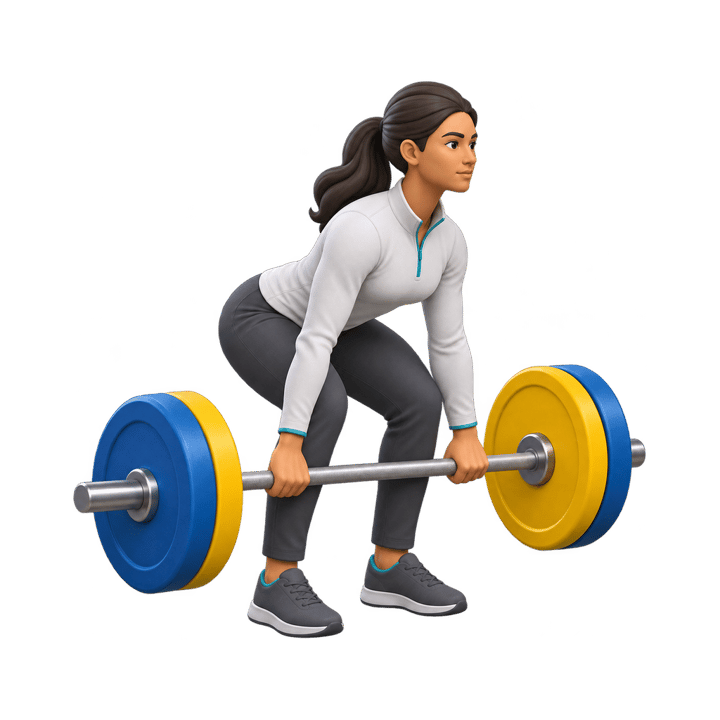
Write down every set, the weight and the reps. Work in a range of about 6 to 10 reps on the big lifts. When all your sets hit 10 with a rep or two left in you, add the smallest step your equipment allows next time, usually 5 lb on a barbell (2.5 lb a side) or the next dumbbell up. If the weight hasn’t moved in three weeks, look at your log before you look for a new program.
If you remember three things
- The weight has to keep going up. Muscle adapts to the load it meets, and a weight it has adapted to stops changing it.
- Adding reps counts too. In 43 trained adults over eight weeks, adding reps and adding weight built about the same strength and muscle.
- It slows down, and that’s normal. In 14,690 people, strength rose 30 to 50% in the first year and leveled off after one to two.
The army doctor
In 1945 US Army hospitals were full of servicemen recovering from injuries to their bones and joints. Thomas DeLorme, an army doctor, had built himself back up with weights after a childhood illness, and he thought heavy work would get them back faster. He had his patients find the most they could lift ten times, their ten-rep max, and do several sets at it.
By 1948 he’d refined it into three sets of ten, each heavier than the last, and as patients got stronger the weights went up with them. He called it Progressive Resistance Exercise, and it’s where “three sets of ten” comes from. His 1951 book on it helped make strength training a real science.
What made it work was the resistance rising as the patients got stronger.
A picture from daily life
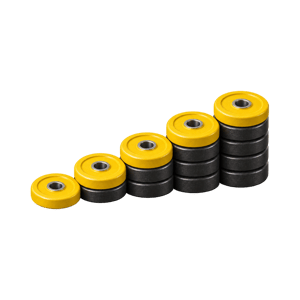
A flight of stairs and a wall can be the same height. You walk up the stairs without thinking, and you can’t get up the wall at all. The only difference is the size of each step.
Adding weight works the same way. Each step is small enough that your body can meet it, and after a year of small steps you’re lifting something you couldn’t have touched on day one.
How it looks in a log
This is the method in practice, sometimes called double progression because the reps go up first and then the weight. Here’s a made-up example, a goblet squat in a range of 8 to 10 reps, three sets.
Week 4 looks like a step back, with fewer reps, and it’s the most important week on the chart. The weight went up. Notice too that 35 to 40 lb is a 14% jump, which is why you build the reps first instead of adding weight every week.
- Pick a range. About 6 to 10 reps for the big lifts (squat, hinge, press), and 8 to 15 for smaller moves and carries.
- Start light enough to hit the bottom of it with two or three reps to spare on every set.
- Add reps each session or each week, as long as your form holds.
- When every set hits the top, add the smallest weight step you have, and drop back to the bottom of the range.
- With no weights to add, make the move harder. Counter push-ups become bench push-ups and then floor push-ups, and chair squats become slow squats with a backpack.
Reps or weight?
Either one. In 2022 researchers split 43 adults who’d been training their legs for at least a year into two groups for eight weeks. One group added weight and kept the reps the same. The other kept the weight and added reps. The weight group’s squat max rose about 2 kg (4 lb) more, a difference the authors called of questionable practical significance, and the reps group grew slightly more in one thigh muscle.
The rule is that something has to go up, the weight or the reps. Adding weight does more the closer your goal is to pure strength, since the 2026 American College of Sports Medicine review found strength rose most with loads of about 80% of your max or more.
How fast should it go?
Fast at first, then slower. In a 2007 study, seven young adults got 39% stronger in five weeks, mostly from their nerves learning to use the muscle. In the training records of 14,690 adults (60% women, average age 48) who did one set of each of six machine exercises once a week, strength rose about 30 to 50% in the first year and ended about 50 to 60% above where they started after six years, with most of that in the first one to two.
That pattern is normal. Early on you might add weight every week. After a year or two you’ll be happy to add a little each month. How long does it take to get stronger?
When you get stuck
Look at your log first. Very often the weight stopped going up, and nobody noticed. If it’s been the same for three weeks, check these in order.
- Are you adding anything? Same weight and same reps for three weeks means you’ve stopped progressing.
- Sleep. In a 2021 study of 13 young adults, one night without sleep cut muscle building after a meal the next day by 18%. How much rest you need.
- Food. Too little protein, or eating far below what you burn, slows everything. What to eat.
- Enough hard sets. Two or three sets per move, each ending with no more than two or three reps left in you.
If everything checks out, a common coaching fix is to take about 10% off the bar and build back up over two or three weeks. It comes from coaching practice, and nobody has tested it in a trial. Why am I not getting stronger?
Doesn’t it have to stop somewhere?
The sceptic says
You can’t add weight forever. Nobody squats 5 lb more every week for 20 years.
The reply
True, and you don’t need to. The steps get smaller and further apart, and at some point the goal shifts to keeping what you’ve built. Plan for that, since strength fades when training stops. In a 2013 review of 103 studies, the loss grew the longer people stopped, and it was larger in people over 65. Two sessions a week at a weight that still feels hard keep most of it.
7 sources
- Todd JS and others, Thomas L. DeLorme and the science of progressive resistance exercise, Journal of Strength and Conditioning Research, 2012europepmc.org
- Plotkin D and others, Progressive overload without progressing load? The effects of load or repetition progression on muscular adaptations, PeerJ, 2022peerj.com
- Steele J and others, Long-term time-course of strength adaptation to minimal dose resistance training, Research Quarterly for Exercise and Sport, 2023europepmc.org
- Currier BS and others, ACSM position stand: resistance training prescription for muscle function, hypertrophy, and physical performance in healthy adults, Medicine and Science in Sports and Exercise, 2026pmc.ncbi.nlm.nih.gov
- Seynnes OR and others, Early skeletal muscle hypertrophy and architectural changes in response to high-intensity resistance training, Journal of Applied Physiology, 2007europepmc.org
- Bosquet L and others, Effect of training cessation on muscular performance: a meta-analysis, Scandinavian Journal of Medicine and Science in Sports, 2013europepmc.org
- Lamon S and others, The effect of acute sleep deprivation on skeletal muscle protein synthesis and the hormonal environment, Physiological Reports, 2021pmc.ncbi.nlm.nih.gov