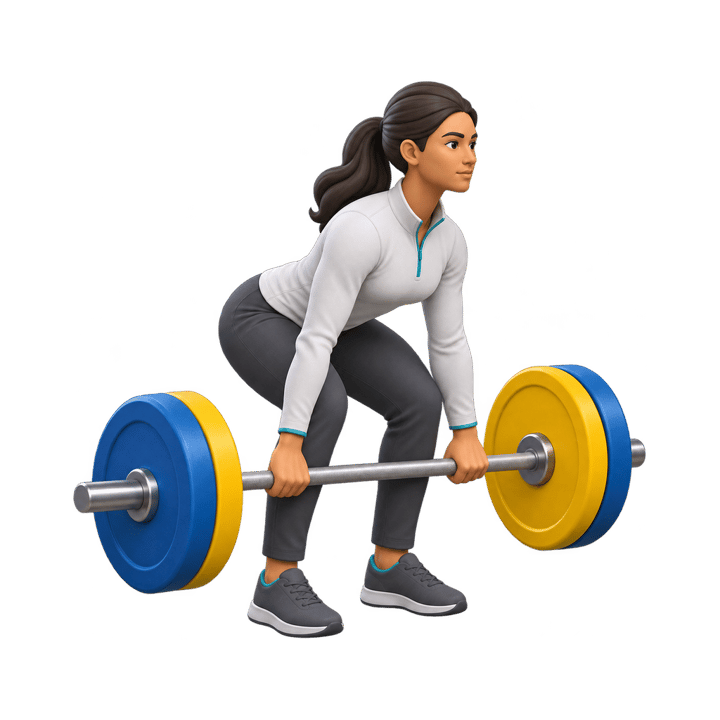
How do you test your strength at home?
On this page
Five tests, about ten minutes, no gym: get down to the floor and back up, do push-ups in one go, hang from a bar, stand on one foot with your eyes closed, and squeeze a grip gauge if you own one. Do them the same way every eight weeks and train whichever comes out weakest.
Most “how strong am I” charts ask for your bench press, or give push-up numbers with no rules for how to count them, so two charts can put the same person in different places. The dead hang charts that go around online are worse, since nobody has published hang times by age at all. The fix is a short set of tests with fixed rules, scored against the studies that have real numbers, and repeated the same way.
What we’d do
Pick an evening, clear some floor and do all five in one go, in the order below, with a phone timer. Write down each number. Put them into How strong am I? to see each one against your age and sex, and spend the next eight weeks on the weakest. Then test again the same way, at about the same time of day. Skip one-rep max tests unless you’re already an experienced lifter. You can estimate your max from any normal set instead.
If you remember three things
- Same rules every time. How you count changes the number more than any chart does. Change the rules and the number means nothing.
- Your weakest test is your plan. One low score points straight at what to practice.
- Every eight weeks. Long enough for real change, short enough to keep you going.
A picture from daily life
If you weigh yourself once in jeans after dinner and once naked in the morning, the difference tells you nothing about your weight. You’d use the same scale, at the same time, in the same clothes.
Strength tests work the same way. A push-up counted with your chest touching the floor and one counted with a half dip are different tests. Keep the rules fixed and the change between tests becomes the useful part.
The ten minutes
- Floor rise. Stand on a clear floor, barefoot. Cross your legs and sit down to the floor, then stand back up, as smoothly as you can. Each way starts at 5 points. Take a point off for each hand, forearm, knee or side of a leg you use, and half a point for a wobble. Your best try counts. A perfect score is 10.
- Push-ups. One unbroken set, chest close to the floor and arms straight at the top, until you can’t do another with good form. Note whether you did them from your toes or your knees. The norms count men from the toes and women from the knees, and the scorer handles either.
- Dead hang. Hang from a bar with straight arms, both hands, no straps. Time from when your feet leave the floor until a hand lets go. Use a low bar you can step down from, with clear space under you.
- One foot, eyes closed. Barefoot, next to a counter you can grab. Cross your arms, lift one foot, close your eyes and time it until your foot touches down or your arms uncross. Best of three.
- Grip, if you own a gauge. Your best squeeze with each hand, added together.
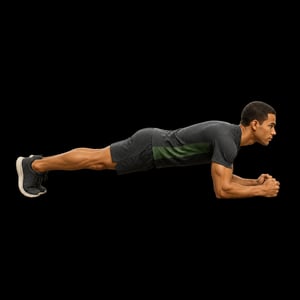
If you’re 60 or older, add the chair stand. Sit in a sturdy chair about 17 inches high, pushed against a wall, arms crossed, and count how many full stands you do in 30 seconds. A plank (forearms, body in one straight line, stop at the first sag) and an estimate from your best recent squat set are both optional. The test timer says the rules out loud and times the hang, balance, plank and chair stand for you.
What the numbers mean
Each test is scored on the same four steps, Building, Fair, Good and Strong, against the best table we could find for it.
The floor rise uses the groups from the 2025 study of 4,282 adults aged 46 to 75. A 10 is Strong, 8.5 to 9.5 Good, 8 Fair and 7.5 or less Building. Score yours.
Standing on one foot with your eyes closed uses a 2007 study of 549 healthy adults, tested barefoot with arms crossed and stopped at 45 seconds. Women and men did the same, and the average fell fast with age.
| Age | Average, eyes closed | Average, eyes open |
|---|---|---|
| 18 to 39 | 15.2 seconds | 44.7 seconds |
| 40 to 49 | 12.7 seconds | 41.9 seconds |
| 50 to 59 | 8.3 seconds | 41.2 seconds |
| 60 to 69 | 4.4 seconds | 32.1 seconds |
| 70 to 79 | 3.1 seconds | 21.5 seconds |
| 80 and up | 1.9 seconds | 9.4 seconds |
That gives the most fun line on the scorecard. Hold 5 seconds with your eyes closed and your balance holds like the average person in their 60s, whatever your age.
Grip uses US adults measured in 2011 to 2012, both hands added together. The middle (half are above, half below) peaks in the 30s.
| Age | Men, middle | Women, middle |
|---|---|---|
| 20 to 29 | 208 lb | 130 lb |
| 30 to 39 | 216 lb | 136 lb |
| 40 to 49 | 208 lb | 133 lb |
| 50 to 59 | 195 lb | 122 lb |
| 60 to 69 | 185 lb | 117 lb |
| 70 and up | 156 lb | 93 lb |
Above the middle is Good, and the top fifth for your age is Strong. What’s a good grip strength?
The dead hang has no published norm by age, so it uses Gyroscope’s training bands. Under 20 seconds is Building, 20 to 45 Fair, 45 to 60 Good, and over a minute Strong. The plank uses the same kind of bands: under 30 seconds, 30 to 60, 60 to 120, and over two minutes. Past two minutes, make it harder instead of longer. How long should I be able to dead hang?
Push-ups are scored on the published table for your age and sex in the scorecard, and men also see where they’d sit in the firefighter study. How many push-ups should I be able to do?
The chair stand uses the CDC’s cutoffs for people 60 and up. Under 12 stands for women and under 14 for men at 60 to 64, for example, is below average for that age, which the CDC counts as a fall risk.
A worked example
Say a 47-year-old woman scores 8.5 on the floor rise (one hand and a wobble coming up), holds 7 seconds on one foot with her eyes closed, hangs for 28 seconds, squeezes 128 lb with both hands and planks for 75 seconds.
| Test | Her result | Band | Her next number |
|---|---|---|---|
| Floor rise | 8.5 out of 10 | Good | One fewer touch takes her to 9.5 |
| One foot, eyes closed | 7 seconds | Building | 2 more seconds to Fair for her age |
| Dead hang | 28 seconds | Fair | 17 more seconds to Good |
| Grip | 128 lb, both hands | Fair | 5 lb more to Good |
| Plank | 75 seconds | Good | 45 more seconds to Strong |
Her balance holds like the average person in their 60s, and it’s her weak link. So for the next eight weeks she practices standing on one foot next to the counter every day, first with her eyes open and then closed, and adds single-leg Romanian deadlifts and step-ups to her two sessions. These are practice drills, not trial protocols.
Can a home test really tell you anything?
The sceptic says
These are crude. A floor, a bar and a phone timer aren’t a lab. One night of bad sleep and the numbers move.
The reply
They’re the tests the studies used. The floor rise, one-foot balance, push-ups and grip were measured just like this in studies of 1,104 to 139,691 people. Any one result has some noise, which is why the rules stay fixed and you test every eight weeks. We’d treat a change of a second or two as noise and a whole step on the scale as real.
Safety
Stop any test that hurts. Hang from a bar low enough to step down from. Do the balance test beside a counter or a wall you can catch. Keep the chair against a wall so it can’t slide. If you have heart disease or high blood pressure, ask your doctor before you test push-ups or a long hang.
9 sources
- Araujo CGS and others, Sitting-rising test scores predict natural and cardiovascular causes of deaths in middle-aged and older men and women, European Journal of Preventive Cardiology, 2025europepmc.org
- Sitting-rising test, scoring rules, Wikipediaen.wikipedia.org
- Springer BA and others, Normative values for the unipedal stance test with eyes open and closed, Journal of Geriatric Physical Therapy, 2007geriatrictoolkit.missouri.edu
- Perna FM and others, Muscular grip strength estimates of the US population from the National Health and Nutrition Examination Survey 2011-2012, Journal of Strength and Conditioning Research, 2016pmc.ncbi.nlm.nih.gov
- Gyroscope, the dead hang benchmarkgyrosco.pe
- Gyroscope, the plank benchmarkgyrosco.pe
- Centers for Disease Control and Prevention, STEADI 30-second chair stand testnj.gov
- Yang J and others, Association between push-up exercise capacity and future cardiovascular events among active adult men, JAMA Network Open, 2019pmc.ncbi.nlm.nih.gov
- Leong DP and others, Prognostic value of grip strength: findings from the PURE study, Lancet, 2015europepmc.org