Lifting weights will make you bulky
Short answerNo
On this page
No. Muscle grows slowly, over months and years, and the strength comes first. On the same program, women grow muscle by about the same share as men, from a much smaller start, so the same effort adds fewer pounds. Most people who lift get stronger and firmer long before they get any bigger.
What we’d do
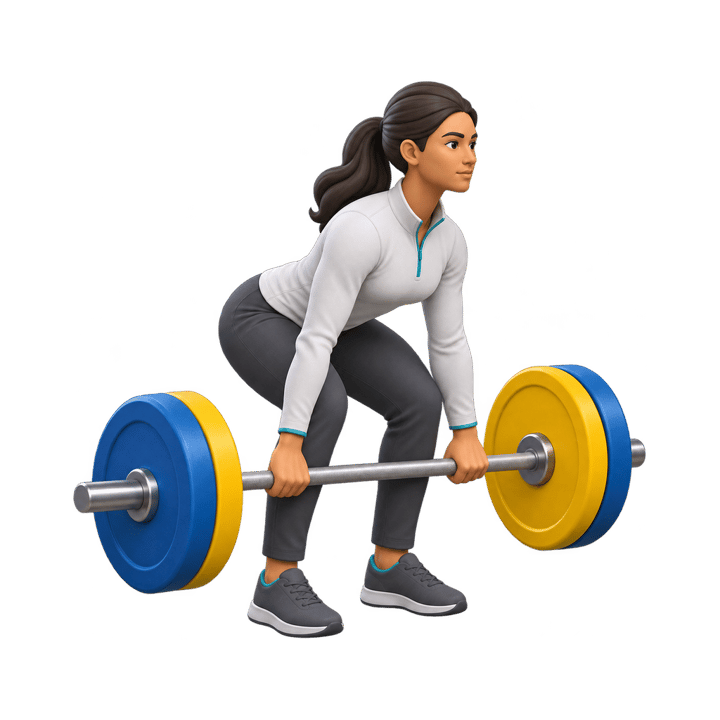
Lift heavy, the same program anyone would do, with the last two or three reps of each set hard. Light weights for endless reps don’t build a different kind of muscle. In 21 studies, light weights taken to failure grew about the same muscle as heavy weights, and less strength. If you ever feel you’re getting bigger than you want, eat a little less and keep lifting.
If you remember three things
- Women and men grow muscle by the same share on the same program, in a 2020 analysis of 10 studies.
- Women start with less. In 468 adults scanned with MRI, men averaged 33 kg of muscle and women 21 kg.
- Strength runs far ahead of size. Beginners got 39% stronger in five weeks while their thigh muscle grew 3.5 to 5.2% in the first three.
Why it seems true
The pictures do it. Search for weightlifting and you get bodybuilders on a stage, so lifting and huge muscles end up as the same idea. Some people also feel a little puffy and tight after their first sessions and take it as the start of bulk. For decades, women’s fitness was sold as light weights for “toning”, which made heavy weights sound like they’d do something different.
A picture from daily life
Jogging twice a week doesn’t turn anyone into a marathon runner by accident. Marathoners train for years, eat for it and plan everything around it.
Bodybuilders are the marathoners of lifting. Their size comes from years of training aimed at size and eating to grow. Two sessions a week at a normal diet puts you on a very different road.
What the studies found
In 2020 three researchers pooled the studies that put men and women on the same lifting programs. Muscle growth came out the same for both sexes, in 10 studies. Upper-body strength rose more in women, relative to where they started, in 17 studies, and lower-body strength about the same.
The difference is the starting point. In a study of 468 adults aged 18 to 88 scanned with MRI, men had 33 kg (73 lb) of skeletal muscle on average and women 21 kg (46 lb). The gap was 40% in the upper body and 33% in the lower.
The same share of growth means different amounts. If both grew their muscle by 5%, as an example, that’s about 1.7 kg (3.6 lb) spread over a man’s whole body and about 1 kg (2.3 lb) over a woman’s. That’s real, and you’d feel it, firmer arms and legs and easier stairs. It isn’t anyone’s idea of bulky.
Strength comes first
Most of the early change happens in your nervous system. In a 2007 study, seven young adults got 39% stronger in five weeks of leg training. Their thigh muscle had grown 3.5 to 5.2% by day 20. In a 2016 study, the muscle fibers of 10 young men had only grown measurably after 10 weeks of lifting. What strength is, and why it grows before muscle.
What “toned” means
Toned usually means two things at once, some muscle under the skin and not too much fat over it. Lifting handles the first part, and heavier weights do it better than lighter ones. Food handles the second. Muscle can’t turn into fat or fat into muscle, and bodyfat.guide covers why that looks like a swap and whether you can lose fat and gain muscle at the same time.
The bigger reason for women to lift
Bone. In the LIFTMOR trial, 101 women after menopause, around 65 and with low bone mass, lifted heavy twice a week for eight months, 5 sets of 5 at more than 85% of their max, plus jumping. Their spine density rose 2.9% while the home-exercise group lost 1.2%.
But I did look bigger
The objection
I started lifting and my clothes got tighter. So it does make you bigger.
What usually happened
Look at the food. Eating more than you burn adds fat whatever you do in the gym. Some people do build muscle easily, and if you’re one of them and want to stay the size you are, eat to maintain and keep lifting. You keep the strength and the bone, and the size stays put.
6 sources
- Roberts BM, Nuckols G and Krieger JW, Sex differences in resistance training: a systematic review and meta-analysis, Journal of Strength and Conditioning Research, 2020europepmc.org
- Janssen I and others, Skeletal muscle mass and distribution in 468 men and women aged 18-88 yr, Journal of Applied Physiology, 2000europepmc.org
- Seynnes OR and others, Early skeletal muscle hypertrophy and architectural changes in response to high-intensity resistance training, Journal of Applied Physiology, 2007europepmc.org
- Damas F and others, Resistance training-induced changes in integrated myofibrillar protein synthesis are related to hypertrophy only after attenuation of muscle damage, Journal of Physiology, 2016europepmc.org
- Schoenfeld BJ and others, Strength and hypertrophy adaptations between low- vs. high-load resistance training, Journal of Strength and Conditioning Research, 2017europepmc.org
- Watson SL and others, High-intensity resistance and impact training improves bone mineral density and physical function in postmenopausal women with osteopenia and osteoporosis: the LIFTMOR randomized controlled trial, Journal of Bone and Mineral Research, 2018europepmc.org