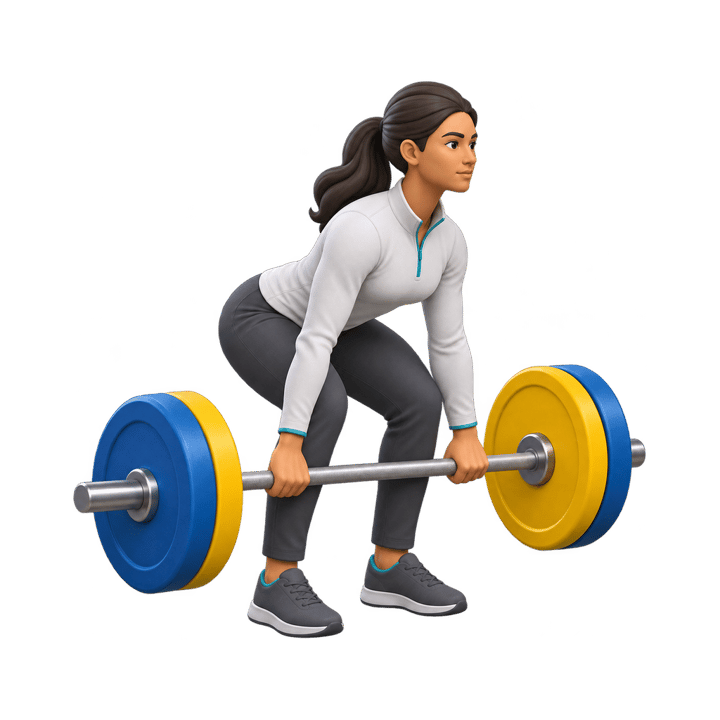
What should you eat to build muscle?
On this page
Lifting builds the muscle, and food lets it happen. Eat a little more than you burn, about 5 to 10% over, and get your protein into the typical range of 1.2 to 1.6 g per kg of bodyweight a day, spread over three or four meals. If you want one supplement, take 3 to 5 g of creatine a day. The rest of the supplement aisle adds very little.
Walk into any gym and you’ll hear two rules. Drink a protein shake within 30 minutes of every workout, and eat everything in sight, because you can’t grow without a huge bulk. Both stick because they’re effort you can buy or eat, and a bulk moves the scale fast. But in the trials, shake timing made no difference once people ate enough protein over the day, and a big surplus mostly added fat.
What we’d do
Lift two to four days a week first. Eat about 5 to 10% more than you burn and gain 0.25 to 0.5% of your weight a week, about half a pound to a pound at 180 pounds. Get your protein from food, a solid serving at every meal, with a shake when a meal falls short. Take 3 to 5 g of creatine monohydrate a day. We wouldn’t buy anything else.
If you’d rather skip the tubs entirely, you can. How to build muscle naturally, without supplements does it with lifting, ordinary food and sleep, with a whole day of meals at about 128 g of protein.
If you remember three things
- Lifting does the building. In 100 frail nursing home residents, a nutrition drink alone changed nothing in 10 weeks, and lifting raised strength 113%.
- A big surplus mostly adds fat. In trained lifters, eating 15% over maintenance built no more muscle than 5% over.
- Protein and creatine help a little. Extra protein stopped adding muscle past about 1.6 g per kg a day, and creatine adds a small strength gain.
A picture from daily life
Bricks dumped on an empty lot don’t build a house. Lifting is the crew, and food is the bricks plus the crew’s lunch. Once the crew has every brick it can lay in a day, a second truck just leaves a pile in the yard, and on you that pile is fat.
How big a surplus
Muscle can only grow so fast, so it can only use so much food. In 2023, Eric Helms and his team split 21 lifters into three groups for eight weeks of lifting three days a week, eating at maintenance, 5% over or 15% over. Muscle grew about the same in all three groups, and the people who gained the most weight gained the most fat. Only 17 finished, since the pandemic cut it short. The researchers recommend gaining 0.25 to 0.5% of your weight a week, slower the longer you’ve lifted, and so does a 2019 review of bodybuilders’ diets.
A lean bulk keeps to that small surplus. A dirty bulk, eating whatever you want, moves the scale faster, and most of the extra is fat you’ll diet off later. bodyfat.guide covers how big a surplus to eat.
A diet works the other way round. It costs some muscle along with the fat, and lifting, with enough protein, is what holds on to it. In six trials of older adults with obesity, lifting three times a week during a 12 to 24 week diet prevented 93.5% of the lean mass the diet cost on its own. New lifters can often gain muscle while they lose fat, and bodyfat.guide explains when that works.
How much protein
Typical is 1.2 to 1.6 g per kg of bodyweight a day, and under 1.2 is too low for most people who lift. Lean people lifting hard can use 2.3 to 3.1 g per kg of lean mass. The Gyroscope app personalizes yours.
| Your weight | Typical protein a day | At each of three meals |
|---|---|---|
| 130 lb (59 kg) | 70 to 95 g | 25 to 30 g |
| 150 lb (68 kg) | 80 to 110 g | 25 to 35 g |
| 180 lb (82 kg) | 100 to 130 g | 35 to 45 g |
| 220 lb (100 kg) | 120 to 160 g | 40 to 55 g |
The top of that range comes from Robert Morton’s 2018 analysis of 49 trials with 1,863 people, all lifting for six weeks or more. Extra protein added an average of 5.5 lb (2.49 kg) to their one-rep max and 0.7 lb (0.30 kg) of lean mass, and the lean mass stopped rising past about 1.6 g per kg a day. The uncertainty around that point ran from about 1.0 to 2.2 g, so some people need more. The gym rule of a gram per pound is 2.2 g per kg, at the far end of that. protein.guide covers how much you need, and the short answer here is how much protein you need to build muscle.
Per meal, after workouts and before bed
Spread it over three to six meals, about 0.4 to 0.55 g per kg each, says the 2019 review. protein.guide covers protein per meal.
The old idea that your body can only use about 30 g at once took a hit in 2023. Jorn Trommelen’s team gave 36 young men nothing, 25 g or 100 g of milk protein after an hour of whole-body lifting. The 100 g dose built more muscle protein than 25 g, and the response lasted more than 12 hours. It was one session, but it suggests the protein in a big dinner gets used too, just more slowly.
The 30-minute window didn’t hold up either. In 2013, Brad Schoenfeld’s team pooled 23 trials of protein timing. Once they counted how much protein people ate in total, timing made no difference, and the daily total predicted growth best.
In a 2015 trial, 44 young men lifted for 12 weeks, and the half who drank 27.5 g of protein every night before bed gained more strength and thigh muscle than the placebo group. But they also ate 27.5 g more protein a day. In a smaller 2018 trial with the daily total matched, casein in the day did as well as casein at night. Bedtime is a good slot for extra protein.
Plant protein
Plants build muscle too, with enough protein. In a 2021 trial, 19 young men who were already vegan and 19 who ate meat lifted twice a week for 12 weeks, all brought up to 1.6 g of protein per kg a day with soy powder for the vegans and whey for the rest. They gained the same leg muscle and leg press strength. They were untrained, and the vegans leaned partly on soy. protein.guide covers plant protein.
Carbs around training
Carbs fuel hard sets, but extra carbs did less than expected. A 2022 review of 49 studies found more carbs didn’t improve lifting in people who’d eaten, for workouts up to about 10 sets per muscle, though they helped in some longer or fasted sessions. A 2026 analysis of 11 trials found more carbs, with protein the same, didn’t add measurable muscle, though that evidence is thin. Eat carbs around training if they help you feel strong, and don’t force extra.
Creatine
Creatine is the one supplement with a long record for muscle. Your muscles store it as phosphocreatine, a quick energy reserve for short, hard efforts, and a supplement raises those stores by about 20 to 40%. Cyril Lanhers and his team pooled the placebo trials twice, 60 for the legs in 2015 and 53 for the upper body in 2017. Both times, creatine added a small extra strength gain on top of training, whatever people’s age, sex or dose.
The International Society of Sports Nutrition says 3 to 5 g a day keeps your stores full, and 3 g a day fills them in about four weeks. Its 2017 review found doses up to 30 g a day for five years safe in healthy people. A pound of raw beef or salmon has about 1 to 2 g, so one 5 g scoop is the creatine in 2.5 to 5 pounds of meat. If you have kidney disease, ask your doctor first. creatine.guide covers what it does and how much to take, and the short answer here is does creatine make you stronger.
The supplements that don’t do much
BCAAs are three of the amino acids in protein, sold on their own. In a 2017 trial, 10 trained young men drank 5.6 g after lifting, and muscle building rose 22% over a placebo. That’s about half the response earlier trials got from 20 g of whey with the same BCAAs, so the protein you already eat does more.
HMB, a breakdown product of leucine, did nothing measurable for strength or lean mass across six trials of 193 trained athletes. And when researchers looked at 50 testosterone boosters in 2020, 90% claimed to raise testosterone, only about a quarter had data behind that, and 13 went over the safe upper limit for zinc, vitamin B3 or magnesium.
18 sources
- Fiatarone MA and others, Exercise training and nutritional supplementation for physical frailty in very elderly people, New England Journal of Medicine, 1994europepmc.org
- Helms ER and others, Effect of small and large energy surpluses on strength, muscle, and skinfold thickness in resistance-trained individuals: a parallel groups design, Sports Medicine Open, 2023pmc.ncbi.nlm.nih.gov
- Iraki J and others, Nutrition recommendations for bodybuilders in the off-season: a narrative review, Sports, 2019europepmc.org
- Sardeli AV and others, Resistance training prevents muscle loss induced by caloric restriction in obese elderly individuals, Nutrients, 2018pmc.ncbi.nlm.nih.gov
- Morton RW and others, A systematic review, meta-analysis and meta-regression of the effect of protein supplementation on resistance training-induced gains in muscle mass and strength in healthy adults, British Journal of Sports Medicine, 2018pmc.ncbi.nlm.nih.gov
- Trommelen J and others, The anabolic response to protein ingestion during recovery from exercise has no upper limit in magnitude and duration in vivo in humans, Cell Reports Medicine, 2023pmc.ncbi.nlm.nih.gov
- Schoenfeld BJ, Aragon AA and Krieger JW, The effect of protein timing on muscle strength and hypertrophy: a meta-analysis, Journal of the International Society of Sports Nutrition, 2013pmc.ncbi.nlm.nih.gov
- Snijders T and others, Protein ingestion before sleep increases muscle mass and strength gains during prolonged resistance-type exercise training in healthy young men, Journal of Nutrition, 2015europepmc.org
- Joy JM and others, Daytime and nighttime casein supplements similarly increase muscle size and strength in response to resistance training earlier in the day: a preliminary investigation, Journal of the International Society of Sports Nutrition, 2018pmc.ncbi.nlm.nih.gov
- Hevia-Larrain V and others, High-protein plant-based diet versus a protein-matched omnivorous diet to support resistance training adaptations: a comparison between habitual vegans and omnivores, Sports Medicine, 2021europepmc.org
- Henselmans M and others, The effect of carbohydrate intake on strength and resistance training performance: a systematic review, Nutrients, 2022pmc.ncbi.nlm.nih.gov
- Henselmans M, Varvik FT and Izquierdo M, The effect of carbohydrate intake on muscle hypertrophy: a systematic review and meta-analysis, Sports Medicine, 2026pmc.ncbi.nlm.nih.gov
- Lanhers C and others, Creatine supplementation and lower limb strength performance, Sports Medicine, 2015europepmc.org
- Lanhers C and others, Creatine supplementation and upper limb strength performance, Sports Medicine, 2017europepmc.org
- Kreider RB and others, International Society of Sports Nutrition position stand: safety and efficacy of creatine supplementation in exercise, sport, and medicine, Journal of the International Society of Sports Nutrition, 2017europepmc.org
- Jackman SR and others, Branched-chain amino acid ingestion stimulates muscle myofibrillar protein synthesis following resistance exercise in humans, Frontiers in Physiology, 2017pmc.ncbi.nlm.nih.gov
- Sanchez-Martinez J and others, Effects of beta-hydroxy-beta-methylbutyrate supplementation on strength and body composition in trained and competitive athletes: a meta-analysis of randomized controlled trials, Journal of Science and Medicine in Sport, 2018europepmc.org
- Clemesha CG, Thaker H and Samplaski MK, Testosterone boosting supplements composition and claims are not supported by the academic literature, World Journal of Men's Health, 2020pmc.ncbi.nlm.nih.gov