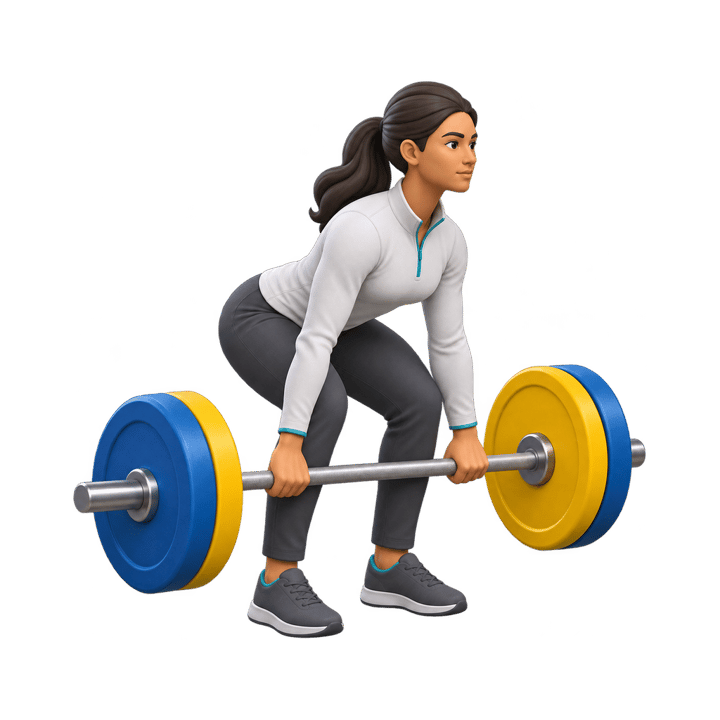
What is strength, and why does it grow before muscle?
On this page
Strength is how much force your muscles can make, and it isn’t the same thing as size or endurance. In the first few weeks of lifting, most of what you gain is your nerves learning to fire more of the muscle you already have. Growth takes over after about three to five weeks.
Most people think stronger means bigger, so they look in the mirror for proof. After three weeks they see the same arms and decide it isn’t working, right when the weights they lift have already gone up. Others think lots of light reps build strength, because the burn feels like work. Both mix up three different things.
What we’d do
Judge the first two months by the weights in your log, never the mirror. Lift heavy enough for strength, which on the big lifts means a weight you can move about 5 to 10 times, stopping two or three reps short. And practice the exact lifts and tests you want to be strong at, since part of strength is a skill your nervous system learns.
If you remember three things
- Strength comes before size. Seven young adults got 39% stronger in 35 days, and their thigh muscle had grown only 3.5 to 5.2% by day 20.
- Heavy weights build more strength. Across 21 studies, light and heavy loads grew muscle about the same, and heavy loads raised one-rep max more.
- Your brain is part of the muscle. Training one arm made the other arm about 8% stronger, and imagining hard contractions raised strength 22%.
Three different things
People use strong, big and fit as if they meant the same thing. They don’t, and they’re built in different ways.
| What it is | How you’d test it | What builds it best | |
|---|---|---|---|
| Strength | The most force you can make, once or a few times | A heavy lift for 1 to 5 reps, the floor rise, grip | Heavy loads, about 80% of your max or more, 2 to 3 sets |
| Size | How much muscle you have | A tape measure or a scan | 10 or more hard sets per muscle a week, light or heavy |
| Endurance | How long or how many times you can keep going | Push-ups in one go, a plank, a dead hang | Practicing the test itself, with lighter loads and longer sets |
| Power | Force made fast | A jump, standing up quickly | Moderate loads (30 to 70% of max) moved fast |
The 2026 American College of Sports Medicine review of 137 reviews and more than 30,000 people found strength rose most with heavy loads and 2 to 3 sets, size with 10 or more sets a week, and power with moderate loads moved fast. The four overlap a lot, but a program built for one doesn’t give you the most of the others.
A picture from daily life
Picture a choir on its first night. Half the singers are only mouthing the words, and the ones who sing aren’t in time. A few weeks of practice and everyone sings, together, and the hall gets much louder with the same people in it. Only after months does each voice get bigger.
Your muscle is the choir. The first weeks of lifting get more of your fibers working at once and in time. Bigger fibers come later.
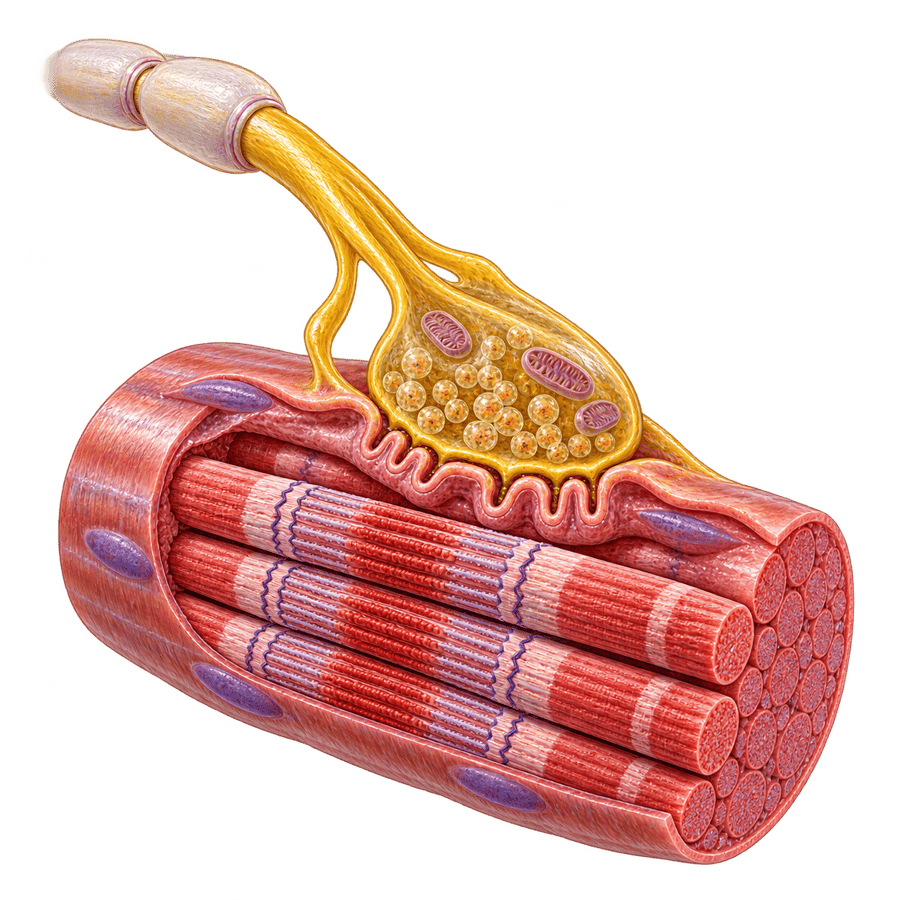
Why do nerves come first?
Every muscle is run by nerve cells in your spinal cord, and each one switches on its own bundle of fibers. When you’re new to a lift you can’t switch them all on hard, at the same moment, in the right order. Training teaches your nervous system to do that.
In 1979 two researchers, Toshio Moritani and Herbert deVries, trained 15 young men and women for eight weeks and measured both the electrical signal to the muscle and its size. Nerve changes explained most of the early gain, and muscle growth became the main driver after the first 3 to 5 weeks. In 2007 researchers trained seven young adults on a leg machine three times a week. In 35 days their strength rose 39% and the electrical activity in the muscle rose 35%. The muscle had grown too, but only by 3.5 to 5.2% at day 20, the first time it could be measured.
Two stranger experiments show how much of this happens in the nervous system.
- Training one side strengthens the other. In a 2004 pooled analysis of 13 trials, people who trained only one arm or leg got 7.8% stronger in the limb they never trained, about a third of the gain on the trained side.
- Imagining it counts a little. In 1992 researchers had people train a small hand muscle for four weeks. The group who pushed for real got 30% stronger. The group who only imagined pushing as hard as they could, without moving, got 22% stronger. The group who did nothing gained 3.7%.
Don’t swap your workouts for daydreams. It was a single finger muscle, and the real thing still won. But it shows that a big part of early strength is your brain getting better at using what’s there.
Then the muscle grows
The nerve gains slow down after the first month or two, and from then on more strength mostly needs more muscle. In a 2016 study, 10 young men lifted for 10 weeks while researchers took small samples of their thigh muscle. The fibers had only grown measurably by week 10, and the muscle building in week one, while the muscle was sorest and most damaged, didn’t predict who grew.
Over years the gains slow down a lot. In the records of 14,690 adults (60% women, average age 48) who lifted once a week at one company, strength rose about 30 to 50% in the first year and was about 50 to 60% above where they started after six years, with little change after the first one or two.
Heavy or light?
Both build muscle, but heavy builds more strength. A 2017 pooled analysis of 21 studies compared light loads (60% of max or less) and heavy loads, with every set taken to failure. Muscle grew about the same. One-rep max rose more with heavy loads. Strength measured a different way, pushing against something that doesn’t move, rose about the same in both.
That last detail says something useful. Heavy lifting made people better at heavy lifting in particular. Strength is partly a skill tied to the movement, which is why your squat can jump in a month while your legs look the same.
The best case against it
The sceptic says
If it’s mostly nerves, early strength is fake. You’ve learned a trick for one machine, not built anything real.
The reply
The force is real. Your muscles really do lift more, carry more and get you off the floor easier. The 2007 study saw muscle growth by day 20, so building starts early too. And in older adults, strength falls about three times faster than muscle (1,880 people in their 70s), so learning to use the muscle you have is a big part of staying strong.
More detail: why strength and muscle part ways with age
In the Health, Aging and Body Composition Study, 1,880 people in their 70s were measured for three years. Leg strength fell 2.6 to 4.1% a year, about three times the loss of leg muscle, and people who gained muscle didn’t hold on to their strength because of it. The researchers put the gap down to a loss of muscle quality, how much force each pound of muscle makes. It’s the same split as in a beginner, running the other way. Getting older has what training does about it.
9 sources
- Moritani T and deVries HA, Neural factors versus hypertrophy in the time course of muscle strength gain, American Journal of Physical Medicine, 1979europepmc.org
- Seynnes OR and others, Early skeletal muscle hypertrophy and architectural changes in response to high-intensity resistance training, Journal of Applied Physiology, 2007europepmc.org
- Yue G and Cole KJ, Strength increases from the motor program: comparison of training with maximal voluntary and imagined muscle contractions, Journal of Neurophysiology, 1992europepmc.org
- Munn J, Herbert RD and Gandevia SC, Contralateral effects of unilateral resistance training: a meta-analysis, Journal of Applied Physiology, 2004europepmc.org
- Schoenfeld BJ and others, Strength and hypertrophy adaptations between low- vs. high-load resistance training, Journal of Strength and Conditioning Research, 2017europepmc.org
- Currier BS and others, ACSM position stand: resistance training prescription for muscle function, hypertrophy, and physical performance in healthy adults, Medicine and Science in Sports and Exercise, 2026pmc.ncbi.nlm.nih.gov
- Damas F and others, Resistance training-induced changes in integrated myofibrillar protein synthesis are related to hypertrophy only after attenuation of muscle damage, Journal of Physiology, 2016europepmc.org
- Steele J and others, Long-term time-course of strength adaptation to minimal dose resistance training, Research Quarterly for Exercise and Sport, 2023europepmc.org
- Goodpaster BH and others, The loss of skeletal muscle strength, mass, and quality in older adults: the Health, Aging and Body Composition Study, Journals of Gerontology, 2006europepmc.org