How to build a strong grip and forearms
On this page
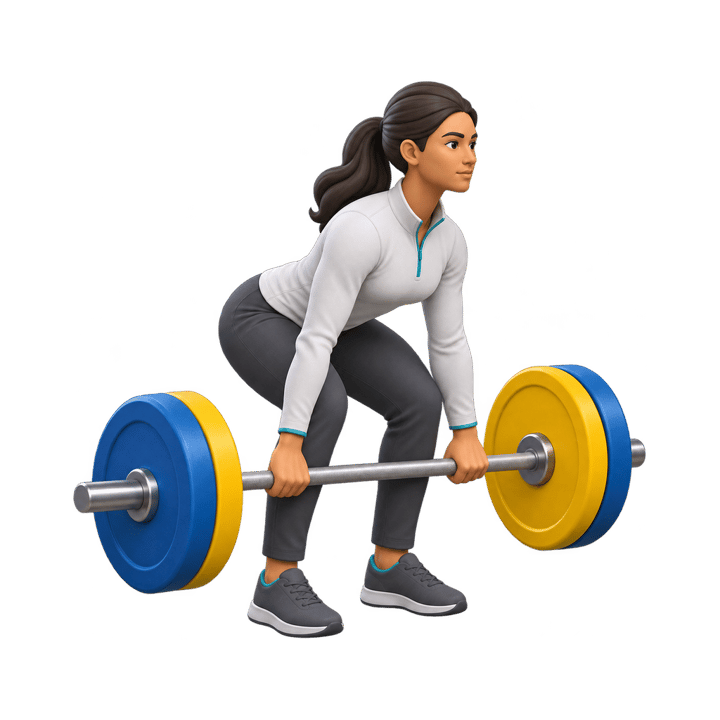
Your grip is the handshake between you and everything you carry, from a jar lid to a suitcase, and the muscles that close your fingers sit in your forearm. Build it with heavy carries, dead hangs and the rows and deadlifts you already do, holding the weight without straps. Add wrist curls if your forearms lag, two or three times a week.
Grip strength became a longevity headline after a huge study in 2015, and a hand gripper costs a few dollars, so plenty of people squeeze one on the couch and call it training. Grip does predict how long people live, but mostly because a strong hand comes attached to a strong body. Other people make the opposite mistake. They never train their grip on purpose, wear straps for every heavy pull, and find out their hands are the weak link the day they carry a sofa.
What your forearms do
Your fingers have no muscles in them. The ones that bend them are in your forearm, two long flexors on the palm side, and they pull on tendons that run through your wrist to your finger bones. The deep one attaches to the tip of each finger and the other to the middle bone. Make a fist and grab your forearm near the elbow with the other hand, and you’ll feel them working. Another set of muscles on the back of your forearm straightens your fingers and pulls your wrist back, and small muscles in your palm handle the fine control.
In a 2007 MRI study of all 32 arm muscles in 10 young adults, the muscles crossing the wrist were 16% of the arm’s muscle. The closing side had more than twice as much as the opening side (11% against 5%), and the deep finger flexor was the biggest muscle crossing the wrist.
You use it for opening a stuck jar, carrying grocery bags from the car in one trip, holding a toddler’s hand in a parking lot, gripping a rail when you slip on the stairs, wringing out a towel and hauling a suitcase off the luggage belt. Every heavy row, deadlift and carry in your program has to go through your hands first. If your grip gives out, the set ends there, however strong your back and legs are.
Why you want a strong grip
Grip went with a longer life in 17 countries. The PURE study measured the grip of 139,691 adults aged 35 to 70, in rich, middle-income and poor countries, with a hand gauge. Over a median of four years, 3,379 of them died. Every 5 kg (11 lb) less grip went with a 16% higher risk of death from any cause and 17% from heart disease, and grip predicted death from any cause and from heart disease better than systolic blood pressure (the top number) did. It didn’t predict diabetes, falls that caused injury or fractures.
But a 2019 review found grip works mostly as a summary of the whole person, going with overall strength, bone density, nutrition, memory, mood and sleep. Nobody has trained grip on its own and shown it adds years, so we’d train the whole body, hands included (more on the grip myth).
It fades with age, and slowly. In the US national health survey, the best squeeze of each hand added together peaked in the 30s, at a middle of about 216 lb for men and 136 lb for women. At 70 and up, the middle was about 156 lb and 93 lb, roughly 30% lower. Find your own row in what’s a good grip strength for my age.
What we’d do
End two or three sessions a week with a heavy carry, a dumbbell or kettlebell in each hand for 2 to 3 walks of 30 to 60 seconds. Hang from a bar for 10 to 30 seconds on most days, building toward 45 to 60. Hold your rows and deadlifts without straps for as long as your hands keep up. If your forearms still lag, add 2 sets each of wrist curls and reverse wrist curls.
The best grip and forearm exercises
| Exercise | Where | How | Sets and reps |
|---|---|---|---|
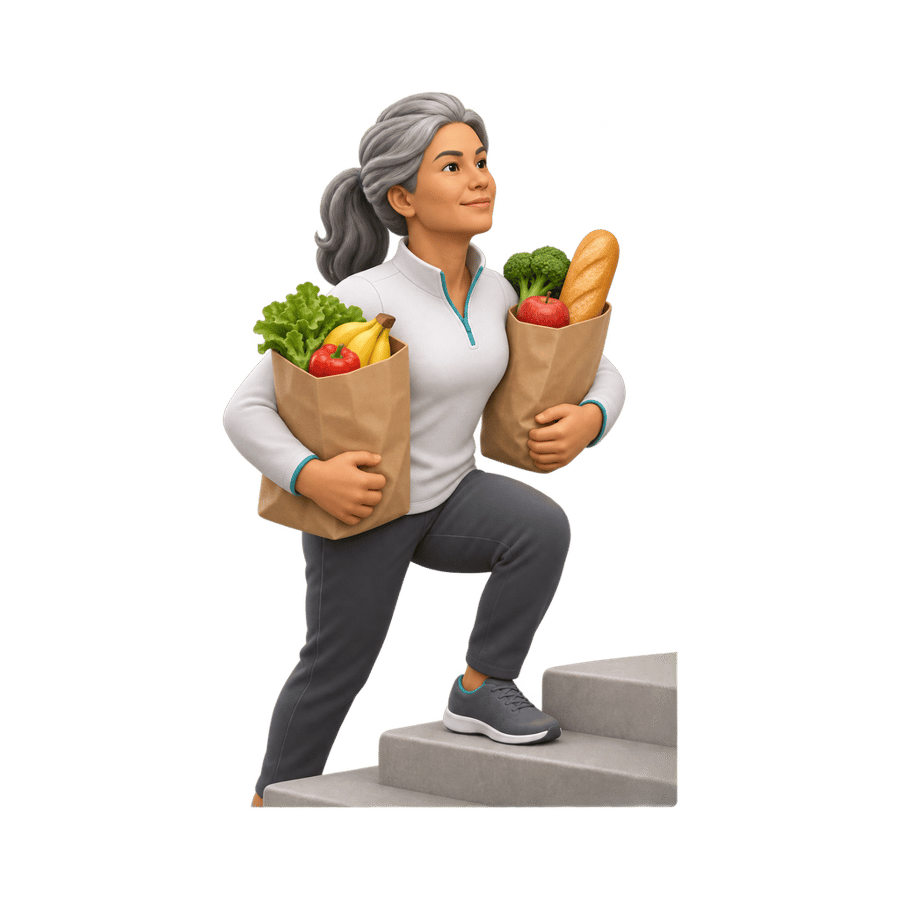
| Farmer carry | Anywhere | A heavy dumbbell, kettlebell or full grocery bag in each hand. Stand tall and walk without letting your shoulders slump | 2 to 3 walks of 30 to 60 seconds |
| Suitcase carry | Anywhere | The same with a weight in one hand only, keeping your body upright | 2 walks of 30 to 45 seconds a side |
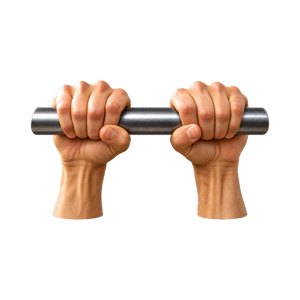
| Dead hang | Home bar or gym | Hang from a bar with straight arms, feet off the floor | 3 hangs of 10 to 30 seconds |
| Wrist curl | Home or gym | Forearms resting on your thighs, palms up, curl a dumbbell up using only your wrist | 2 to 3 sets of 12 to 20 |
| Reverse wrist curl | Home or gym | The same with palms down, a lighter weight | 2 sets of 15 to 20 |
| Hammer or reverse curl | Home or gym | Curl with palms facing in, or facing down, for the muscle along the top of your forearm | 2 to 3 sets of 10 to 15 |
| Plate pinch | Gym | Pinch two smooth weight plates together between your fingers and thumb and hold | 3 holds of 15 to 30 seconds |
Sets, reps and how often
Grip work is small moves. Hammer and reverse curls get 10 to 15 reps, and wrist curls get 12 to 20 since they move a short way, with 1 to 2 minutes of rest, and every set ends 1 to 3 reps short of failure. Carries and hangs go by time. Put them at the end of the session, since a tired grip spoils your rows and deadlifts.
Your forearms already get a lot of work from every row, pull-up and deadlift. Two full-body days a week give most people 4 to 6 hard sets for each muscle, which builds strength and some size. The 2026 American College of Sports Medicine review found 10 or more hard sets a week built the most muscle, with gains flattening around 18 to 20. When a carry feels easy for a full minute, go up to the next dumbbell (about 5 to 10 lb, or 2.5 to 5 kg). With hangs, add seconds. On Gyroscope’s training bands, a hang of 45 to 60 seconds is Good, and over a minute is the top band. How long should I be able to dead hang?
Common mistakes
- A gripper instead of training. A spring gripper trains one kind of squeeze. Carries, hangs and heavy rows train your grip the way you use it, along with the rest of you.
- Straps on every set. Straps help on the heaviest pulls once your back is stronger than your hands. Use them on your top sets only, and hold the bar yourself for the rest.
- Only the closing side. Your forearm already has twice as much muscle for closing as for opening. A couple of sets of reverse wrist curls give the other side some work.
- Hanging on cold shoulders. Warm up with a few rows or arm circles first, and step down before your grip gives out completely.
- Pushing through elbow pain. New pain on the inside or outside of the elbow is a sign to back off the forearm work. Pain that lasts more than a couple of weeks, or numbness and tingling in your fingers, goes to a doctor or physical therapist.
A picture from daily life
Think about a puppet on strings. The puppet’s arms have no motors in them. The strings run up to the puppeteer’s hands, and when he pulls one, the arm moves. Your fingers work the same way. They have no muscles of their own, the tendons are the strings, and the muscles in your forearm are the puppeteer.
The science: what a grip number measures
A squeeze on a hand gauge is your single hardest effort, and it’s quick and cheap, which is why the big studies use it. The author of the 2019 review called grip an “indispensable biomarker” for older adults, meaning a quick measurement that says a lot about the rest of a person’s health. He also wrote that grip doesn’t always reflect overall strength and works better alongside a test of leg strength. A dead hang is a different test, of how long you can hold your own bodyweight, and nobody has published adult hang times by age. Both are good for tracking your own progress if you test the same way every couple of months.
7 sources
- Finger, Wikipediaen.wikipedia.org
- Holzbaur KR, Murray WM, Gold GE and Delp SL, Upper limb muscle volumes in adult subjects, Journal of Biomechanics, 2007mobl.wordpress.ncsu.edu
- Leong DP and others, Prognostic value of grip strength: findings from the Prospective Urban Rural Epidemiology (PURE) study, Lancet, 2015europepmc.org
- Perna FM and others, Muscular grip strength estimates of the US population from the National Health and Nutrition Examination Survey 2011-2012, Journal of Strength and Conditioning Research, 2016pmc.ncbi.nlm.nih.gov
- Bohannon RW, Grip strength: an indispensable biomarker for older adults, Clinical Interventions in Aging, 2019pmc.ncbi.nlm.nih.gov
- Gyroscope, Grip strength and dead hang benchmark, practical bandsgyrosco.pe
- Currier BS and others, ACSM position stand: resistance training prescription for muscle function, hypertrophy, and physical performance in healthy adults, Medicine and Science in Sports and Exercise, 2026pmc.ncbi.nlm.nih.gov