How to build a strong core
On this page
Your core is the ring of muscle around your middle, and its main job is to hold your trunk still while your arms and legs do the work, when you carry groceries, lift a box or swing a bat. Train it that way, with planks, side planks, dead bugs, carries and Pallof presses, two or three times a week after your main lifts.
Most people think core training means crunches, and that enough of them will flatten a belly and bring out a six-pack. Crunches do work the front ab muscle, but they don’t burn the fat sitting on top of it. In a 2011 study, 24 adults did seven ab exercises five days a week for six weeks, and their belly fat and waist size didn’t change (you can’t pick where fat comes off, see spot reduction). The bigger miss is that your core spends most of its day stopping movement, and crunches only train it to make movement.
What your core does
At the front of your core is the rectus abdominis, a long flat muscle on each side of your midline. Tendon bands cross it and split it into the blocks people call a six-pack, and it bends your spine forward, the way a crunch does. Around your sides sit three layers. The external oblique is on the outside, the internal oblique under it runs at right angles to it, and the transversus abdominis sits deepest, its fibers running straight across your body like a belt. At the back, the spinal erectors close the ring (they get their own page, the lower back), and your glutes anchor it at the bottom.
The obliques turn and bend your trunk, and the deep layer pulls your middle in tight. The transversus has the nickname the corset muscle. But most of the day, all these muscles work to keep your trunk from moving. When you carry a heavy bag in one hand, your core stops you from tipping toward it. When you pick a child up off the floor, it holds your back in one firm piece while your hips and legs do the lifting.
Why you want a strong core
It lends strength to the rest of you. In 2009, Stuart McGill and his colleagues measured the trunk muscles during strongman events, from the farmer’s walk to the suitcase carry and the yoke walk, where you carry a heavy frame across your shoulders. In the yoke walk, the hips needed more sideways strength than they had. A deep back muscle called the quadratus lumborum made up the difference by bracing the trunk. The team wrote that “the stiffened torso acts as a source of strength”, and they found that loaded carries trained something the lifts didn’t.
It keeps you steady as you get older. A 2013 review pulled together 20 studies of trunk strength in older adults. People with stronger trunk muscles tended to have better balance, better everyday function and fewer falls. In the training studies, core work raised trunk strength by about 30% on average, and balance and function by about 23%. Most of those trials were small and scored low on quality, so the exact numbers are rough.
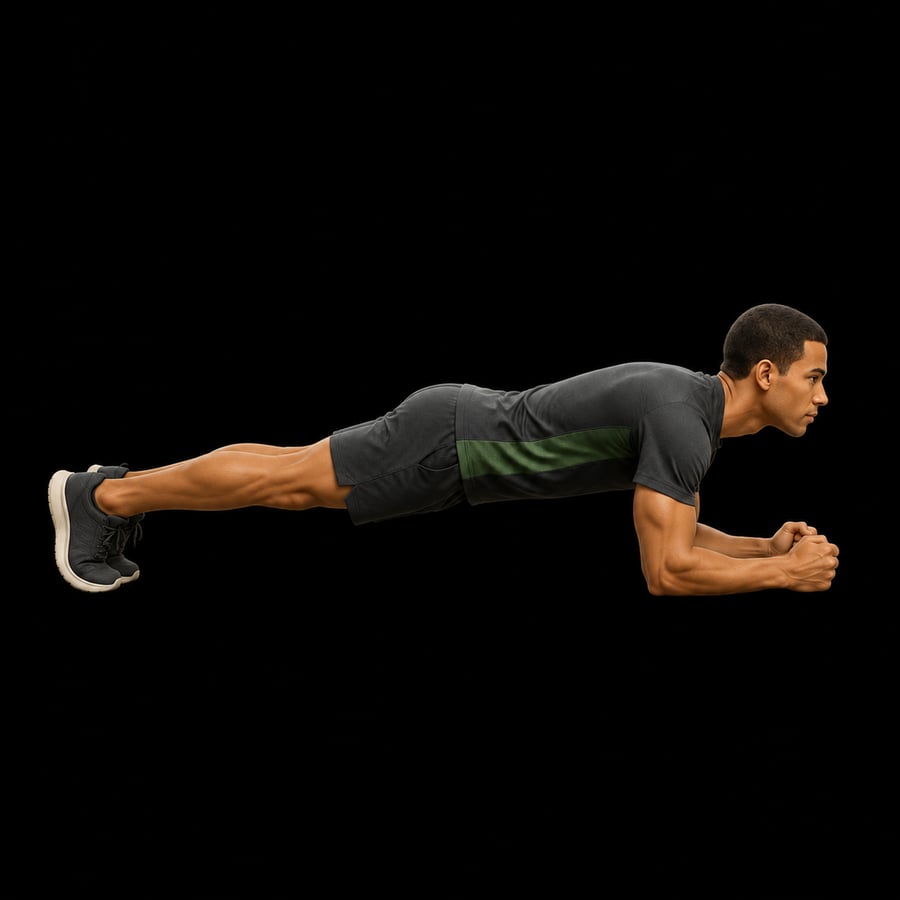
You can test it in two minutes. In 2014, 471 college students held a forearm plank for as long as they could. Men averaged 124 seconds and women 83. Only about 1 in 5 stopped because their abs gave out, and most quit when their arms or legs had had enough. Here’s how long you should be able to plank.
What we’d do
Pick two core moves for each session and do them after your main lifts. One should stop your trunk from bending (a plank, a dead bug or a hanging knee raise) and one should stop it from bending sideways or twisting (a side plank, a Pallof press or a one-hand carry). Do 2 to 3 sets of each. Hold a plank in a straight line from your head to your heels and stop at the first sag. Once you can hold one for two minutes, stop adding time and lift a foot or an arm instead.
The best core exercises
| Exercise | Where | How | Sets and reps |
|---|---|---|---|
| Plank | Home | Forearms under your shoulders, a straight line from head to heels, glutes squeezed. Stop at the first sag | 2 to 3 holds of 20 to 60 seconds |
| Side plank | Home | On one forearm with your feet stacked and your hips high, your body in one flat line | 2 to 3 holds of 15 to 45 seconds a side |
| Dead bug | Home | On your back, arms up, knees over your hips. Lower the opposite arm and leg slowly while your lower back stays pressed into the floor | 2 to 3 sets of 6 to 10 a side |
| Farmer’s or suitcase carry | Home or gym | Walk tall with a heavy dumbbell or kettlebell in each hand, or in one hand for the suitcase carry, without leaning | 3 walks of 30 to 40 steps (each side for one hand) |
| Pallof press | Gym, or a band at home | Stand side-on to a cable or band at chest height. Push the handle straight out from your chest and hold it there without letting it turn you | 2 to 3 sets of 8 to 12 a side |
| Hanging knee raise | Pull-up bar | Hang still, then curl your pelvis up to bring your knees toward your chest. Lower slowly without swinging | 2 to 3 sets of 6 to 12 |
| Ab wheel rollout | Home or gym | From your knees, roll forward as far as you can without your lower back sagging, then pull back | 2 to 3 sets of 5 to 10 |
Sets, reps and how often
Squats, deadlifts, overhead presses and carries all make your core hold your spine still under a load. On top of them, 4 to 6 hard sets of direct core work a week, spread over your two or three sessions, is enough for most people. Rest about a minute between sets.
For holds, add 5 to 10 seconds a week. For moves with reps, add a rep or two until you reach the top of the range, then move to a harder version. If you want a bigger six-pack muscle, train it like any other muscle, with a weighted move like a cable crunch for 10 to 15 reps, each set ending 1 to 3 reps short of failure. The 2026 American College of Sports Medicine review found muscles grew most with 10 or more hard sets a week. Seeing it is a separate job, and that comes down to your bodyfat.
Common mistakes
- Hundreds of crunches for a flat stomach. They build endurance in one muscle and do nothing for the fat over it.
- Sagging or piking in a plank. When your hips drop, your lower back hangs on the joints instead of your abs holding it up. When they pike up, the plank gets easy. Squeeze your glutes and end the set when the line goes.
- Holding your breath the whole set. Brace your middle as if someone’s about to poke your stomach, then keep breathing behind the brace.
- Only training the front. The six-pack muscle is one part of the ring. Side planks, carries and back work cover the rest.
- Swinging on the bar. In a hanging knee raise, a swing lets momentum do the work. Start from a still hang and lower slowly.
A picture from daily life
Think about a tent pole held up by guy ropes. The pole can’t stand on its own, but with ropes pulling evenly from every side, it stays upright in a strong wind. Your spine is the pole, and the muscles of your core are the ropes. When they all pull together, your spine can take a load from any direction. If one rope goes slack, the others pull the pole over, and that’s why side planks and carries belong in your week next to the plank.
The science: your deepest ab muscle fires first
In 1997, two researchers, Paul Hodges and Carolyn Richardson, put fine wire sensors into the deep ab muscles of 15 people, with more on the shoulder. Each person stood and lifted one arm as fast as they could the moment they saw a cue, forward, out to the side or back. Whichever way the arm went, the transversus abdominis switched on before the shoulder muscle did.
Your brain braces your middle before it moves your arm, since a spine with no muscle around it can’t hold itself steady. A year earlier, the same pair had tested 15 people with low back pain against 15 people without it. In the people with back pain, that early brace came late on every movement. Both were small lab studies about timing, and nobody has shown whether the delay causes back pain or comes from it. They do show the deep core switching on as a brace before you move, and that’s the job planks, carries and Pallof presses train.
11 sources
- Rectus abdominis muscle, Wikipediaen.wikipedia.org
- Abdominal wall, Wikipediaen.wikipedia.org
- Abdominal internal oblique muscle, Wikipediaen.wikipedia.org
- Transverse abdominal muscle, Wikipediaen.wikipedia.org
- Vispute SS and others, The effect of abdominal exercise on abdominal fat, Journal of Strength and Conditioning Research, 2011europepmc.org
- Strand SL and others, Norms for an isometric muscle endurance test, Journal of Human Kinetics, 2014pmc.ncbi.nlm.nih.gov
- McGill SM, McDermott A and Fenwick CM, Comparison of different strongman events: trunk muscle activation and lumbar spine motion, load, and stiffness, Journal of Strength and Conditioning Research, 2009europepmc.org
- Granacher U and others, The importance of trunk muscle strength for balance, functional performance, and fall prevention in seniors: a systematic review, Sports Medicine, 2013europepmc.org
- Hodges PW and Richardson CA, Feedforward contraction of transversus abdominis is not influenced by the direction of arm movement, Experimental Brain Research, 1997europepmc.org
- Hodges PW and Richardson CA, Inefficient muscular stabilization of the lumbar spine associated with low back pain, Spine, 1996europepmc.org
- Currier BS and others, ACSM position stand: resistance training prescription for muscle function, hypertrophy, and physical performance in healthy adults, Medicine and Science in Sports and Exercise, 2026pmc.ncbi.nlm.nih.gov