How to build strong glutes
On this page
Your glutes are three muscles on each side of your hips, and the biggest, the gluteus maximus, is the largest muscle in your body. They stand you up from a chair, push you up stairs and drive you forward in a sprint, and the smaller two keep your pelvis level on every step. Train them with hip thrusts, split squats, step-ups and Romanian deadlifts, twice a week.
Most people think of glutes as a looks muscle, built with band walks and donkey kicks for a rounder backside. Others assume squats cover them and never think about them again. Your glutes do a lot more than fill out a pair of jeans, and the moves that build them best are the plain heavy ones that make them straighten your hip under load. Hip thrusts are great for that. But in a 2023 trial, squats grew the glutes about as much.
What your glutes do
You have three glute muscles on each side. The gluteus maximus is the big one you can see. It runs from the back of your pelvis and the base of your spine down to the top of your thigh bone, and when it pulls, it straightens your hip. That’s the move that stands you up from a chair, pushes you up a flight of stairs and pulls you upright after you bend over. In 21 legs weighed by researchers in 2009, from donors who averaged 83, the gluteus maximus came to about 1.2 pounds (547 g) on average, the heaviest of the 27 leg and hip muscles they measured.
The gluteus medius sits higher and out to the side, with the smaller gluteus minimus under it. They swing your leg out to the side, but their bigger job is holding your hip steady. Every time you stand on one leg, which you do for part of every step, the medius on that side pulls on your pelvis so the other side doesn’t drop. When it’s weak, the pelvis sags toward the lifted leg, which doctors call a positive Trendelenburg sign. You can check yours in a mirror. Stand on one foot and watch whether your belt line stays level.
Why you want strong glutes
They’re built for running. In 2006, Daniel Lieberman and his colleagues at Harvard put sensors on the glutes of people walking and running. The gluteus maximus barely worked during level walking, and not much more walking uphill. Once people started running, it switched on hard, holding the trunk up over the standing leg and braking the swinging leg. The human gluteus maximus is unusual among apes in its size, and Lieberman’s team thinks it grew so big because our ancestors ran.
They take over when you sprint. In a 2012 study, researchers measured nine runners from a slow jog up to a flat-out sprint. Up to about 16 mph (7 meters a second), the calves did most of the work holding the body up. Past that, the foot was on the ground too briefly for the calves to push hard enough, and the hip muscles took over, mainly the hip flexors, the gluteus maximus and the hamstrings, by swinging the legs faster.
What we’d do
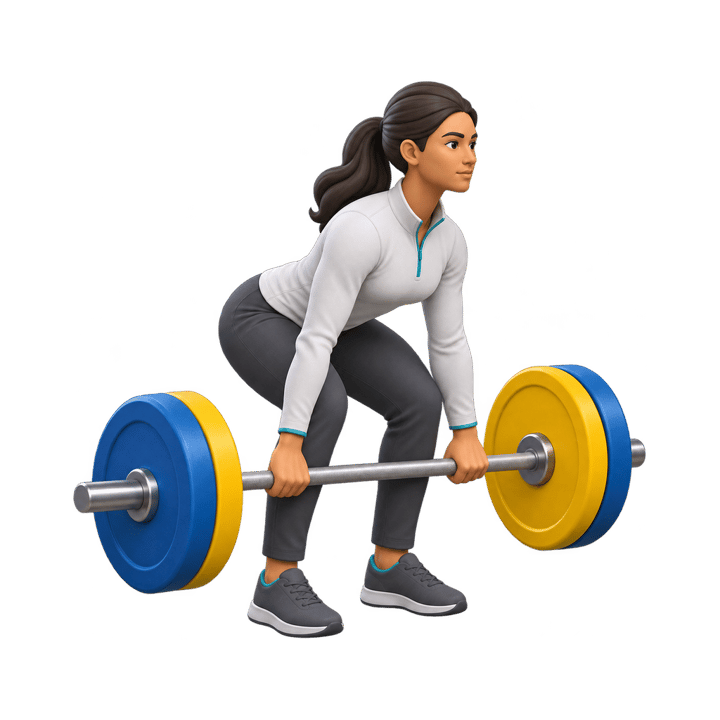
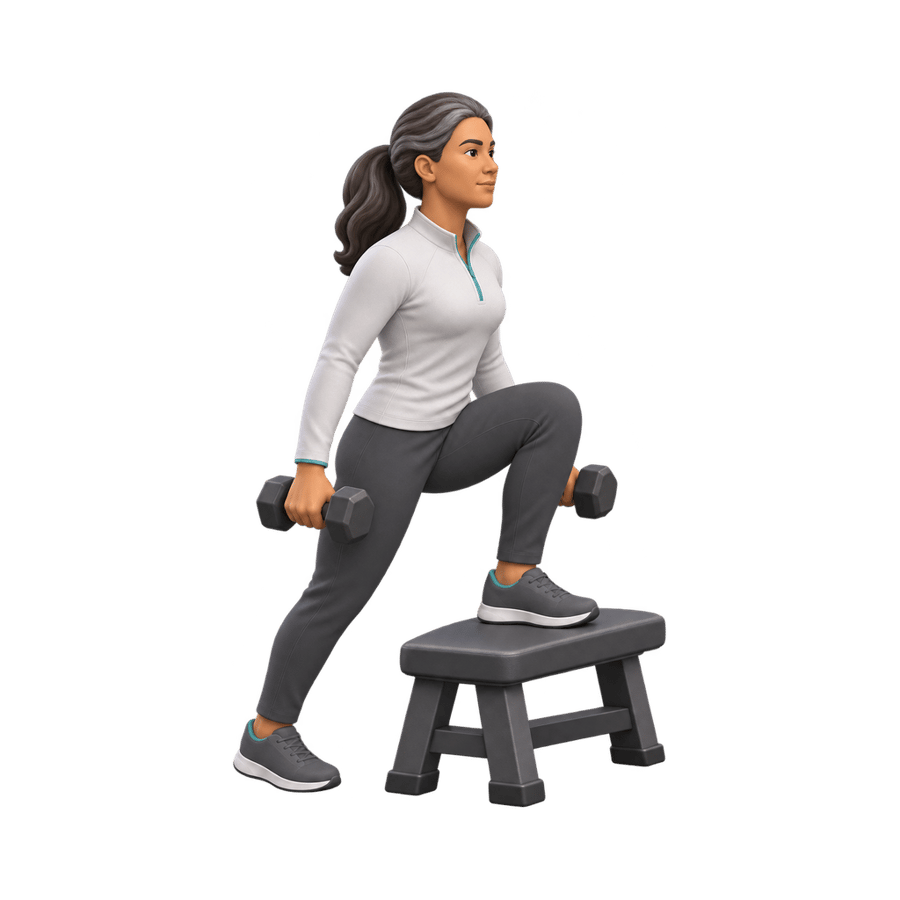
Train your glutes twice a week with one hip move and one one-leg move. The hip move is a hip thrust or a Romanian deadlift, heavy enough that 6 to 10 reps are hard. The one-leg move is a split squat or a step-up, which also works the gluteus medius, since it has to hold your pelvis level the whole set. Push through your heel, and pause for a second at the top of each hip thrust. When every set reaches the top of the rep range with clean form, add weight.
The best glute exercises
| Exercise | Where | How | Sets and reps |
|---|---|---|---|
| Hip thrust | Home or gym | Upper back on a bench or couch, a barbell or dumbbell across your hips. Drive through your heels until you’re flat from knees to shoulders, pause, lower | 3 sets of 8 to 12 |
| Glute bridge | Home | The same move from the floor, shoulders down. Go to one leg when two gets easy | 3 sets of 10 to 15 |
| Bulgarian split squat | Home or gym | Back foot up on a bench, chest leaning a little forward, sink straight down until your back knee nearly touches the floor | 3 sets of 8 to 12 a leg |
| Step-up | Home or gym | Foot on a box or stair at about knee height. Push through that heel to stand, then lower slowly, without pushing off the back foot | 3 sets of 8 to 12 a leg |
| Romanian deadlift | Home or gym | Dumbbells or a barbell, soft knees. Push your hips back until your hamstrings stretch, then stand tall by squeezing your glutes | 3 sets of 6 to 10 |
| Side-lying leg raise or band walk | Home | For the medius. Lie on your side and lift your top leg with your toes pointing forward, or step sideways with a band around your knees | 2 to 3 sets of 12 to 20 |
Sets, reps and how often
Count the hip thrust and the Romanian deadlift as big lifts. That’s 6 to 10 reps for muscle, or 4 to 6 for strength, each set ending 1 to 3 reps short of failure, with 2 to 3 minutes’ rest. Split squats, step-ups and bridges are small moves at 10 to 15 reps, with 1 to 2 minutes’ rest.
On two days a week, most people get about 4 to 6 hard sets of glute work, which builds strength and some size. Squats and lunges add to that, since your glutes work in both. If a bigger, stronger backside is the goal, build toward 10 or more sets a week. The 2026 American College of Sports Medicine review found that’s where muscles grew most, with the gains flattening out around 18 to 20 sets.
Common mistakes
- Arching your back at the top of a hip thrust. When your ribs flare up and your back bends, your lower back finishes the move. Tuck your chin, keep your ribs down and stop when your hips are level with your knees and shoulders.
- Only doing light band work. Band walks and kickbacks make a good warm-up, but the gluteus maximus is a big muscle and it grows from heavy sets that end close to failure.
- Cutting the split squat short. Go down until your back knee nearly touches the floor. The deep bottom is the hard part, and it’s where the glute is stretched the most.
- Pushing off the back foot on step-ups. A bounce from the trailing leg does half the work. Keep that foot light and make the front leg lift you.
- Forgetting the side glutes. If every move uses both feet, the medius never has to hold you level on its own. Add one one-leg move a session.
A picture from daily life
Think about a car jack. You turn a small handle, and the jack’s folded arms straighten out and lift a whole car off the ground. Your gluteus maximus does the same thing at your hip. When you stand up from a low couch or climb a tall step, your body starts folded at the hip, and your glutes straighten it out, lifting your whole bodyweight with them.
The science: hip thrust or squat?
In 2023, researchers split 34 college-age people who’d never trained into two groups for 9 weeks of supervised training, 15 to 17 sessions. One group did only back squats and the other only hip thrusts, for the same number of sets. On the first day, sensors on the skin showed the glutes working harder in the hip thrust than in the squat at every spot the researchers measured.
At the end, MRI scans showed the glutes had grown about the same in both groups, with a small and uncertain edge for the hip thrust. The squat group grew more in the quads and inner thighs. Each group got much stronger in its own lift, and both improved about equally at the deadlift, which neither had trained.
It was a small study in beginners, over two months. The researchers found that how hard a muscle lit up on a sensor didn’t predict how much it grew, and that the squat, which trains more muscle at once, built the glutes about as well. Both moves belong in a good week. If you only have time for one, the squat gives you more leg for the same sets, and the hip thrust is the one to add when your glutes are the goal.
8 sources
- Gluteus maximus, Wikipediaen.wikipedia.org
- Gluteus medius, Wikipediaen.wikipedia.org
- Trendelenburg's sign, Wikipediaen.wikipedia.org
- Ward SR and others, Are current measurements of lower extremity muscle architecture accurate?, Clinical Orthopaedics and Related Research, 2009pmc.ncbi.nlm.nih.gov
- Lieberman DE and others, The human gluteus maximus and its role in running, Journal of Experimental Biology, 2006europepmc.org
- Dorn TW, Schache AG and Pandy MG, Muscular strategy shift in human running: dependence of running speed on hip and ankle muscle performance, Journal of Experimental Biology, 2012europepmc.org
- Plotkin DL and others, Hip thrust and back squat training elicit similar gluteus muscle hypertrophy and transfer similarly to the deadlift, Frontiers in Physiology, 2023pmc.ncbi.nlm.nih.gov
- Currier BS and others, ACSM position stand: resistance training prescription for muscle function, hypertrophy, and physical performance in healthy adults, Medicine and Science in Sports and Exercise, 2026pmc.ncbi.nlm.nih.gov