How to build strong calves
On this page
Your calves lift your whole body off the ground with every step you take, thousands of times a day, and they squeeze blood back up your legs toward your heart while they do it. Train them with slow calf raises, heels dropped low at the bottom, two or three times a week, and do some of them with your knees bent.
Most people think of calves as a looks muscle, the one bodybuilders complain won’t grow, or they skip them because walking seems like enough. But walking is a light load your calves have handled since you were one, so it keeps them going without making them stronger. And calves turn out to be one of the first places strength fades as people get older, long before anyone notices it in their walk.
What your calves do
Your calf is two muscles stacked on top of each other. The one you can see, the gastrocnemius, has two heads that start just above the back of the knee, so it crosses both the knee and the ankle. Under it sits the soleus, a flatter muscle that starts on the back of the shin bone and crosses only the ankle. Both pull on the Achilles tendon, which attaches to your heel, and when they shorten, they point your foot down and lift your heel.
That one movement does more than it sounds like. It’s the push-off at the end of every step, the spring when you run or climb stairs, and the brake when you come down a hill. When you stand still, the soleus keeps pulling gently all the time, since without it your body would tip forward over your feet. In a running study of nine people, the two calf muscles did more than any other muscle to hold the body up against the ground.
The soleus has one more job, and it’s the surprising one. Your leg veins have one-way valves, and every time the calf squeezes, it pushes the blood in them up toward your heart. That’s why the soleus gets called the peripheral heart, and it’s why the CDC tells people on trips longer than 4 hours to move their legs and work their calf muscles to keep the blood flowing.
Why you want strong calves
Your walk depends on them as you age. In 2000, researchers filmed 12 adults with an average age of 69 and 14 adults with an average age of 21 walking at exactly the same speed. The older group did 29% less work at the ankle and made up for it with 279% more work at the hip. Weaker calves mean a shorter push-off, so the hips end up doing a job they weren’t built to do alone.
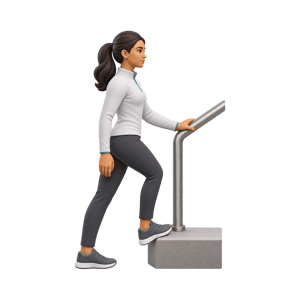
They’re a test you can do right now. Stand on one foot on the edge of a step, hold a rail, and count how many full heel raises you can do. In 203 healthy adults aged 20 to 59, the average was about 28, with no difference between men and women, and the researchers set 25 as the line for normal. A 2017 study of healthy adults found a median of 24 for men and 21 for women. If you can’t reach 20, your calves are a good place to start.
The soleus is a big sugar burner for its size. It’s only about 1% of your body mass. In a 2022 study, 15 adults sat in a chair and kept lifting their heels with their feet flat and knees bent, a move the researchers designed to work the soleus for hours without tiring it. After a sugary drink, their blood sugar rose about half as much (52% less) as on a day they sat still, and their insulin about 60% less. They did it for the whole three-hour test, so it’s a lab result, but it shows how much one small muscle can do when it’s kept busy.
What we’d do
Two or three times a week, do 3 sets of calf raises on a step: one exercise with straight knees (standing) and one with bent knees (seated, with a weight on your thighs). Lower your heels slowly until you feel a deep stretch, pause for a second, then rise as high as you can. Pick a load where the last two or three reps of each set are hard. When you get to 15 clean reps, hold a dumbbell or go to one leg at a time.
The best calf exercises
| Exercise | Where | How | Sets and reps |
|---|---|---|---|
| Calf raise on a step | Home | Balls of your feet on a stair, heels hanging off, a hand on the rail. Lower slowly, pause low, rise high | 3 sets of 10 to 15 |
| One-leg calf raise | Home | The same, on one foot, holding a dumbbell in the other hand when it gets easy | 2 to 3 sets of 8 to 15 a leg |
| Seated calf raise | Home or gym | Sit with your feet flat, a heavy dumbbell or a full backpack on your knees, and lift your heels. Bent knees put the work on the soleus | 3 sets of 12 to 20 |
| Standing calf raise machine | Gym | Shoulders under the pads, balls of your feet on the edge. Same slow lowering and pause | 3 sets of 8 to 15 |
| Calf press on the leg press | Gym | Legs nearly straight, push the platform with the balls of your feet only | 3 sets of 10 to 15 |
| Jump rope | Anywhere | Small, quick bounces on the balls of your feet. It trains the spring rather than the size | 3 to 5 rounds of 30 to 60 seconds |
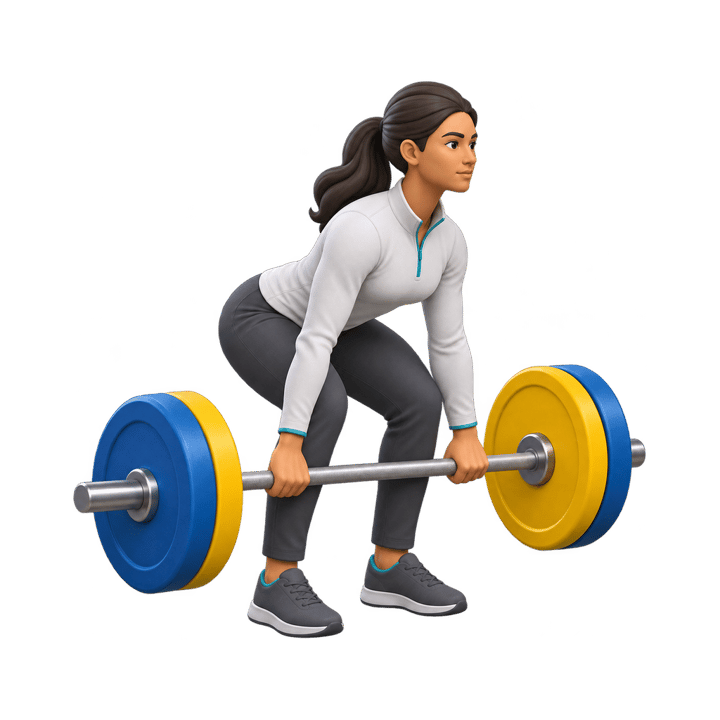
Calves recover fast, so they’re fine to train three days a week, and they fit at the end of any session, after the squats and deadlifts.
Sets, reps and how often
Count your calves like any other muscle. The 2026 American College of Sports Medicine review found muscles grew most with 10 or more hard sets a week, with the gains flattening out somewhere around 18 to 20 sets. For most people, 6 to 10 sets of calf raises a week, spread over two or three days, is plenty. Start with 3 sets twice a week and add a set every week or two.
Light loads build muscle too, as long as each set ends close to failure, so a backpack and a stair can take you a long way. Once 15 to 20 reps on one leg is easy, add weight, since a set of 40 easy reps mostly trains your patience.
Common mistakes
- Bouncing at the bottom. Your Achilles tendon is springy. A quick bounce lets the tendon throw you back up instead of the muscle lifting you. Pause for a full second with your heels low.
- Cutting off the stretch. The bottom half of the movement is where the growth is (see the study below). If your heels stop level with the step, you’re skipping it.
- Only straight legs. Standing raises work both muscles, but the soleus does most of its work with your knee bent. Add a seated raise.
- Too easy, too long. Walking all day doesn’t count as calf training for the same reason. If the last few reps don’t burn and slow down, the set was too light.
- Rushing back after an injury. A sore Achilles, a calf strain or new pain in the back of the heel goes to a doctor or physical therapist before you load it.
A picture from daily life
Think about a pogo stick. The spring at the bottom stores energy when you land and gives it back when you push off. Your Achilles tendon is that spring, and your calf muscles are the hands that wind it up. A strong calf winds a stiffer spring, which is why sprinters and jumpers have such springy strides, and why an older walker whose calves have weakened starts to shuffle.
The science: why the bottom of the calf raise builds more
In 2023, researchers in Brazil split 42 young women into three groups for eight weeks of calf raises, three days a week, 3 sets of 15 to 20 reps to failure. One group used the full range. One used only the bottom half, from the deep stretch up to flat. The third used only the top half, from flat up onto their toes.
The bottom-half group grew the most by far. The inner calf (medial gastrocnemius) grew 15.2% in the bottom-half group, against 6.7% with the full range and 3.4% with the top half. It’s one study, in young women, on one machine. But it lines up with a wider pattern in the research, where training a muscle at long lengths, in the stretch, tends to build more of it. For your calves, that means the slow lowering and the pause at the bottom are the part of the rep that does the most.
The soleus is mostly slow-twitch fibers, the kind built for long, steady work, which is part of why it can keep going all day while you stand and walk. In people the share runs from about 60% to nearly all of it. It’s another reason to keep a seated calf raise in your week, done slowly with a pause.
10 sources
- Triceps surae muscle, Wikipediaen.wikipedia.org
- Soleus muscle, Wikipediaen.wikipedia.org
- DeVita P and Hortobagyi T, Age causes a redistribution of joint torques and powers during gait, Journal of Applied Physiology, 2000europepmc.org
- Hamilton MT, Hamilton DG and Zderic TW, A potent physiological method to magnify and sustain soleus oxidative metabolism improves glucose and lipid regulation, iScience, 2022pmc.ncbi.nlm.nih.gov
- Kassiano W and others, Greater gastrocnemius muscle hypertrophy after partial range of motion training performed at long muscle lengths, Journal of Strength and Conditioning Research, 2023europepmc.org
- Lunsford BR and Perry J, The standing heel-rise test for ankle plantar flexion: criterion for normal, Physical Therapy, 1995europepmc.org
- Hebert-Losier K and others, Updated reliability and normative values for the standing heel-rise test in healthy adults, Physiotherapy, 2017europepmc.org
- Dorn TW, Schache AG and Pandy MG, Muscular strategy shift in human running: dependence of running speed on hip and ankle muscle performance, Journal of Experimental Biology, 2012europepmc.org
- Currier BS and others, ACSM position stand: resistance training prescription for muscle function, hypertrophy, and physical performance in healthy adults, Medicine and Science in Sports and Exercise, 2026pmc.ncbi.nlm.nih.gov
- Centers for Disease Control and Prevention, Blood clots and travel: what you need to knowcdc.gov