How to build strong biceps
On this page
Your biceps bend your elbow and turn your palm up. They’re what you use to carry a grocery bag in the crook of your arm, lift a child onto your hip or drive in a screw. Train them with rows and pull-ups plus 2 or 3 sets of curls, two or three times a week. Light and heavy weights both build them, as long as the last reps are hard.
The biceps is the muscle people flex when they mean strong, and most people think it does all the elbow bending on its own. It shares the job. A flat muscle underneath it, the brachialis, turned out to be just as big in MRI scans, and it bends your elbow whichever way your palm faces. The other big belief is that arms only grow in the 8 to 12 rep range. In a study that trained one arm heavy and the other lighter, the arms grew about the same anywhere from 40% to 80% of max.
What your biceps do
Your biceps has two heads, a long one and a short one, and both start on your shoulder blade. They join in the middle of your upper arm and attach by one tendon to the radius, the forearm bone on the thumb side. Because of where that tendon lands, the biceps is a strong twister as well as a bender. It turns your palm up (doctors call this supination), which is the motion of driving in a screw with your right hand or turning a key. When your palm faces down, the muscles underneath do more of the bending.
Those muscles are the brachialis, which sits under the biceps and attaches to the other forearm bone, and the brachioradialis, which runs along the top of your forearm. The brachialis doesn’t twist at all. It bends your elbow every time, palm up, down or sideways.
Put together, these are the muscles of carrying in front of you. You use them to hold a bag of groceries against your chest, scoop up a toddler, lift a laundry basket, pull a heavy pan off the stove and hoist yourself up into a truck. In a 2007 MRI study of 10 young adults, the biceps and brachialis each averaged about 144 cubic centimeters (a bit more than half a cup), so the muscle you can’t see is as big as the one you show off.
Why you want strong biceps
Your rows already build them. In a 2015 study, 29 young men who’d never lifted trained twice a week for 10 weeks. Half did only lat pulldowns, and half did only biceps curls. Their elbow-bending muscles grew 6.1% and 5.8%, and their strength rose about 10% and 12%. The difference between the groups was too small to count. They were beginners, and arms in trained lifters may need more direct work. A 2020 study in 20 untrained women found that adding curls on top of the big lifts gave a little more arm size (4.4% against 3.5% on a tape measure) and no extra strength.
Strong arms make carrying easier. Every time you hold something in front of you with bent elbows, your biceps and brachialis are holding the weight. A stronger arm lifts the same bag at a smaller share of its max, so carrying a toddler through an airport or a heavy box up the stairs takes less out of you.
What we’d do
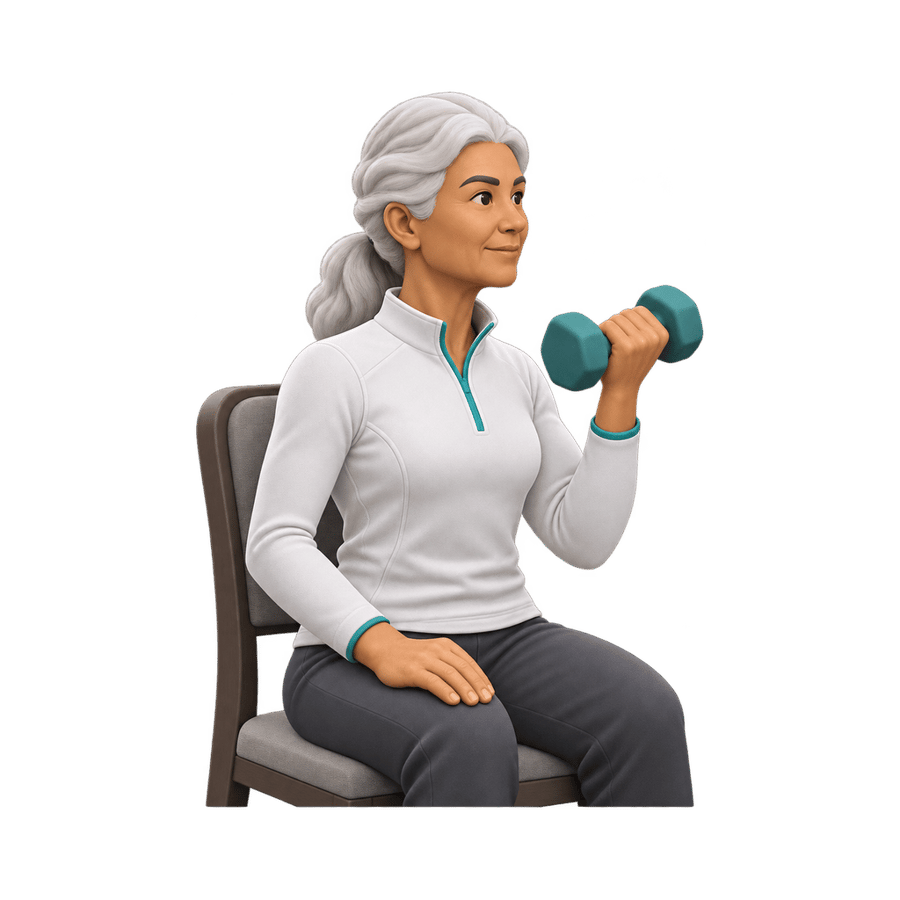
Let your rows and pull-ups do most of the work, and add one curl at the end of two or three sessions a week. Do 2 to 3 sets of 10 to 15 with a dumbbell, a band or a cable, lowering slowly, and stop a rep or two before you can’t lift it. Swap in hammer curls (palms facing each other) every other session for the brachialis and forearm. If your elbows ache, go lighter and do more reps, since the growth is about the same.
The best biceps exercises
| Exercise | Where | How | Sets and reps |
|---|---|---|---|
| Chin-up | Home or gym | Palms facing you, pull your chin over the bar, lower to straight arms. A band takes off weight | 3 sets, stopping a rep or two short |
| Table row, palms up | Home | Under a sturdy table, palms facing you, pull your chest to the edge | 3 sets of 8 to 15 |
| Dumbbell curl | Home or gym | Elbows at your sides, palms up, curl to your shoulders and take 2 to 3 seconds to lower | 2 to 3 sets of 8 to 15 |
| Hammer curl | Home or gym | The same, palms facing each other, for the brachialis and forearm | 2 to 3 sets of 10 to 15 |
| Band curl | Home | Stand on a band and curl the handles up | 2 to 3 sets of 12 to 20 |
| Incline dumbbell curl | Gym | Lie back on a bench tilted up, arms hanging behind your body, then curl. It works the long head from a stretch | 2 to 3 sets of 10 to 12 |
| Preacher or cable curl | Gym | Upper arms braced on the pad, or facing a cable. Lower all the way to nearly straight | 2 to 3 sets of 10 to 15 |
Sets, reps and how often
Curls are small moves, so do 8 to 12 reps if strength is your goal or 10 to 15 for muscle, with 1 to 2 minutes of rest, and end every set 1 to 3 reps short of failure. Rows, chin-ups and pulldowns already give your biceps several hard sets a week. Two full-body days with a row and a pull get most people to 4 to 6 hard sets for the biceps, enough for strength and some size. For the most size, the 2026 American College of Sports Medicine review found 10 or more hard sets a week, with gains flattening around 18 to 20. Two or three sets of curls a session closes that gap.
When you hit the top of your range on every set with clean form, add the smallest step you have. A 5 lb jump on a curl is a big one, so add reps first, or use a band that lets you go up a little at a time.
Common mistakes
- Swinging the weight up. If your back leans and your hips push the dumbbell, it’s too heavy. Keep your elbows by your sides.
- Skipping the lowering. The 2026 review found lowering under load built more muscle. Take 2 to 3 seconds on the way down.
- Stopping short at the bottom. Lower until your arm is nearly straight, since the 2026 review found full range of motion built more strength.
- Curls instead of rows. Curls work best as an add-on, after the rows and pull-ups that train your back and arms together.
- Pushing through elbow pain. A sudden pop or pain at the front of the elbow, a new bulge in the upper arm, or pain that doesn’t settle goes to a doctor first.
A picture from daily life
Think about a drawbridge. The bridge hinges at one end, and a chain pulls the far end up. Your forearm is the bridge, your elbow is the hinge, and your biceps and brachialis are the chains. They attach just past the hinge, so a short pull of the muscle swings your hand through a big arc.
The science: light, heavy, and the rep range
In 2018, researchers in São Paulo had 30 men train for 12 weeks, twice a week, with a different load on each arm and leg. One arm always lifted 20% of its max. The other lifted 40%, 60% or 80%, with the total weight lifted matched between them. Elbow-bending muscle grew about 25% at 40, 60 and 80%, and only about 11% at 20%. Strength rose more with the heavier loads.
A 2015 study of 18 men who already lifted compared 8 to 12 reps with 25 to 35 reps, every set to failure, for 8 weeks. Their arm muscles grew by similar amounts (5.3% with heavy and 8.6% with light, too close to call), and the heavy group gained more strength. A 2021 review by some of the same researchers concluded that muscle grows across a wide range of loads from about 30% of max up, heavy loads win for maximum strength, and moderate loads are the most time-efficient for size. That’s why the protocol uses 10 to 15 reps for curls, with a weight that makes the last couple of reps hard.
9 sources
- Biceps, Wikipediaen.wikipedia.org
- Brachialis muscle, Wikipediaen.wikipedia.org
- Holzbaur KR, Murray WM, Gold GE and Delp SL, Upper limb muscle volumes in adult subjects, Journal of Biomechanics, 2007mobl.wordpress.ncsu.edu
- Gentil P, Soares S and Bottaro M, Single vs. multi-joint resistance exercises: effects on muscle strength and hypertrophy, Asian Journal of Sports Medicine, 2015pmc.ncbi.nlm.nih.gov
- Barbalho M and others, Influence of adding single-joint exercise to a multijoint resistance training program in untrained young women, Journal of Strength and Conditioning Research, 2020europepmc.org
- Lasevicius T and others, Effects of different intensities of resistance training with equated volume load on muscle strength and hypertrophy, European Journal of Sport Science, 2018europepmc.org
- Schoenfeld BJ and others, Effects of low- vs. high-load resistance training on muscle strength and hypertrophy in well-trained men, Journal of Strength and Conditioning Research, 2015europepmc.org
- Schoenfeld BJ, Grgic J, Van Every DW and Plotkin DL, Loading recommendations for muscle strength, hypertrophy, and local endurance: a re-examination of the repetition continuum, Sports, 2021pmc.ncbi.nlm.nih.gov
- Currier BS and others, ACSM position stand: resistance training prescription for muscle function, hypertrophy, and physical performance in healthy adults, Medicine and Science in Sports and Exercise, 2026pmc.ncbi.nlm.nih.gov