How to get a strong chest
On this page
Your chest muscles push things away from you, like a heavy door, a stroller up a curb, or the floor when you get yourself up off it. Train them with push-ups or a bench press two or three times a week, 3 sets that stop a couple of reps short of failure, and pull with your back at least as often as you push.
The chest is the muscle everyone wants and the one most people overdo. “Monday is chest day” is a gym joke because so many people start the week with the bench and a few kinds of flyes, then skip the back. The other mistake goes the other way, where people think they need a gym and a barbell. A push-up puts about two thirds of your bodyweight in your hands, and in small trials push-ups built as much chest as bench pressing.
What your chest does
Your chest muscle, the pectoralis major, is a big fan with two parts. The upper part starts on your collarbone and lifts your arm forward and up. The larger lower part starts on your breastbone and upper ribs and brings your arm down and across your body. Both narrow into one flat tendon on the front of your upper arm bone. Together they push your arms forward, pull them in toward your middle like a hug, and turn them inward.
You use it every day to push open a heavy door, push a cart or a stroller up a ramp, and catch yourself with your hands when you trip forward. Getting up off the floor starts with it too, since your hands push the floor away while your legs get under you.
A push-up turns your own body into the weight. In 2010, researchers had 23 fit young adults hold push-up positions on a force plate. A standard push-up put 64% of their bodyweight through their hands, about 115 lb (52 kg) for a 180-pound person. From the knees it was 49%. Hands up on a box about a foot high made it 55%, and two feet high, 41%. Feet up on the box pushed it to 70% and then 74%, so you can make a push-up lighter or heavier without buying anything.
Why you want a strong chest
Men who could do more push-ups had fewer heart events. In 2019, researchers went back through the records of 1,104 male firefighters in Indiana, average age about 40, who’d done push-ups at a clinic exam in time with a metronome. Over the next 10 years, 37 of them had a heart event. The men who could do more than 40 push-ups had far fewer than the men who managed 10 or fewer. But the 41-plus group had a single event between them, and once the researchers adjusted for age and weight, only one comparison held up (21 to 30 push-ups against 0 to 10). They were all men and mostly fit, so the study can’t tell a woman or a 70-year-old what a count means (how many push-ups you should be able to do, with the full table).
You can build it at home. In a 2017 study, 18 young men trained twice a week for 8 weeks. Half did the bench press at 40% of their max. The other half did push-ups, from the knees or the toes, set up so the load matched the bench. Both groups grew their chest and triceps and raised their bench max by about the same amounts. Earlier, a 2015 study had 30 university students who already lifted train for 5 weeks with heavy bench presses or with push-ups made just as hard by a resistance band across the back. Their strength rose about the same. Both studies were small and short.
What we’d do
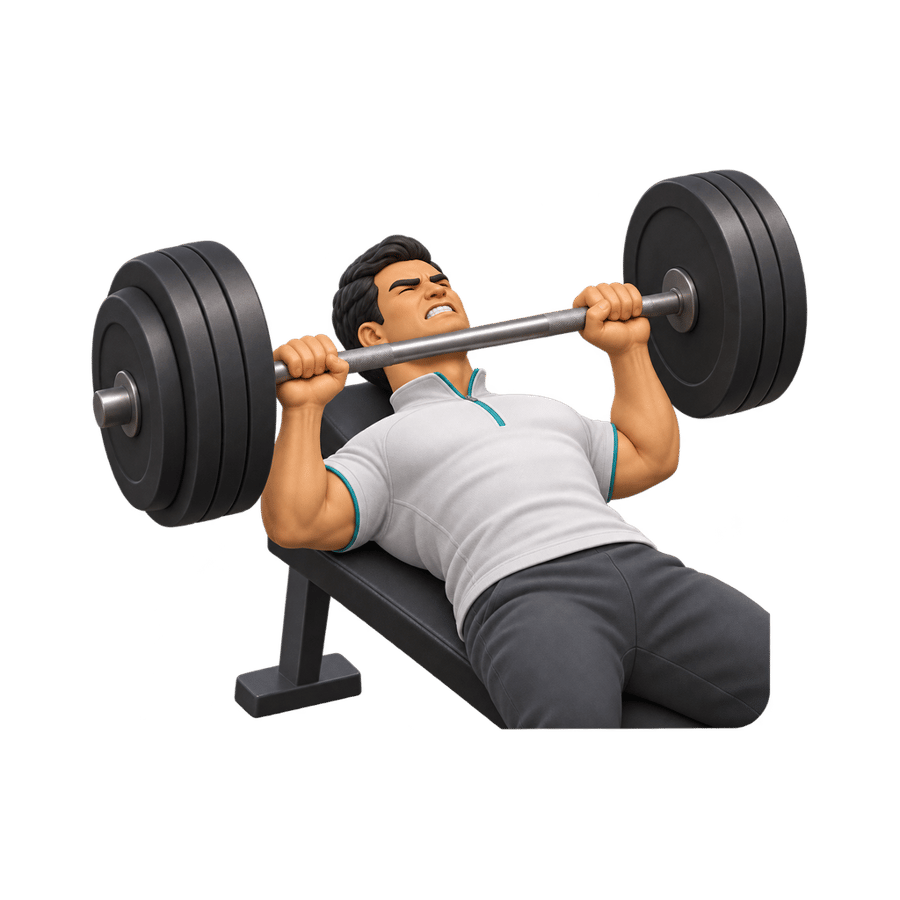
Two or three times a week, do one press for your chest and one row for your back. At home, do push-ups at the height that gives you 6 to 12 clean reps, starting with your hands on a kitchen counter if the floor’s too hard, then working down to a bench, the floor, and finally feet up on a step. At a gym, bench press or dumbbell press for 3 sets of 5 to 10, with 2 to 3 minutes of rest. Stop each set 1 to 3 reps short of failure, and do a set of rows for every set of presses.
The best chest exercises
| Exercise | Where | How | Sets and reps |
|---|---|---|---|
| Counter or bench push-up | Home | Hands on a counter or a sturdy bench, body straight, chest to the edge. The higher your hands, the lighter it is | 3 sets of 8 to 15 |
| Push-up | Home | Hands a little wider than your shoulders, body in one line, chest close to the floor | 3 sets of 6 to 15 |
| Feet-up push-up | Home | Feet on a step or a chair. More of your weight goes into your hands | 3 sets of 6 to 12 |
| Dumbbell floor or bench press | Home or gym | Lower the dumbbells until your upper arms touch the floor, or to chest level on a bench, then press | 3 sets of 6 to 10 |
| Barbell bench press | Gym | Feet flat, shoulder blades pulled back, lower the bar to the middle of your chest and press | 3 sets of 4 to 8 |
| Incline dumbbell press | Gym | Bench tilted up a notch or two, which puts more of the work on the upper chest | 3 sets of 8 to 12 |
| Band or cable fly | Home or gym | Arms a little bent, bring your hands together in front of you like hugging a big tree, slow on the way back | 2 to 3 sets of 10 to 15 |
Sets, reps and how often
The bench press and dumbbell press are big lifts. Do 4 to 6 reps for strength, 6 to 10 for muscle, or 5 to 8 for both, and rest 2 to 3 minutes. Flyes are small moves, 8 to 12 reps for strength or 10 to 15 for muscle, with 1 to 2 minutes of rest. Every set ends 1 to 3 reps short of failure. If you’re new, spend the first two weeks on 2 sets with a weight you could lift 10 to 12 times, stopping at 8 to 10.
Two full-body days give most people about 4 to 6 hard sets for the chest each week, which builds strength and some size. The 2026 American College of Sports Medicine review found 10 or more hard sets a week built the most muscle, with gains flattening out around 18 to 20. When every set hits the top of your range with clean form, add about 5 lb (2.5 kg) and build the reps back up. With push-ups, add reps, then lower your hands a step.
Common mistakes
- Chest day, every day. A week of presses and flyes with no rows builds the front of you and leaves the back behind. In a 2017 study of 55 men who lifted at least twice a week, the ones with shoulder impingement had weaker muscles at the back of the shoulder (the external rotators and lower traps) for their size, and bigger gaps between muscles that pull against each other. It was a snapshot, so nobody knows which came first. Pull as many sets as you push, and see why balanced training works better.
- Half reps. The 2026 review found full range of motion built more strength. Lower until your chest is close to the floor or the bar touches your chest.
- Elbows flared straight out. Tuck them in a little, so your upper arms sit at about 45 degrees to your body, the way most coaches teach it.
- Bouncing heavy weight off your chest. Chest tears are rare, and they usually happen when the muscle is lowering a weight it can’t control, like the bottom of a heavy bench press. Lower under control, and use a spotter or the safety pins when you go heavy.
- Sagging hips on push-ups. A push-up is a moving plank. If your hips drop, put your hands up on a step and keep your body straight.
If you have heart disease or high blood pressure, ask your doctor before you start heavy pressing.
A picture from daily life
Think about pushing open a heavy fire door with both hands. Your hands start near your chest, your arms straighten, and your chest and the backs of your arms drive the door away. A push-up is that same push with your own body as the door, and a bench press is the push lying down, with the door swapped for a bar.
The science: push-ups, dumbbells or a barbell
The American College of Sports Medicine team pooled 137 reviews of strength training, covering more than 30,000 people, and found that the type of equipment made no consistent difference to results. Strength and size came from hard sets, enough of them each week, and push-ups, dumbbells and barbells can all give you those. The bench press is easier to load in small steps for years, since you can add 5 lb at a time, while push-ups move up in bigger jumps from one height to the next.
7 sources
- Pectoralis major muscle, Wikipediaen.wikipedia.org
- Wurm B, VanderZanden T, Spadavecchia M, Durocher J, Bickham C, Petushek E and Ebben W, Kinetic analysis of several variations of push-ups, ISBS Conference Proceedings, 2010ojs.ub.uni-konstanz.de
- Yang J and others, Association between push-up exercise capacity and future cardiovascular events among active adult men, JAMA Network Open, 2019pmc.ncbi.nlm.nih.gov
- Kikuchi N and Nakazato K, Low-load bench press and push-up induce similar muscle hypertrophy and strength gain, Journal of Exercise Science and Fitness, 2017pmc.ncbi.nlm.nih.gov
- Calatayud J and others, Bench press and push-up at comparable levels of muscle activity results in similar strength gains, Journal of Strength and Conditioning Research, 2015europepmc.org
- Kolber MJ and others, Shoulder joint and muscle characteristics among weight-training participants with and without impingement syndrome, Journal of Strength and Conditioning Research, 2017europepmc.org
- Currier BS and others, ACSM position stand: resistance training prescription for muscle function, hypertrophy, and physical performance in healthy adults, Medicine and Science in Sports and Exercise, 2026pmc.ncbi.nlm.nih.gov