How to build strong shoulders
On this page
Your shoulders lift your arms in every direction, and they hold the ball at the top of each arm bone on a socket about as shallow as a golf tee. Build them two or three times a week with three kinds of moves. Press overhead, raise your arms out to the side, and pull toward your face for the back of the shoulder and the rotator cuff underneath.
Most people train the front of the shoulder without trying. Every push-up and bench press works it, and it’s the part you see in the mirror. The back of the shoulder and the rotator cuff sit behind you and never look like much, so they get skipped. But they’re the muscles that keep the joint steady, and the shoulder is one of the places lifters get hurt most. When researchers went through the published injury records in 2010, up to 36% of lifting injuries were at the shoulder.
What your shoulders do
The round muscle on top of your arm is the deltoid, named after the Greek letter delta because it’s shaped like a triangle. It has three parts. The front lifts your arm forward, the way you reach for a mug on a high shelf. The middle lifts it out to the side. The rear pulls it back, like reaching behind you for a seatbelt or pulling the cord on a lawnmower. Muscle recordings suggest the deltoid has at least seven sections your nerves can switch on separately, which is how it can aim your arm almost anywhere.
Under the deltoid sits the rotator cuff, four small muscles (the supraspinatus, infraspinatus, teres minor and subscapularis) wrapped around the top of the arm bone. Their job is to hold that ball centered in its socket while the bigger muscles swing the arm around. The deltoid helps too, since it stops the arm bone from pulling out of the joint when you carry something heavy.
You use all of it every time you lift a carry-on into the overhead bin, slide a box onto a high shelf, wash your hair or reach into the back seat. In a 2007 study that measured all 32 muscles of the arm by MRI in 10 young adults, the deltoid was the biggest of them, and the muscles crossing the shoulder made up more than half (52.5%) of all the muscle in the arm.
Why you want strong shoulders
Torn rotator cuffs are common, and most are silent. In 2013, Japanese doctors scanned both shoulders of 664 people in one village with ultrasound, about a fifth of everyone who lived there. Of those, 22% had a full tear through a rotator cuff tendon. Nobody under 50 had one, but 11% did in their 50s, 15% in their 60s, 27% in their 70s and 37% in their 80s. Two thirds of those tears caused no pain or trouble at all. A tear on a scan doesn’t always mean a bad shoulder, and lots of people with one use their arms every day.
Exercise talked people out of surgery. At a Swedish university hospital, researchers took 102 people on the waiting list for shoulder surgery for impingement, who’d had pain for more than six months and hadn’t got better with earlier treatment. Half did strengthening for the rotator cuff, with slow lowering, and for the muscles that hold the shoulder blade, using weights and bands at home, 3 sets of 15 twice a day. The other half did general movement exercises for the neck and shoulder. After 12 weeks, 20% of the strengthening group still wanted the operation, against 63% of the others. It was one hospital and three months, in people who already had pain.
What we’d do
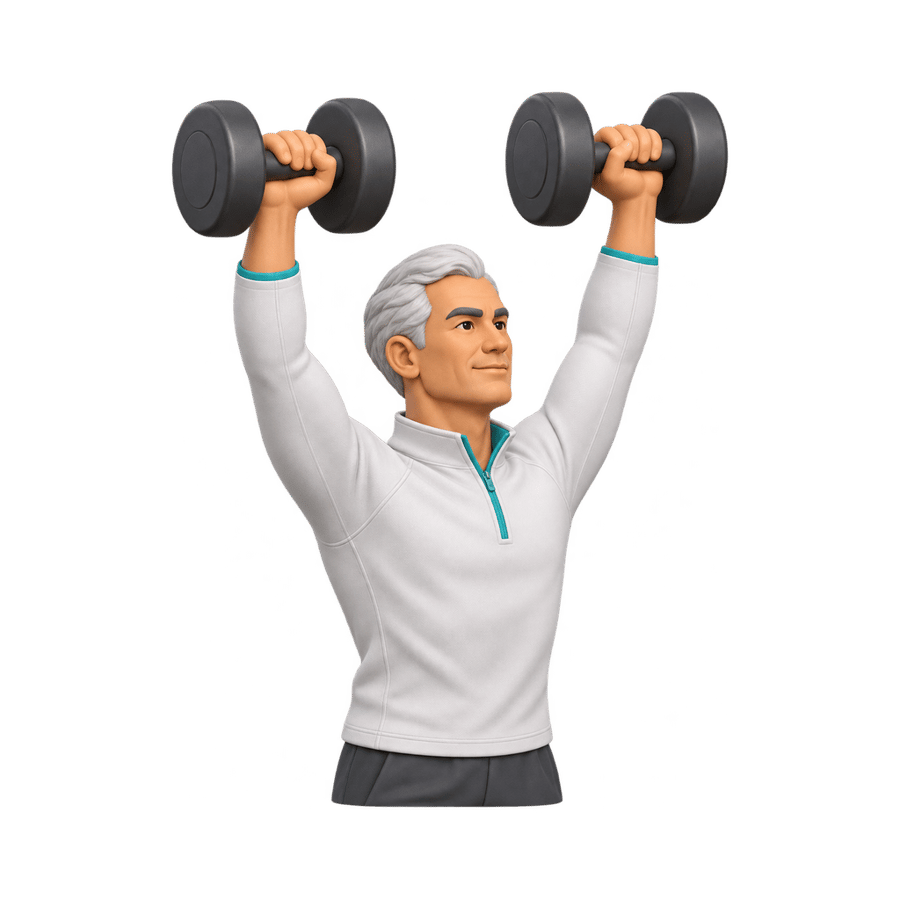
Two or three times a week, do one press, one raise and one pull. Press dumbbells overhead for 3 sets of 6 to 10. Do lateral raises for 2 to 3 sets of 12 to 15, stopping with your hands at shoulder height. Then do face pulls with a band or cable, or rear delt flyes, for 2 to 3 sets of 12 to 15, and finish with one set of band external rotations for each arm. End every set a couple of reps short of failure, and add weight when you hit the top of the range with clean form.
The best shoulder exercises
| Exercise | Where | How | Sets and reps |
|---|---|---|---|
| Pike push-up | Home | Hands on the floor and hips high in an upside-down V. Lower the top of your head toward the floor between your hands, then press back up | 3 sets of 6 to 12 |
| Dumbbell overhead press | Home or gym | Seated or standing, press from your shoulders to straight arms. Turn your palms to face each other if the usual grip pinches | 3 sets of 6 to 10 |
| Barbell overhead press | Gym | Standing, press the bar from your collarbones to straight arms over the middle of your head | 3 sets of 4 to 8 |
| Lateral raise | Home or gym | Light dumbbells or a band. Lift your arms out to the side, elbows soft, and stop at shoulder height | 2 to 3 sets of 12 to 15 |
| Face pull | Home or gym | A band or a rope on a cable at face height. Pull toward your forehead with your elbows high and wide, then squeeze your shoulder blades together | 2 to 3 sets of 12 to 15 |
| Rear delt fly | Home or gym | Hinge forward at the hips with light dumbbells, sweep your arms out wide, pause, lower slowly | 2 to 3 sets of 12 to 15 |
| Band external rotation | Home or gym | Elbow tucked at your side and bent to a right angle. Rotate your forearm outward against a band, slowly back | 1 to 2 sets of 15 a side |
Sets, reps and how often
The overhead press is one of the big lifts, so it gets heavier sets. Do 4 to 6 reps if strength is your goal, 6 to 10 for muscle and 5 to 8 for both, and rest 2 to 3 minutes. Raises, face pulls and rotations are small moves, so do 8 to 12 reps for strength or 10 to 15 for muscle, with 1 to 2 minutes of rest. Every set ends 1 to 3 reps short of failure.
Two full-body days a week give most people about 4 to 6 hard sets for each muscle, which builds strength and some size. The 2026 American College of Sports Medicine review found muscles grew most with 10 or more hard sets a week, and the gains flattened out around 18 to 20. Your front delts already get work from every bench press and push-up, so spend the extra sets on the side and the rear. When every set hits the top of the range, add the smallest step you have, about 5 lb (2.5 kg) on a press. On raises, a 5 lb jump is big, so add reps first.
Common mistakes
- Pushing without pulling. A week of presses and one row loads the front of the shoulder far more than the back. Do at least as many sets of pulling as pushing, and see why balanced training beats a bench-only plan.
- Raising too high. In a 2014 study of 77 men, lifters with signs of shoulder impingement were more likely to do lateral raises and upright rows above shoulder height, and less likely to train their external rotators. It was a snapshot, so it can’t prove the raises caused it, but stopping at shoulder height costs you nothing.
- Pressing and pulling behind your neck. In a 2013 study of 159 men, lifters who did behind-the-neck presses and pulldowns had more signs of a loose, unstable shoulder. Press and pull in front of your head.
- Swinging the weight. Raises and face pulls are light on purpose. If you need your back and legs to heave the weight up, drop to one you can lift and lower in about two seconds each way.
- Lifting through sharp pain. Pain that stops you raising your arm, pain at night, new weakness or numbness goes to a doctor or physical therapist before you train it.
A picture from daily life
The top of your arm bone sits on your shoulder socket like a golf ball on a tee. That’s why you can reach in almost any direction, and it’s also why the ball needs holding in place. The rotator cuff is a hand cupped around the ball, keeping it centered on the tee while the deltoid swings the arm around.
The science: the small muscles at the back
In the 2014 study of recreational lifters, the men who trained their external rotators (the cuff muscles that turn your arm outward) had fewer signs of impingement. In the Swedish trial, the program that worked was mostly slow lowering for the cuff and pulling work for the shoulder blade, the muscles a chest-and-arms routine leaves out. Neither study tested healthy shoulders, so nobody knows yet how much a pain-free lifter gains from the same work. Face pulls and band rotations take a few minutes with light weights, so they’re cheap to add.
9 sources
- Deltoid muscle, Wikipediaen.wikipedia.org
- Rotator cuff, Wikipediaen.wikipedia.org
- Holzbaur KR, Murray WM, Gold GE and Delp SL, Upper limb muscle volumes in adult subjects, Journal of Biomechanics, 2007europepmc.org
- Minagawa H and others, Prevalence of symptomatic and asymptomatic rotator cuff tears in the general population: from mass-screening in one village, Journal of Orthopaedics, 2013pmc.ncbi.nlm.nih.gov
- Holmgren T and others, Effect of specific exercise strategy on need for surgery in patients with subacromial impingement syndrome: randomised controlled study, BMJ, 2012pmc.ncbi.nlm.nih.gov
- Kolber MJ and others, Shoulder injuries attributed to resistance training: a brief review, Journal of Strength and Conditioning Research, 2010europepmc.org
- Kolber MJ and others, Characteristics of shoulder impingement in the recreational weight-training population, Journal of Strength and Conditioning Research, 2014europepmc.org
- Kolber MJ, Corrao M and Hanney WJ, Characteristics of anterior shoulder instability and hyperlaxity in the weight-training population, Journal of Strength and Conditioning Research, 2013europepmc.org
- Currier BS and others, ACSM position stand: resistance training prescription for muscle function, hypertrophy, and physical performance in healthy adults, Medicine and Science in Sports and Exercise, 2026pmc.ncbi.nlm.nih.gov