How to build strong quads
On this page
Your quads are the four muscles on the front of your thigh, and they’re the only muscles that straighten your knee. They get you out of a chair and up the stairs, and they catch you when you trip or land from a jump. Train them with squats, split squats, step-ups and leg presses twice a week, going as deep as your knees allow.
A lot of people go easy on their quads to protect their knees. They skip squats and leg presses because they’ve heard deep knee bends wear the joint out. The evidence points the other way. Weak quads went with more knee arthritis in long-term studies, and for people who already have it, exercise is one of the best tested ways to ease the pain. Deep squats done with learned form also load the knee less than people fear (see squats are bad for your knees).
What your quads do
The quadriceps is four muscles. Three of them start on the thigh bone, the vastus lateralis on the outside, the vastus medialis on the inside (the teardrop just above your kneecap) and the vastus intermedius underneath. The fourth, the rectus femoris, starts on the pelvis, so it also lifts your thigh forward when you walk or run. All four join into one tendon that runs over your kneecap and attaches to your shin, and when they pull, your knee straightens.
They’re the only muscles that do that, so every time you stand up, climb a step or push off the ground, your quads do the lifting. They work hard on the way down too. When you sit into a chair, walk down stairs or land from a jump, they stretch under the load and lower you smoothly instead of letting you drop, and that braking is what catches you when you trip. In 21 legs weighed by researchers in 2009, from donors who averaged 83, the four quads together came to almost 2 pounds (about 900 g), and the vastus lateralis alone was the second heaviest of the 27 leg and hip muscles they weighed, after the gluteus maximus.
Why you want strong quads
They go with healthier knees. In 2015, researchers pooled 5 long-term studies of 5,707 adults who didn’t have knee arthritis at the start, followed for 2.5 to 14 years. People with weak quads at the start had about 65% higher odds of developing painful knee arthritis. These were observational studies, so the weakness might be an early sign of a knee already heading that way. But trials in people who already have arthritis point the same direction. A 2015 Cochrane review of 44 trials with 3,537 people found exercise cut knee arthritis pain by about 12 points on a 100-point scale and improved everyday function by about 10.
They come back at any age. In 1990, Maria Fiatarone and her colleagues took ten frail nursing home residents, aged 90 on average, through 8 weeks of heavy strength training. The nine who finished got 174% stronger on average, the muscle in the middle of their thighs grew 9%, and they walked 48% faster in a heel-to-toe test. The oldest was 96. It was ten people with no comparison group, and four years later the team ran a randomized trial in 100 residents with an average age of 87. Strength rose 113% with training against 3% without, and stair-climbing power rose 28%.
They fade fast when you stop. Five days in a leg cast was enough to shrink the quads of healthy young men by almost 4% (more on that study below).
What we’d do
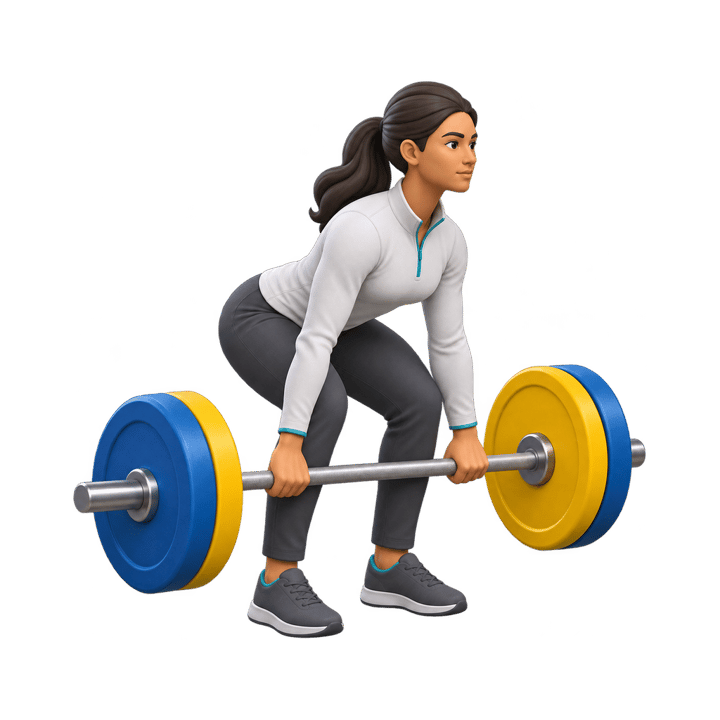
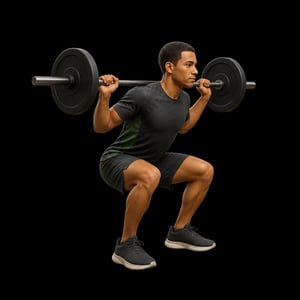
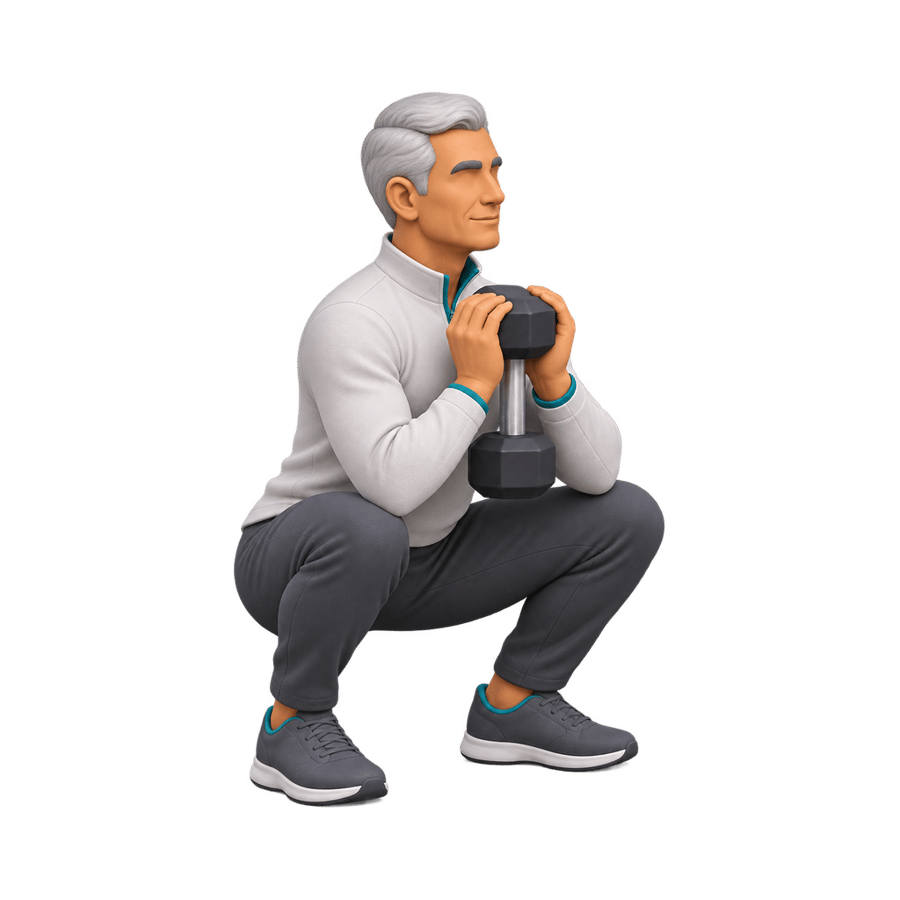
Squat twice a week. Use a goblet squat or a back squat, as deep as you can go with a flat back and your heels down, for 3 sets of 6 to 10 reps, each set ending 1 to 3 reps short of failure. Then add one one-leg move, a split squat or a step-up, for 3 sets of 10 to 15. If your knees are sore, squat down to a bench at a height that doesn’t hurt and lower it over the weeks. If you’re older or haven’t trained in years, start anyway, since the Fiatarone studies show the strength comes back at 90.
The best quad exercises
| Exercise | Where | How | Sets and reps |
|---|---|---|---|
| Chair stand | Home | Arms crossed, stand up from a chair without using your hands, then sit back down slowly | 3 sets of 8 to 15 |
| Goblet squat | Home or gym | Hold a dumbbell or kettlebell at your chest and sit down between your heels as deep as you can with a flat back | 3 sets of 8 to 12 |
| Back squat | Gym | Bar across your upper back, feet about shoulder width, knees following your toes, as deep as you can control | 3 sets of 5 to 8 |
| Bulgarian split squat | Home or gym | Back foot on a bench, front foot far enough out that you can sink straight down | 3 sets of 8 to 12 a leg |
| Step-up | Home or gym | Box or stair at about knee height. Drive through the whole front foot, then lower slowly | 3 sets of 8 to 12 a leg |
| Leg press | Gym | Feet in the middle of the platform. Lower until your knees are well bent, without your lower back peeling off the pad | 3 sets of 8 to 15 |
| Leg extension | Gym | Sit tall, straighten your knees all the way, lower slowly. It trains the quads with no load on your back | 2 to 3 sets of 10 to 15 |
The chair stand is also a test. Here’s the sit-to-stand test and the numbers for your age.
Sets, reps and how often
The squat or the leg press is your big lift. That’s 6 to 10 reps for muscle, or 4 to 6 for strength (around 80 to 85% of your max), with 2 to 3 minutes’ rest. Split squats, step-ups and leg extensions are small moves at 10 to 15 reps, with 1 to 2 minutes’ rest. Every set ends 1 to 3 reps short of failure, when the last reps slow down but stay clean.
Two days a week gives most people about 4 to 6 hard sets for the quads, which builds strength and some size. For the most size, build toward 10 or more sets a week, since the 2026 American College of Sports Medicine review found that’s where muscles grew most. When every set reaches the top of the range with clean form, add the smallest step you have, about 5 to 10 lb (2.5 to 5 kg).
Common mistakes
- Cutting the squat short. A full range of motion was on the 2026 ACSM review’s short list for building strength. Go as deep as you can control.
- Holding your knees back behind your toes. That old rule moves the load onto your hips and lower back (the knees myth has the numbers). Let your knees travel forward over your toes, pointing the same way as your feet.
- Letting your knees cave in. If your knees drift toward each other on the way up, the weight’s too heavy for now.
- Dropping into the bottom. Lower with control. The ACSM review found that putting the emphasis on the lowering half of a rep helped muscles grow.
- Pushing through a bad knee. New or sharp knee pain, swelling, or a knee that locks or gives way goes to a doctor or physical therapist first.
A picture from daily life
Think about the shock absorbers on a car. When a wheel hits a bump, the shock absorber gives under the load and soaks up the hit, so the car doesn’t slam down. When you step off a curb or land from a jump, your quads do the same thing. They lengthen under the load so your knee bends smoothly and slowly, instead of buckling and letting your weight slam down.
The science: what five days off your feet does
In 2016, researchers put 12 healthy young men, average age 22, in a full leg cast on one leg for five days, with the other leg as the comparison. In that time, the quads in the cast leg shrank 3.9%. The researchers also measured how fast those muscles were building new protein. Without a meal, the rate fell by about 41%. After a protein drink, it was 53% lower than in the free leg, so the muscle had also stopped responding to protein the normal way.
Researchers have suggested that short spells like this, repeated across a life, help explain why people lose muscle as they age. It was a small study in young men, and it measured muscle size without testing strength. For the muscles that get you out of a chair, five days was enough to start the loss.
8 sources
- Quadriceps femoris muscle, Wikipediaen.wikipedia.org
- Ward SR and others, Are current measurements of lower extremity muscle architecture accurate?, Clinical Orthopaedics and Related Research, 2009pmc.ncbi.nlm.nih.gov
- Oiestad BE and others, Knee extensor muscle weakness is a risk factor for development of knee osteoarthritis: a systematic review and meta-analysis, Osteoarthritis and Cartilage, 2015europepmc.org
- Fransen M and others, Exercise for osteoarthritis of the knee, Cochrane Database of Systematic Reviews, 2015europepmc.org
- Fiatarone MA and others, High-intensity strength training in nonagenarians: effects on skeletal muscle, JAMA, 1990europepmc.org
- Fiatarone MA and others, Exercise training and nutritional supplementation for physical frailty in very elderly people, New England Journal of Medicine, 1994europepmc.org
- Wall BT and others, Short-term muscle disuse lowers myofibrillar protein synthesis rates and induces anabolic resistance to protein ingestion, American Journal of Physiology, Endocrinology and Metabolism, 2016europepmc.org
- Currier BS and others, ACSM position stand: resistance training prescription for muscle function, hypertrophy, and physical performance in healthy adults, Medicine and Science in Sports and Exercise, 2026pmc.ncbi.nlm.nih.gov