Sore muscles mean the workout worked
Short answerNo
On this page
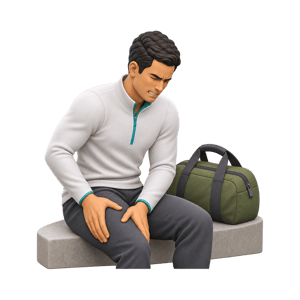
No. The soreness in your first weeks is your muscle repairing damage from a movement it isn’t used to. In a 10-week study, muscle building in that sore first week had no link to who grew. Building only tracked growth once the soreness had faded. Being less sore as you keep going means your muscles adapted, and the training is still working.
What we’d do
Judge a workout by your log, whether the weight or the reps went up, never by how sore you are the next day. Start new exercises with fewer sets so the first week doesn’t flatten you. Train through ordinary soreness, lighter if you need to. If you’re never sore, that’s fine, as long as the numbers are moving.
If you remember three things
- Soreness didn’t predict growth. In week one, when damage was highest, muscle building had no link to who grew.
- One session protects you. A single bout of a new exercise cuts the damage and pain from the next one.
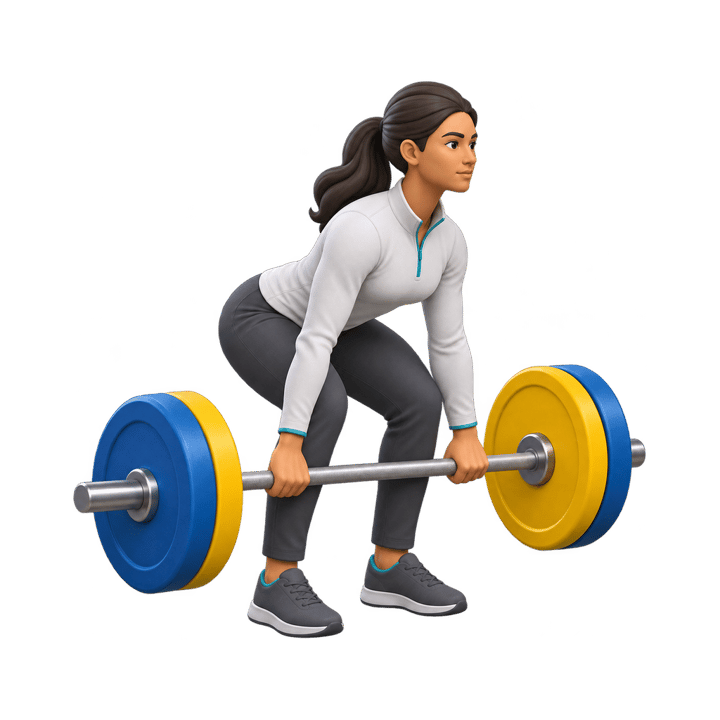
- The lowering part causes the most. Lowering a weight under control makes more of the small damage behind soreness than lifting it.
Why it seems true
Soreness is the one thing you can feel the next day. The muscle aches, stairs are hard, and it feels like proof something happened. Then a few weeks later the same workout leaves you fine, and it’s easy to think you’ve stopped making progress and need something harder, or something new that makes you sore again.
A picture from daily life
New shoes give you blisters the first week. Wear them for a month and your feet toughen where they rub, and the blisters stop. Nobody thinks the shoes stopped working.
Soreness is the blister. It comes from something new, and it fades as your body adapts to it, while the muscle keeps building underneath.
What the study found
In 2016 researchers put 10 young men on a leg training program for 10 weeks and took small samples of their thigh muscle at the start, at week 3 and at week 10. They measured muscle damage under the microscope, how fast new muscle protein was being built after each session, and how much the fibers grew.
| Week 1 | Week 3 | Week 10 | |
|---|---|---|---|
| Muscle damage | Highest | Much lower | Minimal |
| Building after a session | Highest | Lower | Same as week 3 |
| Linked to growth? | No | Yes, strongly | Yes, strongly |
In week one the muscle was building fastest, and almost none of it went to growth. The authors’ explanation was that early on, the building goes into repairing damage. Once the damage faded, the building lined up closely with how much each man grew, and the fibers had grown measurably by week 10.
Why it fades
Muscle protects itself. A single session of an exercise that makes you sore cuts the damage and soreness from the same exercise the next time, which researchers call the repeated bout effect. In one 2003 study, people who repeated the same hard lowering exercise two weeks later had much less pain and lost much less strength afterwards. A review of soreness from the same year found that lowering under load causes more of the small damage behind it than other kinds of muscle work, and that soreness is most common at the start of a sports season.
Less soreness over the weeks is the expected result of training, and the building goes on. After a heavy session, muscle building was still 109% above normal a full day later in a 1995 study, ache or no ache.
Should you train if you’re sore?
Usually, yes. Ordinary soreness is a reason to go lighter that day or train other muscles. The 2003 review suggested that after a session that leaves you very sore, people who train every day should ease off for a day or two. Should I work out if I’m still sore?
Some pain is different. Sharp pain, pain in a joint, swelling or pain that gets worse goes to a doctor or physical therapist. So does severe muscle pain or weakness with dark, red or cola-colored urine, which MedlinePlus lists among the signs of rhabdomyolysis, a serious breakdown of muscle that severe exertion can cause.
Isn’t some soreness a good sign?
The gym view
If you’re never sore, you’re not pushing. A little soreness shows you challenged the muscle.
What the study shows
It shows the muscle met something new. That often happens when you push, and it also happens with an odd new exercise, a long downhill walk or a new sport. The men in the 2016 study grew most once the soreness was gone. The weights in your log tell you far more.
6 sources
- Damas F and others, Resistance training-induced changes in integrated myofibrillar protein synthesis are related to hypertrophy only after attenuation of muscle damage, Journal of Physiology, 2016europepmc.org
- McHugh MP, Recent advances in the understanding of the repeated bout effect, Scandinavian Journal of Medicine and Science in Sports, 2003europepmc.org
- McHugh MP and Tetro DT, Changes in the relationship between joint angle and torque production associated with the repeated bout effect, Journal of Sports Sciences, 2003europepmc.org
- Cheung K, Hume P and Maxwell L, Delayed onset muscle soreness: treatment strategies and performance factors, Sports Medicine, 2003europepmc.org
- MacDougall JD and others, The time course for elevated muscle protein synthesis following heavy resistance exercise, Canadian Journal of Applied Physiology, 1995europepmc.org
- MedlinePlus, Rhabdomyolysis, reviewed 2025medlineplus.gov